Korea Secures Second ITER Power Supply System Contract
Expanding Role in Global Nuclear Fusion Technology Ecosystem
The Korean ITER Business Entity, which is participating in the International Thermonuclear Experimental Reactor (ITER) project, has secured the contract for the second supply of ITER power supply systems, following the first contract.
The Ministry of Science and ICT announced that the ITER International Organization and the Korean ITER Business Entity signed a memorandum of understanding (MOU) on the second supply of ITER power supply systems at 7:00 a.m. (local time) on June 19 in Cadarache, France.
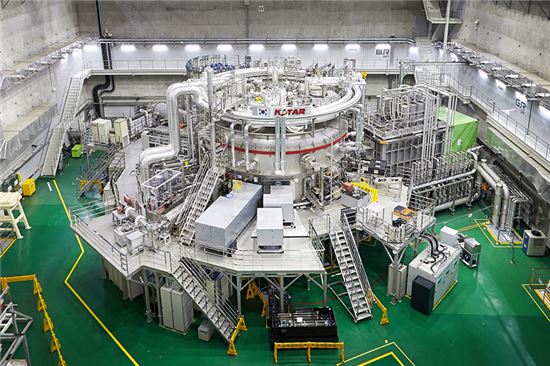 'KSTAR' used for nuclear fusion research installed at the Korea Institute of Fusion Energy. The photo and the article content are not directly related. Courtesy of the Korea Institute of Fusion Energy.
The ITER (International Thermonuclear Experimental Reactor) project is a large-scale international cooperative research and development (R&D) initiative involving seven countries?Korea, the EU, the United States, Japan, Russia, China, and India?aimed at demonstrating the feasibility of large-scale energy production using nuclear fusion reactions.
Korea, a latecomer in the field of nuclear fusion, joined the ITER project in June 2003 to rapidly catch up with and secure fusion technologies accumulated by leading countries. After ratification by the National Assembly in April 2007, the ITER International Organization was officially launched in October 2007, marking the full-scale start of the ITER project.
On a site of approximately 1.8 million square meters in Cadarache, southern France, an international nuclear fusion experimental reactor with a thermal output of 500 MW will be installed to demonstrate the feasibility of large-scale energy production using nuclear fusion reactions.
The project costs are shared with the EU contributing 45.46%, and the remaining six countries each providing 9.09% in both cash and in-kind contributions. Each member country manufactures and procures its allocated ITER key components domestically, which are then assembled in Cadarache, France.
Korea is responsible for producing and supplying nine major components: superconducting conductors, vacuum vessel bodies, vacuum vessel ports, blanket shielding blocks, assembly equipment, thermal shields, tritium storage and supply systems, superconducting magnet power supply systems, and diagnostic devices. To strategically secure core fusion technologies, these devices are being manufactured through domestic industries.
The ITER power supply system is a power conversion device that supplies current to a total of 48 superconducting coils (18 TF, 6 CS, 6 PF, 18 CC). It is a core system for nuclear fusion energy generation, ensuring the stable maintenance of plasma throughout the entire process, including plasma initiation and heating, plasma position and shape control, magnetic field error correction, and plasma termination (extinction).
Korea completed the first supply of power supply systems to ITER in December last year. Due to changes in the ITER project schedule, additional power supply systems were required, leading Korea to secure an additional contract worth 52 million euros (approximately 82.2 billion KRW).
With this contract, Korea is scheduled to supply power supply systems to ITER over a total period of seven years and six months. Notably, the domestic company that participated in the first supply will participate again, which is expected to further advance the design, manufacturing, and operational capabilities related to this technology. This is also expected to lay the foundation for Korea to establish itself as a leading country in future domestic and international nuclear fusion projects and next-generation energy industries.
In addition, a memorandum of understanding for the high-voltage power supply system (560,000 euros, approximately 8.84 billion KRW) and the hydrogen storage vessel for the neutral beam (11 million euros, 1.73 billion KRW), for which Korea's contracts were finalized on June 12 (local time), is scheduled to be signed at the ITER Organization in July.
The Ministry of Science and ICT explained that since 2007, Korea has been securing core technologies in the process of supplying nine key components and equipment for the construction of the fusion reactor as part of the ITER project, resulting in 721 published papers, 61 patent applications, and 52 registered patents.
The ministry also stated that Korea has achieved contract orders worth about 1 trillion KRW (967.2 billion KRW) from the ITER Organization and other participating countries, contributing to the revitalization of the domestic nuclear fusion industry ecosystem and promoting the excellence of Korean companies worldwide.
Jung Taekryeol, Director of the Public Fusion Research Policy Division at the Ministry of Science and ICT, said, "With this contract, Korea will be able to leverage its advanced design, manufacturing technologies, and system integration capabilities accumulated in the field of ITER power supply systems to expand its leading role in the global technology ecosystem."
© The Asia Business Daily(www.asiae.co.kr). All rights reserved.
















