Launch of Joint Development for Solid Oxide Fuel Cells
Collaboration with Norwegian Classification Society and German Cruise Operator
Optimal for High-Electricity-Demand Cruise Ships... Targeting Eco-Friendly Market
HD Hyundai has officially begun developing fuel cell technology for application in cruise ships, marking a strategic move to target the European eco-friendly ship market. By advancing "solid oxide fuel cell (SOFC)" technology?which reduces both carbon emissions and noise, and enables the recycling of high-temperature waste heat?the company aims to secure leadership in the era of decarbonized shipping.
On June 19, HD Hyundai announced that its affiliates?HD Korea Shipbuilding & Offshore Engineering, HD Europe Research Center, and HD Hydrogen?have launched a joint development project (JDP) with Norwegian Classification Society (DNV) and Germany's leading cruise operator, TUI Cruises, to apply SOFC systems to cruise ships. As the first phase of this collaboration, HD Korea Shipbuilding & Offshore Engineering and HD Europe Research Center will establish SOFC safety design standards suitable for cruise ships over an approximately eight-month period, from this month until February next year.
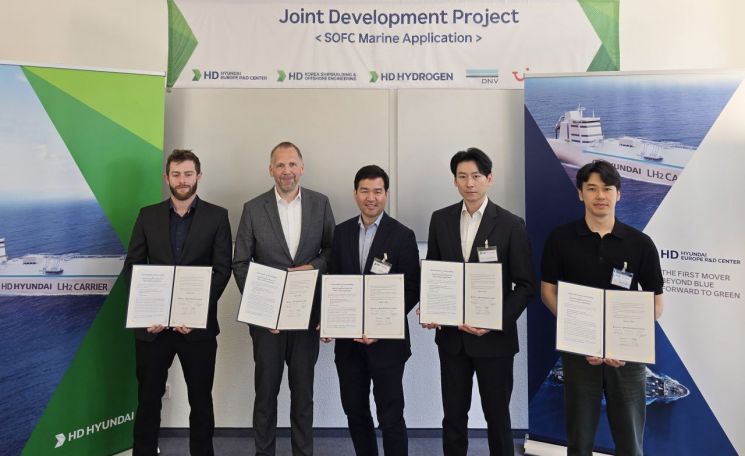 Lucas, engineer at Norwegian Classification Society (from left), Christian Lerher, director of fleet operations and health at TUI Cruises, Gu Seop Yeom, head of HD Europe Research Center, Junyoung Byun, manager of HD Hydrogen Business Development Team, and Minseok Kim, manager of HD Korea Shipbuilding & Marine Fuel Cell System Research Lab, recently attended the "Joint Development Agreement Ceremony for the Application of SOFC Systems to Cruise Ships" held at the HD Europe Research Center located in D?sseldorf, Germany, and took a commemorative photo. HD Hyundai
HD Hydrogen will analyze the applicability of its proprietary SOFC under various operating conditions using performance data from its own development. Additionally, considering the SOFC's characteristic of operating at high temperatures between 600 and 1,000 degrees Celsius, the company will also develop waste heat recovery and recycling technologies, as well as carbon capture and storage (CCS) technology to further reduce carbon emissions. DNV will ensure structural safety and regulatory compliance with classification standards from the early design stages, while TUI Cruises will share real-world operational data from its cruise ships to establish the requirements for actual ship applications.
SOFC is a high-efficiency fuel cell that generates electricity by reacting hydrogen?sourced from natural gas, ammonia, and other fuels?with oxygen. It produces electricity without combustion, resulting in minimal carbon or pollutant emissions, and offers higher efficiency than conventional marine engines. In particular, it is considered well-suited for cruise ships, which have high power demands. HD Hyundai plans to use Europe as its technology hub and proactively target demand in this market.
The market growth potential is also significant. According to market research firm Grand View Research, the global SOFC market is projected to grow at an average annual rate of 40.7%, reaching approximately $7.124 billion (about KRW 9.8 trillion) by 2030.
An HD Hyundai representative stated, "This international joint development project will be a critical turning point for demonstrating HD Hyundai's decarbonized ship technology in Europe," adding, "Based on our low-carbon, high-efficiency fuel cell technology, we will lead the maritime industry's transition to decarbonization."
Meanwhile, HD Hyundai established its hydrogen fuel cell subsidiary, HD Hydrogen, last year and began developing SOFC solutions applicable to a wide range of vessels.
© The Asia Business Daily(www.asiae.co.kr). All rights reserved.

















