As skies gradually become overcast across the country, both central and southern regions are expected to officially enter the monsoon season on June 19.
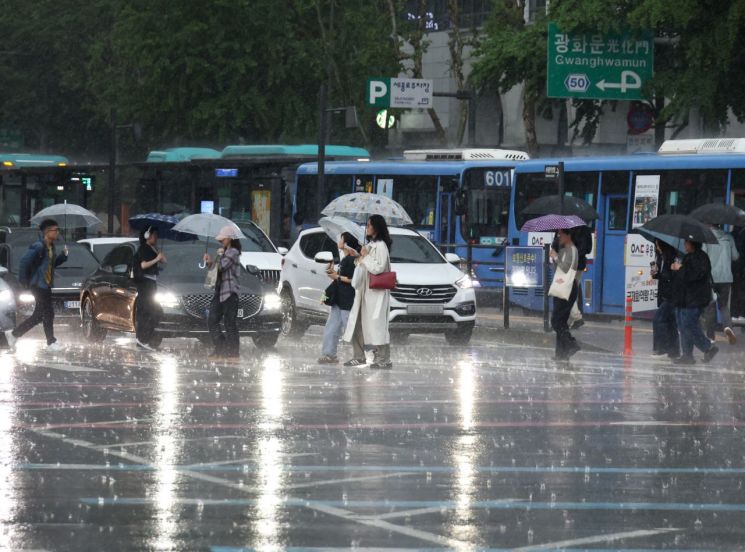 Citizens are crossing the crosswalk with umbrellas at Gwanghwamun Intersection in Jongno-gu, Seoul. Photo by Yonhap News
According to the Korea Meteorological Administration, rain is expected to begin in Jeju Island from the morning, expand to Chungnam, Jeolla, and western inland Gyeongnam in the afternoon, and reach the Seoul metropolitan area, inland Gangwon, and Chungbuk by nighttime. Compared to the average period from 1991 to 2020, this means the monsoon season is starting six days earlier in central regions and four days earlier in southern regions. The average monsoon onset dates are June 25 for central regions and June 23 for southern regions.
Over the two days until June 20, expected rainfall amounts are as follows: 20 to 60 mm for Seoul, Incheon, Gyeonggi, the five West Sea islands, inland and mountainous Gangwon, Daejeon, Sejong, Chungnam, and Chungbuk (with more than 80 mm possible in northern Gyeonggi, the five West Sea islands, and northern inland Gangwon); 5 to 20 mm for the east coast of Gangwon, Gwangju and Jeonnam, and Daegu and Gyeongbuk (excluding northern inland and northeastern mountainous Gyeongbuk); 10 to 40 mm for Jeonbuk; 5 to 40 mm for Gyeongnam and northern inland and northeastern mountainous Gyeongbuk; and 5 to 30 mm for Jeju Island.
The Korea Meteorological Administration expects that the development of a mesoscale low-pressure system along the stationary front will bring heavy rainfall, possibly leading to the issuance of heavy rain warnings. Such warnings are issued when rainfall is expected to exceed 90 mm in three hours or 180 mm in twelve hours.
Mesoscale low-pressure systems strengthen the "low-level jet" (a fast wind blowing at about 1.5 km altitude in the lower atmosphere), increasing the supply of water vapor and destabilizing the atmosphere, which can lead to torrential rain, thunder, and lightning. It is very difficult to predict the occurrence of mesoscale low-pressure systems. In fact, during last year's monsoon season, frequent mesoscale low-pressure systems along the stationary front caused large differences in rainfall between regions, reducing the accuracy of rainfall forecasts. There were 16 instances of extreme downpours with hourly rainfall exceeding 100 mm.
However, sweltering heat is expected before the rain begins. Morning lows are forecast to range from 18 to 24 degrees Celsius, and daytime highs from 25 to 34 degrees. In inland areas, daytime temperatures are expected to reach around 30 degrees, with many places experiencing maximum perceived temperatures above 31 degrees.
© The Asia Business Daily(www.asiae.co.kr). All rights reserved.
![Clutching a Stolen Dior Bag, Saying "I Hate Being Poor but Real"... The Grotesque Con of a "Human Knockoff" [Slate]](https://cwcontent.asiae.co.kr/asiaresize/183/2026021902243444107_1771435474.jpg)















