Early Learning Experiences Can Lead to Lowered Self-Esteem and Emotional Instability
There have been claims that excessive early private education has a negative impact on the brain development and emotional stability of infants and young children.
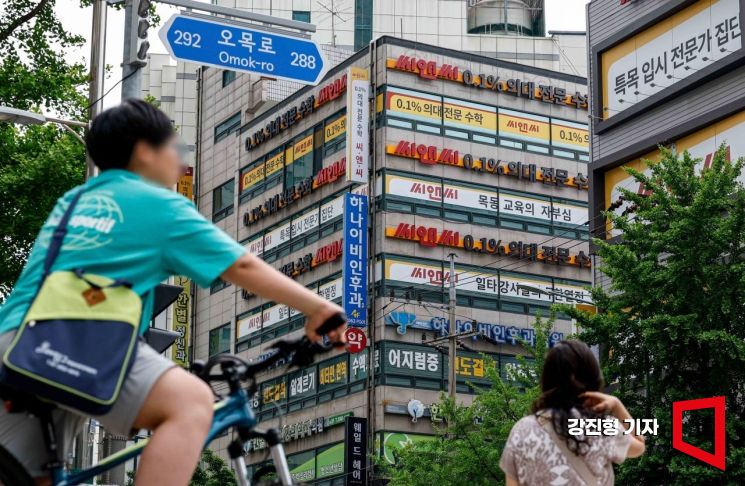 Various academies are located in the academy district building in Mokdong, Yangcheon-gu, Seoul. Photo by Kang Jinhyung
On June 18, Yonhap News reported that such claims were raised at the "Citizen Discussion for Private Education Reduction Project," held by the Seoul Metropolitan Office of Education at the Seoul Metropolitan Council members' hall.
On this day, Professor Um Soyoung from Yonsei University College of Medicine stated, "If early childhood education programs are excessively focused on academics, they may hinder the development of creativity, play skills, and sociality, which are crucial at this stage."
She explained, "Continuous stress during early childhood can adversely affect brain development," adding, "If stress hormones are secreted excessively, it also negatively impacts cognitive function and emotional stability."
She further cited domestic and international research findings, saying, "Early learning experiences at an unprepared age can later decrease academic interest and motivation during school years, which may lead to poor academic performance, lowered self-esteem, and emotional problems."
During the discussion, participants pointed out that fundamental measures in public education are needed to reduce excessive private education, including early private education for infants and young children.
Lee Deoknan, head of the Education and Culture Team at the National Assembly Research Service, argued that policies should aim for "everyone doing less or not doing it at all," such as restricting academy lesson hours. He pointed out, "Considering the psychology of parents participating in private education, measures such as limiting academy teaching hours and providing incentives for after-school programs are necessary."
Additionally, Koo Bonchang, director of policy research at World Without Worries About Private Education, proposed policies to the Seoul Metropolitan Office of Education, including the establishment of a student happiness committee, strengthening supervision of English academies for young children, and researching future-oriented college admissions systems.
In his opening remarks at the discussion, Seoul Metropolitan Office of Education Superintendent Chung Geunsik stated, "There are even claims that the so-called 'age 4 test' and 'age 7 test' are a kind of criminal act that hinders the normal development of children," adding, "The criticism that excessive pressure before students are ready for learning hinders their normal development is ringing in our ears."
He continued, "The issue of private education has troubled us since the beginning of modern education, and there are even claims that there is no future for South Korea because of it," emphasizing, "Meaningful solutions will only emerge through close communication and cooperation among the central government, the political community, and civil society."
Recently, the domestic early childhood private education market has become so overheated that terms like "age 4 test" and "age 7 test" have emerged, referring to preschool children preparing for level tests to enter famous English academies.
In fact, according to a survey conducted by the Ministry of Education from July to September last year of 13,241 parents of households with children under the age of six, the overall participation rate in private education reached 47.6%. This means that one out of every two infants and young children receives private education. The total amount spent on private education was 815.4 billion won, and the average monthly cost per child was calculated at 332,000 won.
© The Asia Business Daily(www.asiae.co.kr). All rights reserved.
![Clutching a Stolen Dior Bag, Saying "I Hate Being Poor but Real"... The Grotesque Con of a "Human Knockoff" [Slate]](https://cwcontent.asiae.co.kr/asiaresize/183/2026021902243444107_1771435474.jpg)
















