Ministry of Land, Infrastructure and Transport and Local Governments
Hold Council to Promote REIT Development Projects
On June 19, the Ministry of Land, Infrastructure and Transport announced that it would hold a meeting at the Korea REITs Association to discuss development projects using the Real Estate Investment Trusts (REITs) model with major local governments.
The meeting was convened to establish a collaborative system between the central government and local governments, following last month's amendment of the Real Estate Investment Company Act, which provided a legal basis for project REITs and regional coexistence REITs. The amended law will take effect in late November.
A REIT is a type of indirect real estate investment in which a professional asset management company acquires, develops, or operates real estate using funds pooled from multiple investors, and then distributes the profits to the investors. A project REIT is a development-specialized REIT with reasonably relaxed regulations during the development phase. A regional coexistence REIT is characterized by restricting public offering eligibility so that real estate profits can be prioritized for local residents.
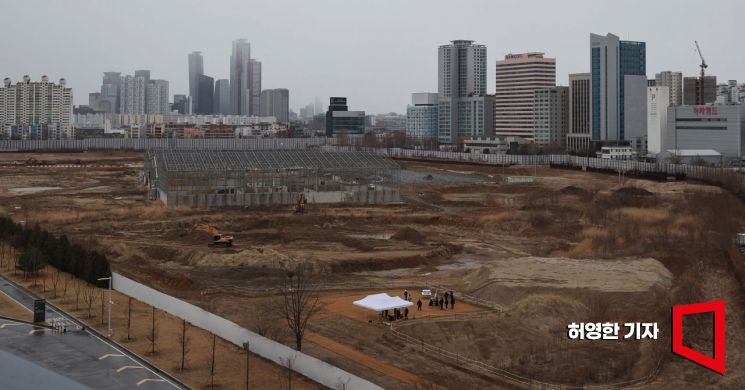 Aerial view of the Yongsan Maintenance Depot site, planned as an international business district. Photo taken in February 2024. Photo by Younghan Heo younghan@
The meeting was attended by four local governments, twelve local public corporations, and Korea Land and Housing Corporation (LH). Participants agreed to share the current status of major urban development projects under review, and to discuss ways to incorporate REITs as well as other matters requiring consultation.
The Seoul Metropolitan Government has decided to introduce a regional coexistence REIT for the Yongsan International Business District. The city is considering applying this model to the mixed-use business zone site that will be developed directly by Seoul Housing and Communities Corporation (SH). Seoul is also reviewing the possibility of expanding the use of this model to various other projects, including public land that the city is developing or planning to sell.
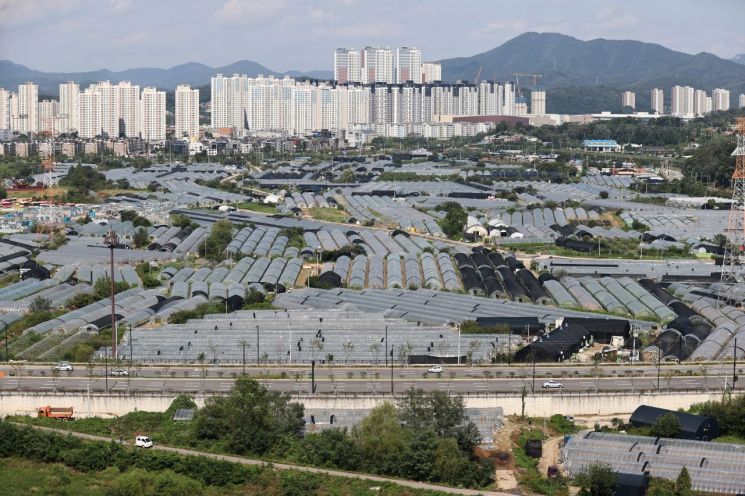
Gyeonggi Province will introduce the Gyeonggi Opportunity REIT in cooperation with Gyeonggi Housing and Urban Development Corporation (GH). The plan is to develop major residential sites in the 3rd New Town through REITs. The province is also considering healthcare REITs, which develop and operate senior housing while providing medical services; public infrastructure REITs, which reduce the financial burden on local governments and supply essential social overhead capital (SOC) in a timely manner; and tech REITs, which develop and operate future industry assets such as data centers and solar power plants. Local residents will have priority rights to subscribe to REIT shares.
Incheon Urban Development Corporation proposed developing a mixed-use public housing site near Jemulpo Station through a project REIT. The plan is to obtain approval within this year, begin construction next year, and supply a total of 3,497 housing units by 2031.
The Ministry of Land, Infrastructure and Transport expects that these measures will help establish a business model in which professional real estate companies not only develop but also directly operate projects. The ministry is also considering offering special incentives, such as public contribution or easing floor area ratio regulations.
REITs are attracting attention as a means to address the shortcomings of traditional real estate development projects. Conventional projects have typically been carried out by project finance investment companies without equity capital requirements, making them highly sensitive to interest rates and fluctuations in the real estate market. With the recent legal amendment, it will become possible to develop and operate projects through project REITs with stable equity capital. The structure in which project operators monopolized profits will also be changed so that a large number of local residents can benefit, which is drawing interest from local governments.
Kim Gyucheol, Director-General for Housing and Land at the Ministry of Land, Infrastructure and Transport, said, "By introducing project REITs with stable equity capital, we expect to strengthen the overall soundness of the market." He added, "We will revitalize regional development using the REIT model, disperse speculative demand concentrated in physical real estate, and shift the real estate industry paradigm so that business profits are provided to the wider public, not just a select few."
© The Asia Business Daily(www.asiae.co.kr). All rights reserved.
![Clutching a Stolen Dior Bag, Saying "I Hate Being Poor but Real"... The Grotesque Con of a "Human Knockoff" [Slate]](https://cwcontent.asiae.co.kr/asiaresize/183/2026021902243444107_1771435474.jpg)
















