Seeking Solutions Such as Allowing Nighttime Parking on Nearby Roads
Considering the Establishment of a Dedicated Organization for the "Suffering" Alley Commercial Districts
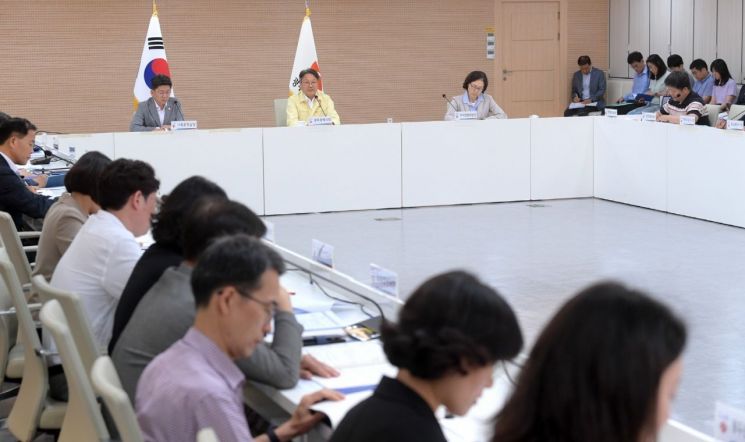 On the morning of the 18th, Gwangju Mayor Kang Gijeong attended the Alley Economy Situation Meeting held in the city hall's mid-sized conference room with heads of public institutions present, discussing measures to promote consumption by each institution and revitalize the alley economy. Provided by Gwangju City
Gwangju City is making an all-out effort to revitalize the alley economy by allowing nighttime parking on roads near alley commercial districts and supporting one-on-one matching between public institutions and traditional markets or alley shopping districts.
On June 18, Gwangju City established the "Alley Economy Situation Room" within the Planning and Coordination Office as a hub for implementing on-site, hands-on policies to revitalize local commercial districts and protect small business owners. The first meeting was held on the same day, officially launching its operations. The meeting, presided over by Mayor Kang Gijeong, was attended by more than 40 participants, including directors and heads of public institutions in Gwangju.
Gwangju City and public institutions are working together through the Alley Economy Situation Room to find concrete measures to alleviate the difficulties faced by small business owners and inject vitality into the local economy.
Public institutions shared various measures to promote consumption by each institution and revitalize the alley economy, such as grocery shopping, having lunch at alley restaurants, expanding the use of traditional markets, and producing promotional advertisements for small business owners.
They also engaged in in-depth discussions on specific measures that can provide tangible support to small business owners, including: allowing nighttime parking on roads near alley commercial districts; supporting one-on-one matching between the city or public institutions and traditional markets or alley shopping districts; promoting the use of the public delivery app; and establishing a dedicated organization for alley commercial districts. After the meeting, participants moved to a restaurant within the alley commercial district near Kumho Tire in Gwangsan-gu for lunch, demonstrating their commitment to supporting the local economy.
Starting with this meeting, the city plans to fully operate the "Alley Economy Situation Meeting" and strengthen on-site, hands-on responses to restore the alley economy. In addition, to ensure the sustainability of alley economy policies, the city is considering establishing a dedicated organization for alley commercial districts under the Gwangju City government.
The city also plans to hold a meeting on June 20 to promote the public delivery app, aiming to develop practical support measures that small business owners can truly benefit from, such as reducing delivery fees and securing fair sales channels.
Mayor Kang Gijeong stated, "Many citizens are suffering in pain. We must put all our efforts into saving the alley economy. As our citizens have shown their expectations for the new government by achieving the highest voter turnout in the country, Gwangju City and public institutions must work in full cooperation with the Lee Jaemyung administration so that the hearts of our citizens can beat with new hope."
Meanwhile, the city is accelerating the operation of both the "Alley Economy Situation Room" and the "Presidential Election Pledge Seoul Situation Room," known as the "two wings situation rooms," to revitalize the local economy and ensure the inclusion of presidential election pledges in national policy agendas.
© The Asia Business Daily(www.asiae.co.kr). All rights reserved.
![Clutching a Stolen Dior Bag, Saying "I Hate Being Poor but Real"... The Grotesque Con of a "Human Knockoff" [Slate]](https://cwcontent.asiae.co.kr/asiaresize/183/2026021902243444107_1771435474.jpg)















