Housing Costs Drive Up Inflation
Government to Begin with Greater Seoul Supply Measures
"It would be an overstatement to call it price control."
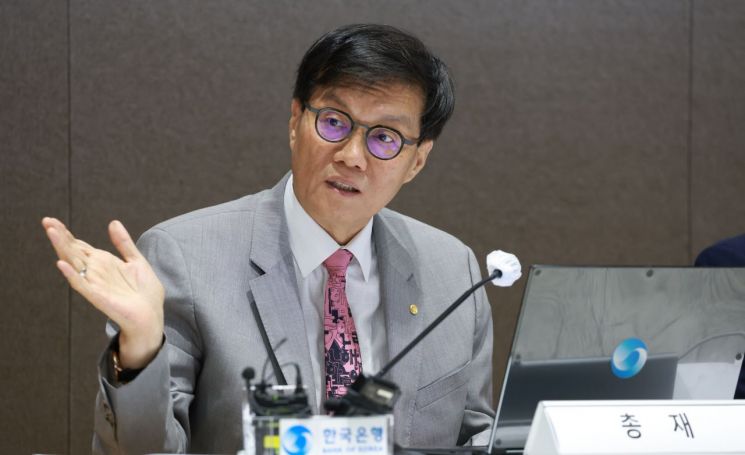 Lee Changyong, Governor of the Bank of Korea, is speaking at the briefing session on the status of inflation targeting held at the Bank of Korea in Jung-gu, Seoul on the 18th. Bank of Korea
Lee Changyong, Governor of the Bank of Korea, addressed questions at the 'Price Stability Target Operation Status Briefing' held at the Bank of Korea's annex in Jung-gu, Seoul, on the 18th, regarding some views that the government is artificially controlling the prices of processed foods such as instant noodles. He stated, "When the price of a specific item rises, the price management authorities examine it in detail, looking closely at whether it is due to supply factors or if there are particular reasons for the increase. They then consult and coordinate with producers, which is only natural." He added, "I do not think it is appropriate to call each of these actions price control."
Housing Costs Drive Up Inflation... Government to Start with Greater Seoul Supply Measures
Governor Lee pointed out that while the current inflation rate remains stable at the target level (2.0%), perceived inflation is still high, making it difficult for the public. He identified the burden of housing costs for households in the Greater Seoul area as one of the main factors. He said, "The rise in housing prices in the Seoul metropolitan area is due to both the trend of interest rate cuts and the expectation that supply will be insufficient for several years." He emphasized, "(The new administration) must manage these expectations well from the outset. To do this, concrete supply measures for the Greater Seoul area must be presented." He further diagnosed that, fundamentally, policies such as developing new hub cities to reduce the incentive for young people to flock to the metropolitan area and implementing regional quotas for university admissions should be considered. He noted that the Bank of Korea is also considering interest rate cuts in light of economic conditions, but stressed that it must avoid making the mistake of excessively amplifying expectations for rate cuts.
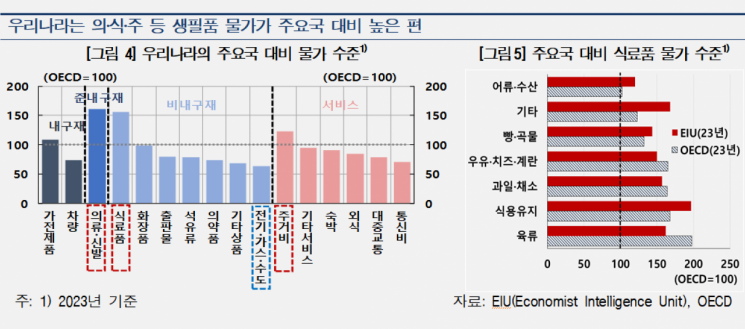
The prices of essential consumer goods in Korea have remained high for a prolonged period compared to major economies due to structural issues such as low productivity and high transaction costs. According to the Bank of Korea, the price levels of essentials such as food, clothing, and housing in Korea are 1.2 to 1.6 times higher than the OECD average. As of 2023, Korea's price indices for clothing (161), food (156), and housing (123) significantly exceed the OECD average (100). After the COVID-19 pandemic, high inflation led to sharp increases in food and energy prices, and this year, a series of price hikes in processed foods has further contributed to a cumulative 19.1% increase in the cost of living from 2021 through last month. Governor Lee emphasized that to address the high cost of living, household burdens, and declining consumption vitality, structural reforms such as expanding supply capacity and improving distribution systems must also be considered.
If International Oil Prices Remain at $75 Due to Middle East Conflict, Next Year's Inflation to Rise by 0.3%p
While inflation is expected to remain stable in the second half of the year, the key variable is geopolitical conflict in the Middle East. The Bank of Korea analyzed that if the ongoing military conflict between Israel and Iran causes international oil prices to average $75 per barrel through next year, this year's inflation rate will rise by 0.1 percentage points compared to the 'May Economic Outlook,' and next year's rate will increase by 0.3 percentage points. Last month, the Bank of Korea had forecast average international oil prices of $69 this year and $65 next year, projecting inflation rates of 1.9% for this year and 1.8% for next year based on those assumptions. Governor Lee said, "The market is discussing even greater levels of uncertainty, but the situation is difficult to predict." He added, "International oil prices have a significant impact on our economy, including inflation. I hope the situation does not deteriorate further."
Regarding the supplementary budget plan, which is expected to total around 20 trillion won and includes universal payments and differentiated support based on individual circumstances, Governor Lee prefaced his remarks by saying, "The multiplier effect will differ depending on the specific areas where the funds are used, so I can only comment after reviewing the details." He added, "Given that the economy is not in a good condition, I have believed, even before this decision, that the impact of the supplementary budget on growth would be greater than its impact on inflation." However, he explained that, due to fiscal constraints, selective support is more efficient than universal support. The Bank of Korea expects that, given the timing of the execution, a supplementary budget of around 20 trillion won will have a limited impact on inflation this year, but could raise next year's inflation rate by about 0.1 percentage points.
Regarding concerns that issuing a won-denominated stablecoin could increase the money supply and fuel inflation, Governor Lee stated, "Changes in the money supply will depend on how the stablecoin is issued and the form of its reserve assets." He emphasized, "The Bank of Korea believes that a won-denominated stablecoin is necessary. We do not oppose it." However, he noted concerns that the issuance of a won-denominated stablecoin could actually increase, rather than decrease, demand for dollar-denominated stablecoins, potentially complicating foreign exchange management. He also mentioned that if payment and settlement services are expanded beyond banks to non-bank institutions, a comprehensive approach will be needed regarding changes in bank profitability and business models. Governor Lee stated, "Once the responsible ministries such as the Ministry of Economy and Finance and the Financial Services Commission are established, we will continue inter-ministerial consultations."
© The Asia Business Daily(www.asiae.co.kr). All rights reserved.
![Clutching a Stolen Dior Bag, Saying "I Hate Being Poor but Real"... The Grotesque Con of a "Human Knockoff" [Slate]](https://cwcontent.asiae.co.kr/asiaresize/183/2026021902243444107_1771435474.jpg)

















