Urging the Union to Accept the 3% Wage Increase Proposed by the Regional Labor Relations Commission
Deployment of 42 Charter Buses... Listening to Passengers' Concerns
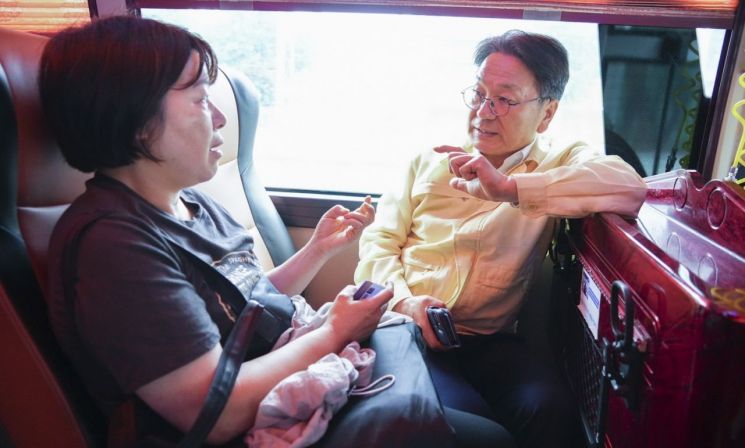 On the morning of the 18th, Gwangju Mayor Kang Gijeong boarded the emergency transport vehicle, the Circulation 01B charter bus, which departed from the public bus garage in Seoh-gu Sehwadong. He inspected the dispatch times and engaged in conversations with citizens on board about the schedule. Provided by Gwangju City
Regarding the city bus strike, Gwangju Mayor Kang Gijeong stated on the 18th, "The union must accept the 3% wage increase proposal put forward by the Regional Labor Relations Commission and immediately halt the strike." He added, "After ending the strike, let's form a negotiation table to continue discussions, including measures to realistically adjust bus fares and additional wage adjustment proposals."
During a press briefing that afternoon, Mayor Kang said, "Starting at 5:30 a.m., I spent two hours and twenty minutes riding the emergency charter bus Circulation 01-B, which was urgently deployed by the city, to meet passengers and observe the bus operation situation." He continued, "When I visited the site, I saw that the damage from the bus strike fell entirely on students and ordinary citizens who rely on public transportation every day, and the strike benefits no one." He emphasized, "We need to consider not only wages but also rational improvements for the entire city bus system, including extending the retirement age and the quasi-public operation system."
On the 15th, Mayor Kang also issued a "Public Appeal," proposing the suspension of the strike, improvement of workers' conditions through the formation of a consultative body, and discussions on the direction of the quasi-public operation of city buses.
The city bus labor and management have held six rounds of autonomous negotiations and four rounds of mediation by the Jeonnam Regional Labor Relations Commission, but failed to reach an agreement. On the 13th, the Jeonnam Regional Labor Relations Commission proposed a 3% wage increase as a compromise between the management's 2.5% offer and the union's demand for an increase of over 5%. Management accepted the proposal, but the union rejected it, resulting in a breakdown in negotiations.
Starting from this day, the city has urgently deployed 42 emergency charter buses on 14 routes with high congestion during commuting hours to minimize inconvenience for citizens. Since charter buses are different from regular city buses and may cause confusion, a Gwangju City official is on board each bus to assist citizens on site. The charter buses are free of charge for all citizens.
From 5:30 a.m. for about two hours, Mayor Kang boarded the charter bus to inspect the bus operation in person. He listened to the difficulties faced by passengers, directly explained the current city bus strike situation, and asked for their understanding.
To public officials supporting the charter bus operations, Mayor Kang said, "I am well aware that you are already busy with your original duties and now have to take on additional work," and added, "I sincerely thank all Gwangju City officials who are enduring these difficulties and responding to the current situation with exceptional resolve."
Meanwhile, as part of its emergency transportation measures, Gwangju City is operating a 24-hour emergency response headquarters, increasing subway service by 12 additional runs as an alternative means of transportation, expanding taxi operations during commuting hours, lifting the vehicle rotation system for public institutions, adjusting school start and end times in cooperation with the Office of Education, and deploying charter buses.
© The Asia Business Daily(www.asiae.co.kr). All rights reserved.
![Clutching a Stolen Dior Bag, Saying "I Hate Being Poor but Real"... The Grotesque Con of a "Human Knockoff" [Slate]](https://cwcontent.asiae.co.kr/asiaresize/183/2026021902243444107_1771435474.jpg)















