Who Is Ayatollah Ali Khamenei?
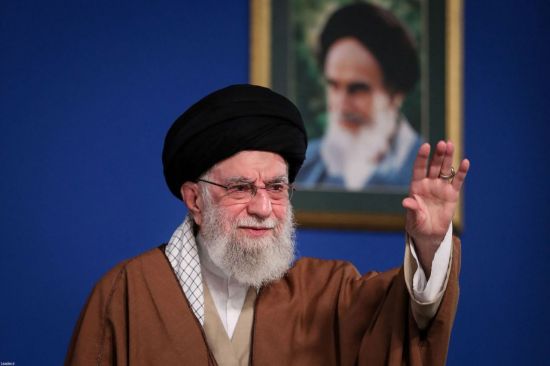 Ayatollah Ali Khamenei, Iran's Supreme Leader, is waving his hand after finishing a speech on March 21 (local time). Photo by AFP
"We know his exact whereabouts. Surrender unconditionally."
The next target designated by U.S. President Donald Trump and Israeli Prime Minister Benjamin Netanyahu is Ayatollah Ali Khamenei, Iran's Supreme Leader, who is often called the "Father of Iran." For 35 years, he has ruled Iran, a nation of 88 million people, with an iron fist. CNN described him as "one of the most powerful rulers in the Middle East." His death carries the risk of escalating into a full-scale Middle East war. For this reason, Reuters reported that even President Trump rejected Israel's plan to eliminate Khamenei.
Born in 1939 in the holy city of Mashhad, Iran, he was a disciple of Ruhollah Khomeini, who led the 1979 Islamic Revolution. After Khomeini's death, he was elected Supreme Leader in 1989. In Iran's theocratic system, he is both the "representative of God" and the commander of the government, judiciary, and military. In addition, he is known to control the Islamic Revolutionary Guard Corps (IRGC) and the Quds Force. The Quds Force is a secret special unit that oversees groups such as Hamas, Hezbollah, and the Houthi rebels.
For nearly 40 years, Khamenei has reigned as Iran's top authority, raising the country's profile within the international community. Externally, he has confronted the United States and Israel and advanced Iran's controversial nuclear program. Rather than exercising direct military force, he has exerted influence over the West indirectly through a network of pro-Iranian armed groups known as the "Axis of Resistance."
The myth of Iran's "invincibility" began to crack after the October 7, 2023 surprise attack on Israel by the militant group Hamas. Israel's airstrikes on Gaza, attacks by Hezbollah (Iran's main proxy force), and Israel's unprecedented strikes on Iran's nuclear facilities and senior military leadership have shaken the previously solid axis of power. Israel, which had long been waiting for an opportunity to strike Iranian territory, did not miss this opening.
With the backing of President Trump, Prime Minister Netanyahu currently shows no intention of stopping attacks on Iran. The justification of Iran's denuclearization also strengthens Israel's position. In an interview with Fox News on the 15th, Netanyahu was asked whether "regime change in Iran is also part of the military effort." He replied, "The Iranian regime is very vulnerable, so that could certainly be the result." He also stated, "We must stand up to the oppression of this evil regime," making it clear that the purpose of the airstrikes is "the overthrow of the Iranian regime."
Meanwhile, Khamenei's whereabouts remain unknown. Since Israel's surprise airstrikes began on the 13th, Ayatollah Khamenei has not appeared in public for five days. Some anti-government Iranian media outlets have reported that he is hiding in an underground bunker with his family. His location has not been confirmed and appears to be under strict protection.
© The Asia Business Daily(www.asiae.co.kr). All rights reserved.
![Clutching a Stolen Dior Bag, Saying "I Hate Being Poor but Real"... The Grotesque Con of a "Human Knockoff" [Slate]](https://cwcontent.asiae.co.kr/asiaresize/183/2026021902243444107_1771435474.jpg)















