Gwangju Chamber of Commerce and Employers Federation Issue Statements
"Urgent Emergency Measures Needed"
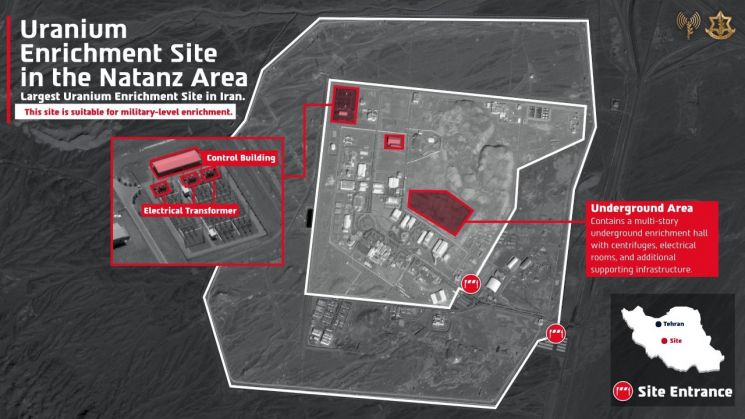 Attention is focused on the reason why Israel launched a sudden airstrike on Iran's nuclear facility on the 13th (local time) while Iran was negotiating a nuclear deal with the United States. Israel cited the justification that it detected Iran developing nuclear weapons and planning to destroy Israel. However, there is also speculation that Prime Minister Benjamin Netanyahu, who was recently facing the collapse of the coalition government, may have sought a breakthrough by portraying Iran as an external enemy. The photo shows Iran's Natanz nuclear facility, which Israel struck on that day. Photo by Yonhap News
The business community in Gwangju and South Jeolla Province has expressed concerns that the recent military clashes between Israel and Iran in the Middle East may negatively impact the regional economy, citing rising oil prices and disruptions in the supply of raw materials.
On June 18, the Gwangju Employers Federation issued a statement titled "Concerns Over Prolonged Israel-Iran Middle East War," stating, "With recent military clashes between Israel and Iran in the Middle East, the international situation is changing rapidly." The Federation added, "We are concerned that this situation will have a tangible impact on our regional economy, going beyond a simple geopolitical conflict."
The Federation predicted that the surge in international oil prices and restrictions on maritime transport caused by the war would directly shock local manufacturers and the regional economy. It specifically expressed concerns about ▲ a prolonged increase in international oil prices and regional economic instability, and ▲ disruptions in the supply of raw materials due to maritime transport restrictions.
The Gwangju Employers Federation explained, "Due to the prolonged war, international oil prices have surged by more than 7 to 10 percent in a short period, deepening instability in the crude oil market," and added, "The Middle East supplies a significant portion of the world's crude oil, and South Korea also depends on the Middle East for more than 70 percent of its crude oil imports."
It continued, "In this situation, rising oil prices can sharply increase energy costs and production expenses within the region, which may weaken the competitiveness of manufacturers." The Federation also emphasized, "Heightened tensions in Middle Eastern waters and the potential blockade of the Strait of Hormuz could cause serious disruptions to maritime transport. The Strait of Hormuz is a strategic chokepoint through which about 20 percent of the world’s crude oil and liquefied natural gas (LNG) passes. If it is blocked, there are no alternative routes, making disruptions to the raw material supply chain inevitable."
The Gwangju Employers Federation anticipated that if shipping rates rise, logistics costs increase, and the supply of imported raw materials becomes unstable, local companies will face greater production disruptions and cost burdens.
Additionally, the Federation stated, "A significant number of local manufacturers are experiencing losses such as declining performance due to global geopolitical risks, and are reporting production disruptions caused by increased energy and raw material procurement costs and supply problems." It added, "We urge the government, Gwangju City, and other relevant authorities to mobilize all administrative and financial support to minimize the impact of the Israel-Iran war on the regional economy, including surges in international oil and raw material prices and maritime transport restrictions."
The Gwangju Chamber of Commerce and Industry also issued a press release on the same day, stating, "With military tensions between Israel and Iran escalating rapidly and even the possibility of a full-scale armed conflict being raised, there are concerns that if the situation is prolonged, there will be negative ripple effects on the Gwangju regional economy." The Chamber added, "The Middle East is a major hub for global oil exports, and if geopolitical instability intensifies, a sharp rise in international oil prices is inevitable."
The Chamber noted, "There are projections that the impact of this situation could extend beyond the international energy market to the global supply chain and overall import and export logistics." It also emphasized, "If the Strait of Hormuz, a key maritime logistics route connecting Europe and Asia, is blocked, global shipping rates could rise by as much as two to three times, and average vessel transport times could be delayed by more than one to two weeks."
It continued, "The military clash between Israel and Iran is not limited to diplomatic and security issues; it is also a significant variable that can directly affect the business environment of local companies." The Chamber stated, "The government must promptly prepare comprehensive emergency measures, including oil price stabilization policies, support for import and export logistics costs and raw material procurement, and financial and tax support for small and medium-sized enterprises."
© The Asia Business Daily(www.asiae.co.kr). All rights reserved.
![Clutching a Stolen Dior Bag, Saying "I Hate Being Poor but Real"... The Grotesque Con of a "Human Knockoff" [Slate]](https://cwcontent.asiae.co.kr/asiaresize/183/2026021902243444107_1771435474.jpg)















