"Energy Industry Will Become a Key Driving Force of the Korean Economy"
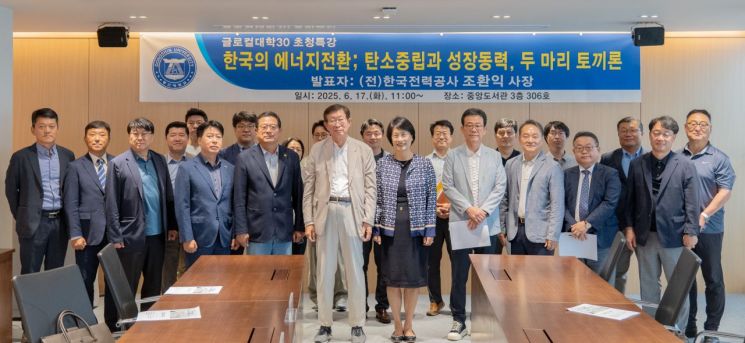 Photo of a special lecture by Cho Hwanik, former CEO of KEPCO, invited by Dongshin University Glocal30.
The Dongshin University consortium, which received preliminary designation for the Ministry of Education's 2025 Glocal University 30 Project as an innovative model for building a carbon-neutral smart cluster and the 'Regional Public Small but Strong University Consortium UCC,' hosted a special lecture by Cho Hwanik, former CEO of Korea Electric Power Corporation (KEPCO), marking the start of its full-scale efforts for carbon neutrality and regional industrial development.
According to Dongshin University on June 18, the special lecture by former KEPCO CEO Cho Hwanik was held the previous morning in the seminar room on the third floor of the university's central library. The event was attended by President Lee Juhee, Vice President for External Affairs Song Kyungyong, Vice President for Academic Affairs Jeon Jin, other university officials, Lee Hyunchan, Director of the Energy Valley Enterprise Development Institute, and about 30 other participants.
The lecture was held under the theme "Korea's Energy Transition: Carbon Neutrality and Growth Engines, the Two Rabbits Theory."
The lecture was divided into two parts. In Part 1, "Korea's Energy Transition: Carbon Neutrality and Growth Engines, the Two Rabbits Theory," Cho introduced carbon neutrality as a solution to climate change and the economic crisis, and discussed the direction of energy policy that Naju should pursue.
Cho pointed out that current energy prices are being artificially suppressed for political reasons, and that an imbalance is occurring as only industrial electricity rates are being raised.
In Part 2, "The New Government's Energy Policy Direction and Implications for Naju," he explained detailed policies such as the development of AI, climate response, offshore wind power, and solar power. He also discussed areas for improvement, including promoting competition in the distribution and sales markets and measures to improve the efficiency of direct transaction markets such as PPAs.
For Naju, he suggested proactively attracting various support and development policies, forming an industry-academia-research cooperation cluster in the power sector, and utilizing resources such as nurturing local talent to fundamentally change the landscape.
Cho stated, "Countries like China and Japan are already trading energy in the market by exporting related technologies and equipment such as batteries and solar power," and added, "If we view energy from an industrial perspective and build competitiveness, the energy industry will become a key driving force of the Korean economy."
Regarding the global increase in climate disasters, he said, "Korea is also experiencing more frequent extreme weather events such as heat waves, floods, and wildfires," and emphasized, "Since carbon reduction and energy transition are essential, it is urgent to secure core technologies such as electricity and solar power and to strengthen the business foundation for green growth."
Meanwhile, Dongshin University, together with Chodang University and Mokpo Science University, is aiming for official designation after receiving preliminary designation for the 2025 Glocal University Project, with its 'Regional Public Small but Strong University Consortium' UCC (University Community Collaboration) innovation model, which seeks to revitalize the region's foundational industries through the establishment of a carbon-neutral smart cluster.
© The Asia Business Daily(www.asiae.co.kr). All rights reserved.
![Clutching a Stolen Dior Bag, Saying "I Hate Being Poor but Real"... The Grotesque Con of a "Human Knockoff" [Slate]](https://cwcontent.asiae.co.kr/asiaresize/183/2026021902243444107_1771435474.jpg)















