Briefing on the Status of the Inflation Target Operation
Governor Lee Changyong:
"Consumer price inflation expected to remain stable in the second half"
"Perceived inflation remains high... Fundamental structural reforms needed"
Lee Changyong, Governor of the Bank of Korea, projected that the consumer price inflation rate, which has recently hovered near the target level of 2.0%, will remain stable in the second half of this year. However, he pointed out that perceived inflation remains high, causing significant hardship for the public, and emphasized the need to seek fundamental measures for price stability through structural reforms.
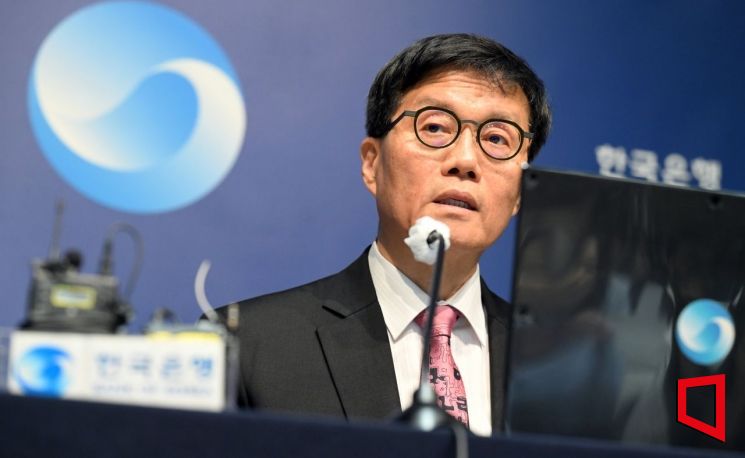
At a briefing on the "Status of the Inflation Target Operation" held at the Bank of Korea’s annex in Jung-gu, Seoul, on June 18, Governor Lee stated, "While the increase in prices for processed foods and certain services in the first half of this year will act as upward factors throughout the year, these will be offset by low demand pressure, so both consumer price inflation and core inflation rates are expected to remain stable at the upper end of the 1% range in the second half of the year." He added that it is important to note the recent rise in international oil prices, which has emerged as an upward factor for inflation due to escalating geopolitical tensions in the Middle East. Governor Lee also pointed out that there are uncertainties regarding the inflation outlook, including the direction of U.S. tariff policies and the pace of domestic demand recovery.
According to the Bank of Korea, the consumer price inflation rate rose slightly from 1.8% year-on-year in the second half of last year to 2.1% for January to May this year. On a monthly basis, it decreased from 2.2% at the beginning of the year to 1.9% in May, influenced by falling international oil prices and low demand pressure. The core inflation rate, which excludes food and energy, has also remained stable. It stayed in the upper 1% range from January to March this year, then edged up to 2.1% in April and 2.0% in May due to price increases in certain service items.
However, the inflation rate for daily necessities?items with high purchase frequency and expenditure weight for consumers?has exceeded the overall consumer price inflation rate. The inflation rate for processed foods has surpassed 4%, and prices for dining out have also continued to rise.
Governor Lee stressed that the elevated price level following the period of high inflation after COVID-19 has become a burden for households, and that fundamental measures for price stability should be sought through structural reforms. He noted, "Prices for agricultural, livestock, and fisheries products have shown high volatility, and recently, price increases for essentials such as processed foods have heightened perceived inflation for vulnerable groups." He further pointed out, "For processed foods and dining out, the continued pass-through of rising production costs to prices could prolong the burden on vulnerable groups."
He also cited the polarization of the housing market due to rising home prices in the Seoul metropolitan area as a factor increasing the housing cost burden for households in the region. Governor Lee said, "Problems such as the price level and polarization in the real estate market are largely structural in nature, making it difficult to address them solely through monetary policy. Therefore, we must also consider structural reform measures such as expanding supply capacity and improving distribution structures."
© The Asia Business Daily(www.asiae.co.kr). All rights reserved.
![Clutching a Stolen Dior Bag, Saying "I Hate Being Poor but Real"... The Grotesque Con of a "Human Knockoff" [Slate]](https://cwcontent.asiae.co.kr/asiaresize/183/2026021902243444107_1771435474.jpg)















