Choi Minhee and 13 Other Democratic Party Lawmakers Propose Bill
Expansion from State Audits and Investigations to Full Committee Meetings
Administrative Fines for Deliberate Refusal or Evasion of Attendance Orders
Some Criticize the Bill as "Business Strangulation" and "Potentially Unconstitutional"
The Democratic Party of Korea has introduced a bill to amend the “Act on Testimony and Appraisal at the National Assembly” (Testimony and Appraisal Act), which significantly expands the scope under which the National Assembly can issue compulsory attendance orders to witnesses.
According to the National Assembly Bill Information System on June 18, Choi Minhee, Chair of the Science, Technology, Information and Broadcasting and Communications Committee and a member of the Democratic Party, along with 13 other lawmakers, recently proposed the amendment to the Testimony and Appraisal Act.
Last year, then-Acting President and Prime Minister Han Ducksoo exercised his right to request reconsideration (veto) on the Testimony and Appraisal Act, which the Democratic Party had passed as a bill regulating “important agenda reviews and hearings,” resulting in its repeal.
The newly proposed bill expands the scope to include “general cases such as full committee meetings.” The committee chairperson may convene a full committee meeting at their discretion if they determine it is necessary.
Notably, this amendment also introduces a new administrative fine provision. Under the current Testimony and Appraisal Act, if the National Assembly refers a non-attending witness for prosecution, the witness could face up to three years in prison or a fine of up to 10 million won, depending on the court’s decision.
However, the proposed amendment stipulates that a witness who fails to attend the National Assembly without just cause or who deliberately refuses to accept a summons may be fined up to 30 million won. In addition, a witness who does not comply with a compulsory attendance order or who intentionally avoids receiving the order may be fined up to 50 million won.
The amendment also provides that if a witness, while attending the National Assembly, undermines its authority through assault, threats, or insulting remarks, a fine of up to 50 million won may be imposed. If a witness provides false testimony, a fine of up to 100 million won may be imposed.
Choi Minhee, who sponsored the amendment, explained the rationale by stating, “The criminal prosecution process takes a long time due to evidence collection and fact-finding, and it is difficult to respond promptly to a witness’s non-attendance. Therefore, criminal prosecution is not considered an appropriate means to compel witness attendance.”
She further explained, “By expanding the compulsory attendance order for non-attending witnesses beyond committees for state audits or investigations to include general cases such as full committee meetings, and by establishing grounds for imposing administrative fines on those who meet the requirements for non-attendance and related offenses, the amendment aims to enhance the effectiveness of testimony and appraisals at the National Assembly.”
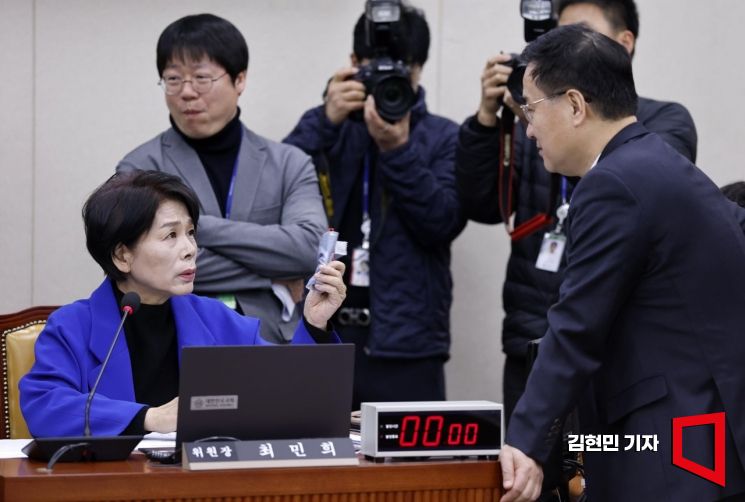 Choi Minhee, Chair of the National Assembly Science, Technology, Information and Broadcasting and Communications Committee, is talking with Choi Hyungdoo, the ruling party secretary, at the full committee meeting held at the National Assembly on March 5, 2025. Photo by Kim Hyunmin
On the other hand, there are concerns that excessively expanding the National Assembly’s powers could infringe on basic rights. In particular, business circles have expressed dissatisfaction that this could impose management burdens, such as disrupting the schedules of CEOs who need to attract overseas clients. Ko Dongjin, a lawmaker from the People Power Party and former president of Samsung Electronics, criticized the bill on his Facebook page, stating, “This would allow the National Assembly to summon businesspeople 365 days a year,” and described it as “a bill that literally tightens the noose around businesses.”
Ko specifically cited Article 61 of the Constitution, which states, “The National Assembly may conduct audits of state affairs or investigations into specific state matters, and may require the submission of documents or the attendance and testimony or statements of opinion by witnesses as necessary.” He emphasized, “Above all, this is a bad law with potential for unconstitutionality. The power to require witness attendance and testimony should only be exercised during state audits or investigations, which is also the purpose and legislative intent of the current Testimony and Appraisal Act.”
© The Asia Business Daily(www.asiae.co.kr). All rights reserved.
![Clutching a Stolen Dior Bag, Saying "I Hate Being Poor but Real"... The Grotesque Con of a "Human Knockoff" [Slate]](https://cwcontent.asiae.co.kr/asiaresize/183/2026021902243444107_1771435474.jpg)















