Quota for Processed Egg Products Used in Confectionery and Baking Expanded to 10,000 Tons
Government to Lower Supply Price of Eggs Delivered to Large Supermarkets
'Task Force for Reforming the Supply and Distribution Structure of Agricultural and Food Products' to Be Established
As egg prices have surged, the government has decided to increase the quota for processed egg products used in confectionery and baking to 10,000 tons, and to push for a reduction in the supply price of eggs delivered to large supermarkets. The government expects egg production to stabilize after September, citing a decrease in consumption during the July-August vacation and school holiday season, as well as the full-scale import of processed egg products. The government plans to establish measures for supply stability and structural improvement through the 'Task Force for Reforming the Supply and Distribution Structure of Agricultural and Food Products.'
According to the Ministry of Agriculture, Food and Rural Affairs on June 18, the producer price of eggs (30-count) in early June was 5,726 won, up 17.4% from the previous year. The consumer price also rose by 8.3%.
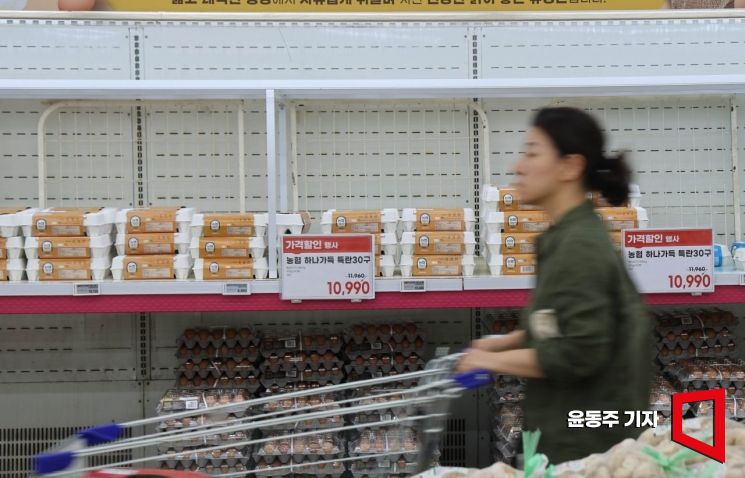
An Yongdeok, Director of Livestock Policy at the Ministry of Agriculture, Food and Rural Affairs, said, "Egg prices are expected to gradually decline due to reduced consumption during the July-August vacation and school holidays, and the full-scale import of processed egg products starting in July," adding, "Egg production will likely stabilize after September."
First, to disperse demand and stabilize the prices of processed foods, the government plans to expand the quota for processed egg products (such as yolk, whole egg, and egg white) used in confectionery and baking from the current 4,000 tons to 10,000 tons by the end of the year. To expand egg production, the government will encourage extending the average laying period of hens from 84 weeks to 87 weeks and, in collaboration with producer organizations, will promote the use of vitamins and supplements to ensure stable egg production. In addition, the Ministry of Agriculture, Food and Rural Affairs plans to expand the egg production base by including a facility investment support budget of 14.4 billion won in the supplementary budget to accommodate the increased cage area standards for laying hens. Furthermore, to ease the burden on consumers, the government is working to lower the supply price of eggs delivered to some large supermarkets by 1,000 won per 30-count tray, utilizing funds from the producer association.
The government is not considering egg imports. Director An said, "We considered imports in 2021 when egg supply was difficult due to the outbreak of highly pathogenic avian influenza (AI), but that is not the case now," adding, "The average daily egg production is expected to increase by 2% year-on-year to 48.64 million eggs, and the number of laying hens is sufficient, so there is no need to consider imports at this stage."
The Ministry of Agriculture, Food and Rural Affairs expects the supply of broiler chickens this month to increase by 0.8% compared to the same period last year, and that the price of domestic chicken will remain stable. However, the government plans to minimize any supply gaps caused by the outbreak of AI in Brazil to ensure stable supply. To this end, starting at the end of July, 4,000 tons of Thai chicken will be supplied promptly to Korea, diversifying import sources, and efforts will be made to secure substitute quantities by simultaneously expanding the supply of domestic chicken. For Brazilian chicken, the government will resume import procedures so that stable supply can begin in August, and will provide the industry with information on distribution and quarantine procedures.
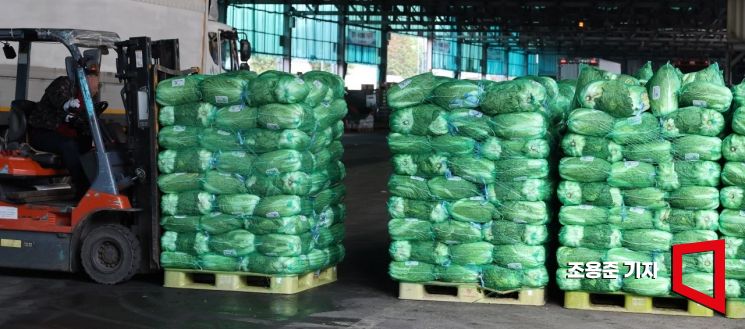 An official is organizing napa cabbages that have arrived from the production area at the vegetable collection center in Garak Wholesale Market, Songpa-gu, Seoul.
The government expects the supply of napa cabbage to remain stable this year. Jeong Jaehwan, Director of the Horticultural Industry Division at the Ministry of Agriculture, Food and Rural Affairs, said, "Private sector storage of spring napa cabbage has increased by about 10%, and the intention to cultivate napa cabbage for harvest during the peak demand period of Chuseok in September is expected to rise. If weather conditions are favorable, there should be no supply instability as seen last year," adding, "As of June, the wholesale price of napa cabbage is lower than usual due to increased shipments of spring napa cabbage, and this level is expected to be maintained until the end of June as shipments continue."
For stable napa cabbage production, the government will also establish and implement mid- to long-term plans to enhance the sustainability of summer napa cabbage production in response to climate change. Beginning in 2026 (with a pilot program in 2025), the government will fully implement the 'Summer Napa Cabbage Income Stability Insurance' to ensure that farm income remains above a certain level even if production decreases or market prices fall. In cooperation with related agencies such as the Rural Development Administration, the government will research improvements to cropping systems for intensive control of major pests and diseases such as soil nematodes and fusarium wilt, which are occurring more frequently. The government will also develop and distribute new varieties resistant to high temperatures, as well as new technologies such as low-temperature films and micro-sprinkling systems. In addition, the government will identify suitable areas for alternative summer napa cabbage cultivation to respond to a decrease in cultivation area caused by continuous cropping damage in highland areas of Gangwon Province, and will continue to improve the production system.
To minimize the burden on consumers from processed food and dining-out prices, the government will work with the food industry to minimize the number and rate of price increases, stagger the timing of price hikes, and hold discount events. The government will also continue to communicate with the food and dining-out industries to identify difficulties and alleviate management burdens.
The Ministry of Agriculture, Food and Rural Affairs will also establish measures to stabilize the supply and improve the structure of agricultural and livestock products. An official from the ministry said, "As public interest in food prices rises, we will discuss supply measures for each item, including agricultural, livestock, food, and dining-out products, and rationally improve the distribution structure of agricultural and livestock products, which has been identified as one of the causes of price instability," adding, "We plan to quickly establish measures for supply stability and structural improvement by forming the 'Task Force for Reforming the Supply and Distribution Structure of Agricultural and Food Products.'"
© The Asia Business Daily(www.asiae.co.kr). All rights reserved.


















