Trump Issues Ultimatum: "We Know the Supreme Leader's Whereabouts"
National Security Meeting Convened... "Military Strike with U.S. Forces Considered"
WTI and Brent Crude Surge Over 4% Amid Middle East Instability
U.S. Retail Sales Fall for Second Consecutive Month in May
Fed Expected to Hold Interest Rates Steady on the 18th
All three major U.S. stock indexes fell simultaneously on June 17 (local time) in New York. As President Donald Trump raised the level of pressure against Iran to its highest point and instability in the Middle East worsened, investor sentiment for risk assets cooled rapidly. International oil prices surged by more than 4%.
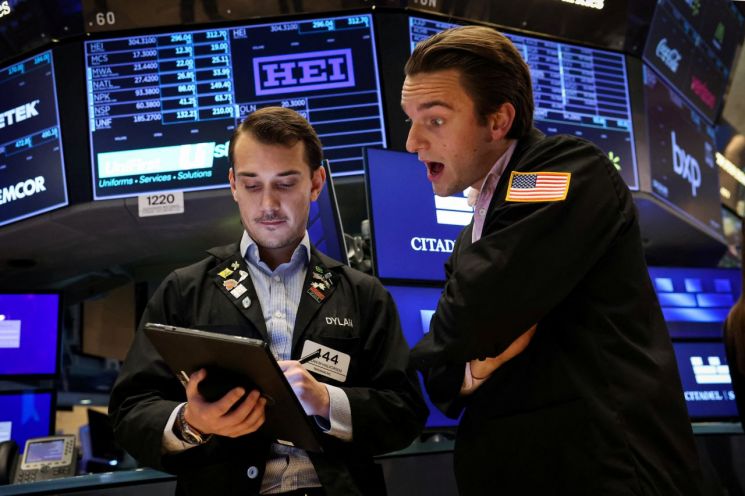
On this day in the New York stock market, the blue-chip Dow Jones Industrial Average closed at 42,215.8, down 299.29 points (0.7%) from the previous trading day. The large-cap S&P 500 index dropped 50.39 points (0.84%) to 5,982.72, and the tech-heavy Nasdaq index fell 180.12 points (0.91%) to finish at 19,521.09.
President Trump issued an ultimatum to Iran, which is currently engaged in armed conflict with Israel. On his self-created social networking service, Truth Social, he stated, "We know exactly where the so-called 'Supreme Leader' is hiding," adding, "He is an easy target, but he will be safe there. At least for now, we will not remove (kill!) him." He continued, "Our patience is wearing thin," and shortly after, posted another message saying, "Surrender unconditionally!" Effectively, he raised the pressure on Iran to its highest level, even mentioning the possibility of assassinating Iran's Supreme Leader, Ayatollah Khamenei.
Following this, President Trump held an emergency meeting with his national security team in the White House Situation Room to discuss the armed conflict between Israel and Iran. Having returned to the U.S. a day early from the G7 summit, President Trump focused this meeting on discussing military response options against Iran with his aides. In connection with this, CNN reported that President Trump is increasingly favoring the use of U.S. military assets to strike Iranian nuclear facilities rather than pursuing a diplomatic solution. According to local media, President Trump is reportedly considering providing Israel with strategic weapons such as bunker busters, which are capable of directly targeting Iran's underground nuclear facilities.
International oil prices soared as tensions in the Middle East escalated again. West Texas Intermediate (WTI) crude closed at $74.84 per barrel, up $3.07 (4.28%) from the previous day, while Brent crude, the global oil price benchmark, finished at $76.45 per barrel, up $3.22 (4.4%) from the previous day.
In addition to the Middle East conflict, weak U.S. retail sales data released in the morning further dampened investor sentiment. According to the U.S. Department of Commerce, retail sales in May 2025 totaled $715.4 billion, a 0.9% decrease from the previous month. Experts polled by Dow Jones had expected retail sales to decline by 0.6%, but the actual drop was larger than forecast. Retail sales for April were also revised downward from a previously reported 0.1% increase to a 0.1% decrease. This marks the first time since the end of 2023 that retail sales have declined for two consecutive months, indicating that consumers are once again cutting back on spending. Households, which had increased purchases of items such as automobiles ahead of the full implementation of tariffs, are now closing their wallets again amid trade policy uncertainty, making a contraction in consumer spending?a key pillar of the U.S. economy?a reality.
Chris Rupkey, chief economist at FwdBonds, commented, "Consumers are anxious about what will happen next," diagnosing, "The economy is slowing as people choose to save rather than spend cash at stores and shopping malls."
The retail sales indicator, which provides insight into the state of the U.S. economy, was released just ahead of the Federal Reserve's interest rate decision the following day. The Fed is holding its two-day Federal Open Market Committee (FOMC) meeting starting today and will decide the benchmark rate the next day. The interest rate futures market currently reflects a 99.8% probability that rates will be held steady at the current range of 4.25-4.5% per year. If the Middle East conflict pushes oil prices higher, the likelihood of a Fed rate cut in the future is expected to decrease further.
Ross Mayfield, investment strategist at Baird, analyzed, "The weak (retail sales) report could give the Fed room to take a more dovish (accommodative) stance."
By stock, Tesla plunged 3.9%. Apple dropped 1.4%, while Nvidia and Microsoft (MS) fell by 0.39% and 0.23%, respectively. Alphabet, Google's parent company, and Meta, Facebook's parent company, declined by 0.4% and 0.7%, respectively.
U.S. Treasury yields are trending downward. The 10-year Treasury yield, the global benchmark, dropped 6 basis points (1bp = 0.01 percentage point) from the previous day to 4.38%, while the 2-year Treasury yield, which is sensitive to monetary policy, is down 1 basis point from the previous day to 3.95%.
© The Asia Business Daily(www.asiae.co.kr). All rights reserved.

















