Minutes of the May 29 Monetary Policy Committee Meeting Released
Unanimous Decision to Cut Base Rate to 2.50% Per Annum
"Household Debt Requires Caution," Committee Members Agree
At the Bank of Korea Monetary Policy Committee meeting on the 29th of last month, where the decision to cut the base interest rate was made unanimously, committee members all cited concerns over economic sluggishness as the reason for the rate cut.
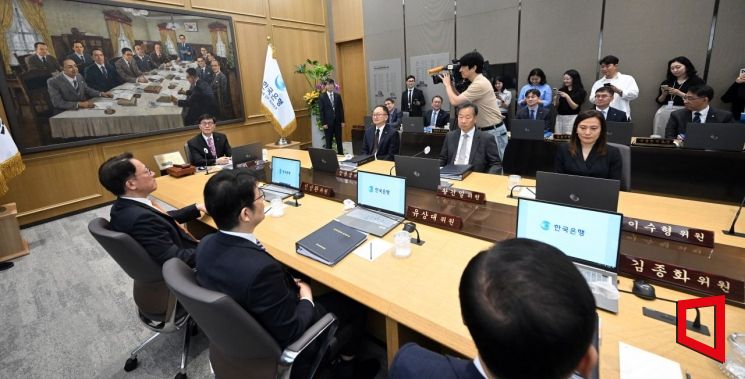 Lee Changyong, Governor of the Bank of Korea, is presiding over the Monetary Policy Committee meeting at the Bank of Korea in Jung-gu, Seoul, on the 29th of last month. Photo by Joint Press Corps
According to the minutes of last month's Monetary Policy Committee meeting released on the 17th, the committee members stated that, in lowering the base rate from 2.75% to 2.50% per annum by 0.25 percentage points, they took into account the expectation that growth would slow significantly due to sluggish domestic demand recovery and a decline in exports caused by worsening trade conditions. One member noted, "While inflation is showing stable movement at the target level and foreign exchange risks have somewhat eased, the sluggish economic trend continues." Another member also stated, "Since both domestic demand and exports are weak and are expected to deteriorate significantly, further monetary policy action is needed to reduce the extent of the economic downturn."
The domestic economy recorded negative growth in the first quarter as exports slowed amid weak domestic demand. The committee members expressed concern that the real economy is weakening further, with delayed recovery in private consumption and facility investment alongside sluggish construction investment, and a decrease in private sector jobs. The export growth rate is also expected to slow as the impact of U.S. tariff increases becomes more pronounced. One member said, "While domestic demand is expected to gradually recover as economic sentiment improves, the pace of recovery is likely to be slow," and added, "Exports are also expected to slow further due to worsening trade conditions, so this year's growth rate will fall well short of previous projections." The future growth path is also described as highly uncertain due to factors such as the progress of trade negotiations among major countries including Korea, changes in the global financial environment, and the government's economic stimulus measures.
In international financial markets, concerns over U.S. fiscal soundness have come to the fore, leading to a rise in U.S. long-term Treasury yields, while the U.S. dollar, which had shown temporary strength, has weakened again. The won-dollar exchange rate fell to the high 1,300 won range for the first time this year, influenced by progress in U.S.-China trade negotiations and expectations of stronger Asian currencies, but this process was accompanied by high volatility. Liquidity in the foreign exchange market and conditions for foreign currency funding are generally assessed to be stable.
Domestic inflation has remained stable at around 2% for both the consumer price index and core inflation rate, despite larger increases in processed food and some service prices, due to falling international oil prices and low demand-side pressure. The committee expects this trend to continue going forward.
One member emphasized, "Maintaining a wait-and-see approach in determining the direction of monetary policy is not an option for us, at least at this point," adding, "It is necessary to offset the decline in exports to some extent through domestic demand, and in order to maximize the effectiveness of the policy mix, monetary policy should complement the confirmed supplementary budget."
However, the committee members commonly pointed out the need to pay attention to the increasing trend in household debt. Household loans in the financial sector increased significantly in February and March due to a rise in housing transactions. One member noted, "After the expansion and re-designation of land transaction permit zones, housing transactions have decreased, and with the implementation of the third-stage stress DSR scheduled, the growth of household loans is expected to slow gradually. However, as housing prices in Seoul continue to rise and expectations for price increases in preferred areas remain, there is still considerable pent-up demand. Therefore, we must continue to monitor the impact of monetary easing on household debt." Another member emphasized, "Concerns about rising household debt should be addressed through proactive micro-level adjustments as the situation develops."
Another member also stated, "Going forward, monetary policy should continue to focus on rate cuts in response to the sluggish economy," but added, "Since external uncertainties remain high and financial stability risks such as household debt persist, any additional rate cuts should be decided carefully, closely monitoring developments in tariff negotiations between the United States and major countries, the monetary policy direction of major central banks, and changes in household debt and exchange rate conditions."
There is also an analysis that attention should be paid to managing external sector risks, such as the possibility of capital outflows due to the widening Korea-U.S. interest rate gap. One member stated, "As the reversal of domestic and foreign interest rate differentials persists and large-scale overseas securities investments by residents continue, a structural imbalance in foreign exchange supply and demand is emerging, which requires caution."
© The Asia Business Daily(www.asiae.co.kr). All rights reserved.

















