U.S. Convenes NSC Meeting... Possibility of Supporting Israel Discussed
Bunker Buster Support Needed to Destroy Iran's Nuclear Facilities
Concerns Over Escalation if U.S. Becomes Involved
As clashes between Israel and Iran intensify, the New York Times (NYT) reported on June 16 (local time) that President Donald Trump of the United States is facing a critical decision: whether to pursue diplomacy as a solution, or to consider the use of a "bunker buster" bomb.
According to Fox News, President Trump on this day ordered an early return from the Group of Seven (G7) summit and instructed the convening of a National Security Council (NSC) meeting. Although the specific agenda for this NSC meeting has not been disclosed, given that he returned early citing the situation in the Middle East, there is speculation that the issue of military support for Israel will be discussed.
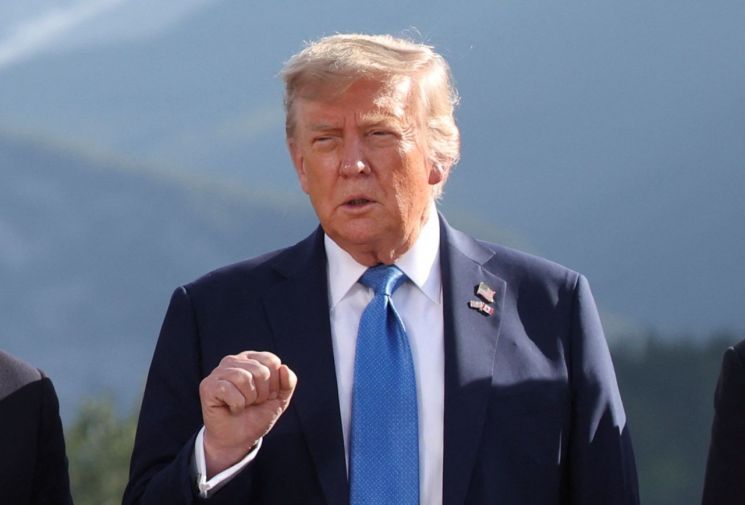
On this day, President Trump pressured Iran on his social media platform, Truth Social, stating, "Iran should have signed the agreement I told them to sign," and "Iran cannot have nuclear weapons." He also warned, "Everyone must evacuate Tehran immediately."
On the same day, Iranian Foreign Minister Abbas Araghchi stated in a statement, "If President Trump is sincere about diplomacy and is interested in stopping the war, the next step will be very important," expressing an open stance on an agreement. However, the NYT explained that if a diplomatic solution proves impossible, or if Iran does not comply with President Trump's demand for nuclear disarmament, President Trump will be left with options such as the use of a bunker buster.
Iran's major nuclear facilities include Natanz in Isfahan Province and Fordow in Qom Province. Among these, the Fordow nuclear facility is built deep underground in a mountainous area. Experts believe that the only weapon suitable for destroying Fordow is the U.S. military's massive bunker buster, the GBU-57. It is known that Israel has requested U.S. support for the GBU-57.
The GBU-57 weighs 13.6 tons and can only be carried by the U.S. Air Force's B-2 stealth bombers. Israel does not possess these bombers. Therefore, if a bunker buster strike is to be carried out, the U.S. military would have to conduct the operation. Over the past two years, the U.S. military has practiced operations to drop the GBU-57 on Fordow, and has established a plan that requires multiple B-2 bombers to drop the bombs in succession.
The problem is that if President Trump approves such an operation, the United States would become directly involved in a war between Israel and Iran. President Trump repeatedly emphasized during his presidential campaign that he would not send U.S. troops to wars taking place outside the United States, so this would be in direct contradiction to his previous stance.
If the United States supports Israel, Iran could attempt direct retaliation against the U.S., potentially escalating the war. Just before Israel's airstrike on June 11, Iranian Defense Minister Aziz Nasirzadeh warned, "All U.S. bases in the region are within our range," and threatened to attack U.S. regional bases if a conflict breaks out.
However, if the United States does not provide bunker buster support, Israel's core objective of eliminating Iran's nuclear weapons development capability becomes unattainable. If the power supply to the Fordow nuclear facility is cut, the centrifuges could spin out of control and become damaged or destroyed, but this is not certain. Experts believe that as long as the Fordow facility remains, Iran will be able to maintain the key equipment necessary for nuclear development.
Brett McGurk, former White House NSC Coordinator for the Middle East and Africa, said regarding the Fordow nuclear facility, "It has always been the most critical issue," and added, "If enrichment operations continue at Fordow after this conflict, it cannot be considered a strategic success."
The NYT noted, "For now, President Trump has the luxury of taking both positions," stating that he can claim to his supporters that he is trying to end the conflict peacefully by threatening with a bunker buster, and also pressure Iran to halt uranium enrichment, whether through a diplomatic agreement or the threat of a bunker buster. However, the paper added, "If this combination of persuasion and coercion ends in failure, President Trump will face a moment when he must decide whether this war is Israel's war or America's war."
© The Asia Business Daily(www.asiae.co.kr). All rights reserved.
![Clutching a Stolen Dior Bag, Saying "I Hate Being Poor but Real"... The Grotesque Con of a "Human Knockoff" [Slate]](https://cwcontent.asiae.co.kr/asiaresize/183/2026021902243444107_1771435474.jpg)















