UK Auto and Steel Tariffs Reduced
US-UK Trade Deal Signed at G7 Summit
On June 16 (local time), President Donald Trump of the United States attended the Group of Seven (G7) summit and held a bilateral meeting with UK Prime Minister Keir Starmer, resulting in the signing of a trade agreement. This marks the first trade deal reached since President Trump decided in April to grant a 90-day suspension of reciprocal tariffs imposed on countries worldwide. With less than a month left before the suspension deadline, President Trump also held a series of meetings with the leaders of Canada, Japan, and the European Union (EU), but failed to achieve any concrete results.
President Trump and Prime Minister Starmer met and signed the agreement on the sidelines of the G7 summit held in Canmore, Alberta, Canada.
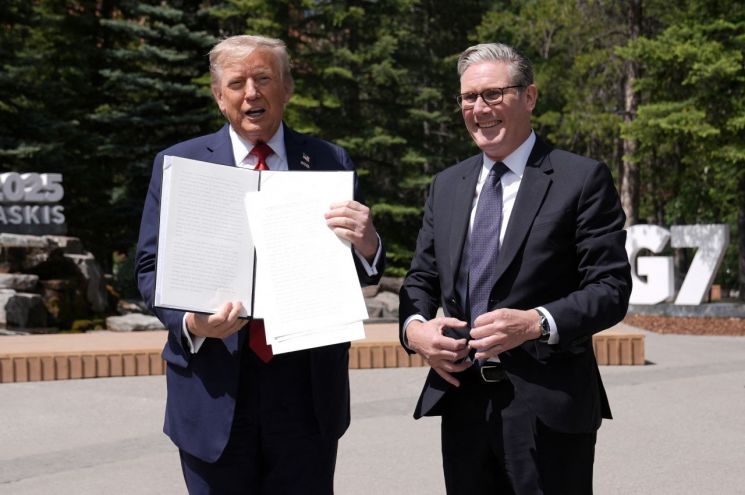 President Donald Trump (left) and UK Prime Minister Keir Starmer announced the signing of a trade agreement after holding a summit meeting on the 16th (local time) during the G7 summit held in Canmore, Alberta, Canada. Photo by Reuters Yonhap News
President Trump told reporters that it was "a fair deal for both countries" and said, "It will create many jobs and generate income." Prime Minister Starmer stated, "This agreement covers automobile tariffs and the aerospace sector, and is a very significant deal."
According to Bloomberg and US political news outlet Politico, starting this month, the United States will impose an annual 10% tariff on 100,000 UK-made automobiles. This rate is lower than the 25% tariff applied to cars imported from other countries.
Tariffs on UK steel and aluminum will remain at 25% for the time being. However, if the UK makes efforts to meet US demands regarding supply chain security and ownership of production facilities, the tariff rate will be reduced to 0% in the future. The reason the tariff rate is not being lowered immediately is due to US concerns over supply chain security. According to The Guardian, the United States is concerned that, despite the UK government acquiring management rights of British Steel, legal ownership still remains with China’s Jingye Group. This ownership structure is acting as a factor restricting an immediate reduction in tariffs.
Additionally, the United States has agreed to exempt certain sectors of the UK aerospace industry from tariffs. Furthermore, depending on the results of the ongoing national security investigation into pharmaceuticals and pharmaceutical ingredients, the two sides agreed to negotiate significant preferential treatment for UK-made pharmaceuticals and ingredients. In return, the UK agreed to expand its tariff-free import quotas for US beef and ethanol.
Bloomberg reported on the conclusion of the tariff negotiations between the two countries, stating that it "justifies a diplomatic approach that avoids publicly criticizing President Trump," and explained that, from President Trump’s perspective, securing concessions from the UK in the agricultural sector signals that the tariff war is producing results.
With the end date for the reciprocal tariff suspension approaching, leaders from various countries used the G7 summit as an opportunity to meet with President Trump and seek solutions to the tariff issue. President Trump met with Canadian Prime Minister Mark Carney and agreed to pursue a trade deal within 30 days, but failed to reach an agreement with Japanese Prime Minister Shigeru Ishiba due to differences over tariffs. In talks with the EU, both sides agreed to expedite working-level negotiations.
A summit meeting between President Lee Jaemyung and President Trump was also initially scheduled. However, President Trump, who had planned to attend the G7 summit from June 15 to 17, decided to return to the United States early after the official dinner on the night of the 16th, citing developments in the Middle East, leading to the cancellation of the summit.
As such, President Trump held a series of meetings with the leaders of Canada, Japan, and the EU, but the outlines of any agreements have yet to emerge. With President Trump returning early due to the situation in the Middle East, it is expected that the scheduled summit meetings will be canceled one after another.
© The Asia Business Daily(www.asiae.co.kr). All rights reserved.

















