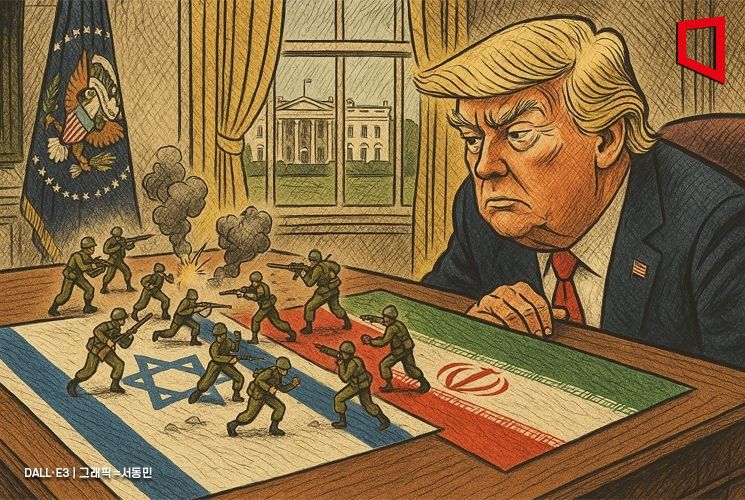
On June 17, Korea Investment & Securities released a report titled "Risk Assessment of the Israel-Iran Conflict," stating that while the Israel-Iran war has limited potential to trigger a surge in oil prices, it would be difficult to rule out the possibility of stagflation in the United States if the conflict were to escalate into a full-scale war.
Immediately after Israel's airstrike on Iranian territory on June 13, international oil prices soared, and the market reacted sensitively to the geopolitical risk. West Texas Intermediate (WTI) crude rose by about 7% in a single day, surpassing $73 per barrel. However, as of June 16, the upward trend has somewhat stabilized, with prices holding at around $72 per barrel. This spike in oil prices is attributed to concerns over potential closure of the Strait of Hormuz and fears of a full-scale war in the Middle East, both of which raise worries about supply disruptions. U.S. Treasury yields initially fell due to a preference for safe assets, but rebounded as rising oil prices rekindled inflation concerns. This suggests that the market is already factoring in a chain reaction of "rising oil prices leading to heightened inflation concerns, which in turn raise the possibility of continued tightening by the Federal Reserve (Fed)."
Korea Investment & Securities projected that "the likelihood of sustained high oil prices due to Middle East risks is limited." This is because China and Russia, allies of Iran, have limited capacity to assist, and the United States and Europe have room for strategic intervention to prevent escalation. If the conflict intensifies and oil prices rise to levels seen during the Russia-Ukraine war, the likelihood of U.S. intervention increases.
There are also several factors on both the demand and supply sides that could exert downward pressure on oil prices. Concerns over a slowdown in global growth, heightened by the U.S.-China trade dispute and uncertainty over Trump's tariff policies, are clearly leading to a decline in oil demand. On the supply side, since May, OPEC+ (comprising OPEC member countries and non-OPEC partners) has increased production by about 410,000 barrels per day and has indicated that this production expansion will continue into July.
However, the report also analyzed that in the worst-case scenario, where the Israel-Iran conflict escalates into a full-scale war, it would be difficult to rule out the possibility of stagflation in the United States. The U.S. is already facing heightened inflation risks due to rising import prices resulting from Trump's tariff policies. In addition, the shock of rising oil prices caused by escalating geopolitical tensions would further intensify supply-side price pressures. This renewed inflation risk, combined with increased financial market volatility, could lead to a rapid and excessive contraction in real-sector consumption and investment.
Ultimately, with both inflation and economic risks?both of which the Fed is wary of?intensifying, the Fed's calculations for future interest rate decisions will become even more complicated. Historical examples show that the combination of monetary tightening and external shocks such as rising oil prices increases the likelihood of a recession. In all six U.S. recessions since 1980, monetary tightening preceded the downturn. In four of these cases (1980, 1990-1991, 2001, and 2020), negative external shocks such as war or COVID-19 followed monetary tightening. When the real economy is weakened by monetary tightening aimed at reducing demand-side price pressures, external shocks can significantly amplify downward pressure on the economy.
On top of the Trump tariff risk, the added oil price shock from the Israel-Iran conflict has created further obstacles for the Fed in achieving both its inflation target and a soft landing. Since the Fed began its aggressive tightening cycle in March 2022, core PCE inflation slowed to 2.5% year-on-year as of April. With the 2% target now in sight, Trump's tariff policies are already increasing upside risks to inflation.
Korea Investment & Securities stated, "If energy prices, which have contributed to disinflation so far, start to rise again, U.S. core inflation could expand to the upper 3% range within the year," and added, "If the recent rebound in inflation expectations is accompanied by a clear upturn in actual inflation, it will be difficult for the Fed to cut interest rates within the year."
© The Asia Business Daily(www.asiae.co.kr). All rights reserved.
![Clutching a Stolen Dior Bag, Saying "I Hate Being Poor but Real"... The Grotesque Con of a "Human Knockoff" [Slate]](https://cwcontent.asiae.co.kr/asiaresize/183/2026021902243444107_1771435474.jpg)















