Reducing Greenhouse Gas Emissions and Cutting Heating and Cooling Costs by 25-30%
"Ensuring Economic Feasibility Through Incentives Such as Acquisition Tax Reductions"
Attracting Private Capital for the Southwest District Energy Project Through an SPC Model
Seoul Energy Corporation is moving forward with plans to actively introduce renewable energy heating and cooling systems utilizing geothermal energy into redevelopment projects in Seoul, such as Moa Town and the Rapid Integrated Planning initiative.
On June 16, Hwang Boyeon, President of Seoul Energy Corporation, met with a reporter at the company's headquarters in Mok-dong and stated, "Geothermal energy is a representative carbon-free, eco-friendly energy source. If effectively utilized, it can reduce greenhouse gas emissions and save residents on heating and cooling costs." He added, "With the expansion of eco-friendly incentives and technological development, the burden of high initial investment costs has been reduced, so there is no reason to delay its adoption."
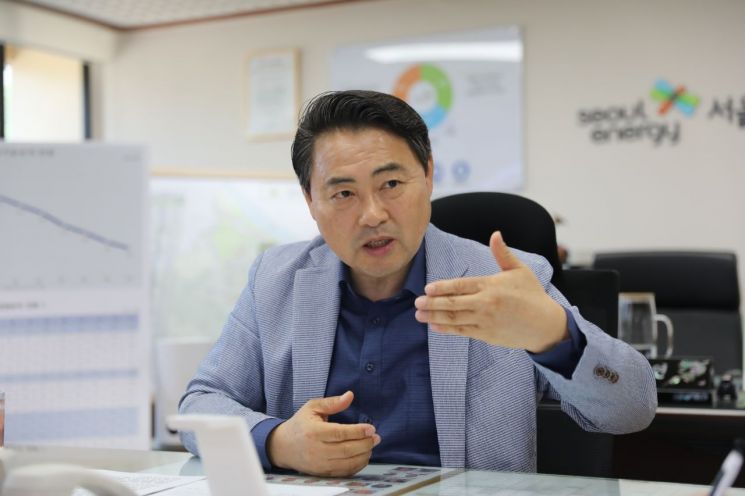 In an interview, Hwang Boyeon, President of Seoul Energy Corporation, said, "Geothermal energy is a representative eco-friendly energy source that is environmentally friendly and, if well utilized, can significantly reduce residents' utility bills." Provided by Seoul Energy Corporation.
President Hwang explained, "The expansion of renewable energy in Seoul has so far focused on solar power, but further expansion is now difficult. Geothermal energy utilizes heat stored underground, and by installing closed-loop geothermal pipes throughout an entire complex, it is possible to supply large-scale renewable energy that was previously impossible on a building-by-building basis."
According to the corporation, residents can save 25 to 30 percent on annual heating and cooling costs, and energy efficiency can be further increased by integrating geothermal systems with solar power. President Hwang said, "We are currently pursuing the application of geothermal heating and cooling systems as a priority in redevelopment apartment complexes with 300 to 1,000 households."
The top priority for application is Moa Town. Moa Town is an urban regeneration model designed to group low-rise residential areas, where large-scale redevelopment is difficult, into block units for improvement. In the mid- to long-term, the system could also be expanded to large-scale redevelopment projects such as Rapid Integrated Planning, as well as to private redevelopment and reconstruction projects.
The increase in incentives, such as acquisition tax reductions and floor area ratio benefits, is also a positive factor. Starting this month, it has become mandatory for multi-family residential buildings to obtain at least the minimum (grade 5) Zero Energy Building (ZEB) certification. At the same time, laws and regulations related to responding to the climate crisis are being strengthened, and incentives such as acquisition tax reductions, increased limits on loans from the Housing and Urban Fund, reduced donation rates, and relaxed standards for floor area ratio and building height are also being expanded.
President Hwang said, "The biggest obstacle to geothermal projects has been the burden of initial investment costs, but with the expansion of incentives, the payback period for investments has been shortened from the previous 10 to 15 years to within 10 years." He continued, "By utilizing these incentives, associations can install the necessary facilities without significant burden, and residents can save on heating and cooling management costs throughout their residence." He added, "The corporation provides comprehensive energy consulting and technical support from the early stages, and in cooperation with Seoul City and SH Corporation, we are currently discussing the possibility of introducing the system with an association in Gangseo-gu."
Regarding another key project for Seoul Energy Corporation?the second phase of the Magok District Southwest District Energy Facility?President Hwang said, "We are pursuing a method of attracting private capital and establishing a separate corporation (SPC), while also reviewing a consortium approach." He explained, "Seoul Energy Corporation will provide the land, while private developers, construction companies, and LNG suppliers will invest equity. This structure will enable the establishment of a stable, long-term revenue model." He added, "We plan to sign an SPC or consortium agreement by the end of the year and begin full-scale operations next year."
Since President Hwang took office, Seoul Energy Corporation has been overcoming chronic structural deficits caused by being unable to pass on soaring costs, such as natural gas prices, to sales prices. This has been achieved by significantly reducing costs through strengthened safety management measures, such as 100 accident-free days during the winter and intensive on-site inspections. The goal for this year is to reduce the deficit to 7.5 billion won, and next year, the corporation expects to turn a profit for the first time since its establishment in 2016.
Hwang Boyeon, who took office last December, previously served as Director-General of Seoul's Climate and Environment Headquarters, Director-General of Urban Transportation, and Director-General of Economic Policy. During his tenure at Seoul City, he led key policies such as the reorganization of the public transportation system, climate and environment policies, energy transition, and the expansion of renewable energy adoption.
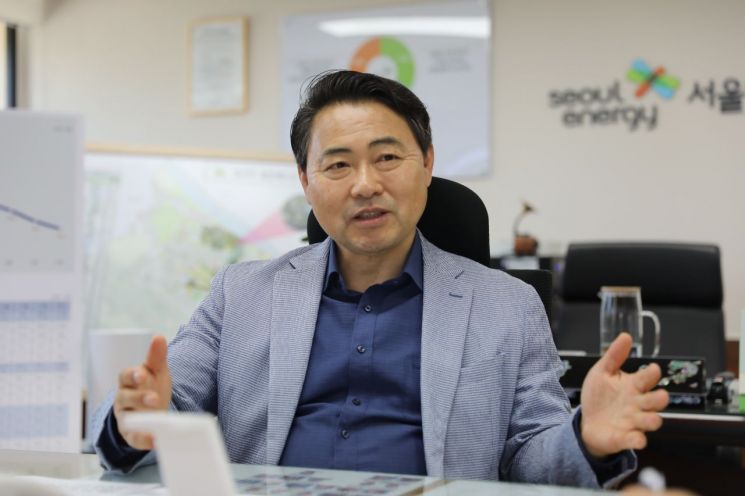 Hwang Boyeon, president of Seoul Energy Corporation, said about the second phase of the Magok District Southwest District Energy Facility project, "We are promoting a method of attracting private capital and establishing a separate corporation (SPC), while also reviewing a consortium approach." Provided by Seoul Energy Corporation.
© The Asia Business Daily(www.asiae.co.kr). All rights reserved.


















