Four Major Institutes, Including UNIST, Launch Collaborative Convergence Research
Eight Research Groups Selected for the 'InnoCORE Project'
Recruitment of 400 Postdoctoral Researchers Begins in AI, Hydrogen, and Energy Fields
As the government moves to prevent the outflow of talent in the AI sector by offering postdoctoral researcher positions with an annual salary of 100 million won, the host institution UNIST (President Park Jongrae) officially launched the 'InnoCORE Research Group' on June 16.
The InnoCORE Research Group aims to pursue technological innovation through the convergence of AI and science and technology, with the goal of nurturing leaders who will drive the future of advanced AI industries.
UNIST will recruit up to 100 key talents in the AI energy sector.
The research areas include the 'Intelligent Hydrogen Technology Innovation Group' and the 'AI-Space Solar Power Research Group.' These two groups will foster high-level talent in the fields of hydrogen energy technology and space solar power generation.
The 'InnoCORE Research Group' is led by the four major Institutes of Science and Technology: UNIST, KAIST, DGIST, and GIST.
In particular, the program aims to attract young scientists specializing in AI convergence and support their growth into global researchers by working alongside Korea's top research teams. Selected candidates are guaranteed an annual salary of 90 million won.
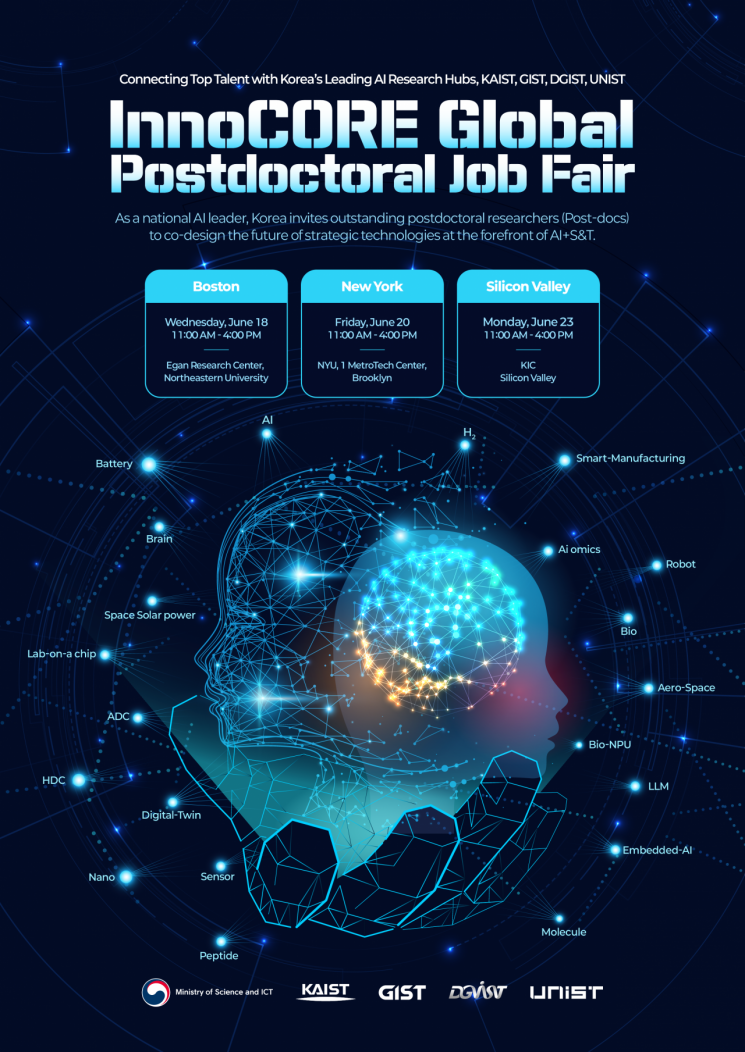
UNIST, together with the Ministry of Science and ICT, plans to hold local recruitment information sessions in Boston, New York, and Silicon Valley in the United States during June. In addition, the university will actively recruit overseas talent through international academic journals such as 'Nature' and 'Science,' as well as recruitment platforms like 'LinkedIn.'
Park Jongrae, President of UNIST, stated, "UNIST is focusing on fostering AI convergence research and is producing practical research outcomes through collaboration with industry. Through the InnoCORE project, we will lead AI-based manufacturing innovation and accelerate technology commercialization to strengthen the competitiveness of the national manufacturing sector."
KAIST, DGIST, and GIST will each oversee research groups such as the Ultra-Large Language Model Innovation Group, Bio-Embodied Physical AI, AI+Nano Convergence for Early Diagnosis of Brain Diseases, and AI-Innovative New Drug Research Group. Starting this year, the four major Institutes of Science and Technology plan to recruit a total of 400 postdoctoral researchers and operate a total of eight research groups.
The eight selected research groups will finalize their detailed research plans by the end of June and begin their research starting in July.
© The Asia Business Daily(www.asiae.co.kr). All rights reserved.
![Clutching a Stolen Dior Bag, Saying "I Hate Being Poor but Real"... The Grotesque Con of a "Human Knockoff" [Slate]](https://cwcontent.asiae.co.kr/asiaresize/183/2026021902243444107_1771435474.jpg)















