Nationwide Housing Price Trend Survey
"Cold Wave of Decline" Continues in Provincial Areas
Housing prices in Seoul have risen again, with the increase being more pronounced in the three Gangnam districts. The upward trend, especially in preferred complexes such as those slated for reconstruction, has shown little sign of slowing down. The rise originating from Gangnam is gradually spreading to the northern part of Seoul as well. In key areas of northern Seoul, the upward trend continued, particularly in semi-new and station-area complexes.
According to the May statistics of the "National Housing Price Trends" released by the Korea Real Estate Board on the 16th, the comprehensive housing sale price index in Seoul (including apartments, row houses, and detached houses) rose by 0.38% compared to the previous month. The increase widened by 0.13 percentage points from 0.25% in the previous month. Among these, apartment sale prices rose by 0.54%, driving the overall increase.
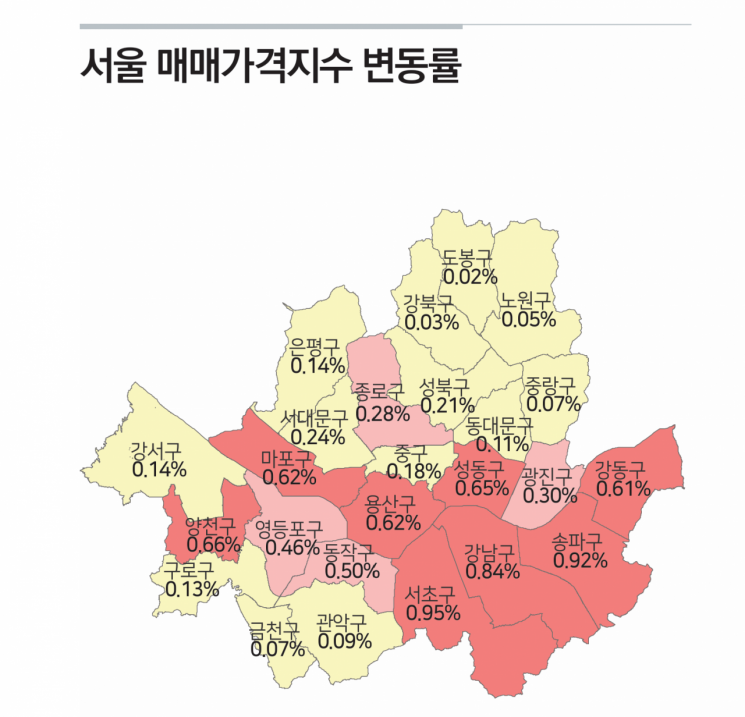
The rise in housing prices was particularly notable in the three Gangnam districts. Seocho-gu recorded the highest increase among Seoul's 25 autonomous districts, rising by 0.95%, followed by Songpa-gu (0.92%) and Gangnam-gu (0.84%). This was due to a combination of factors, including expectations for redevelopment projects, strong school districts, and favorable transportation. Yangcheon-gu (0.66%) saw increases mainly in the Mok-dong and Sinjeong-dong areas, while Gangdong-gu (0.61%) experienced rises mainly in small and medium-sized apartments in Godeok and Myeongil-dong.
The northern part of Seoul also saw an upward trend. Seongdong-gu (0.65%) rose mainly in Geumho-dong and Seongsu-dong, Yongsan-gu (0.62%) in Ichon-dong and Sanchon-dong, and Mapo-gu (0.62%) saw a significant increase in semi-new complexes in Ahyeon-dong and Yeomni-dong. Jongno-gu (0.28%) also showed an upward trend, mainly in Pyeong-dong and Chungsin-dong.
Across the greater Seoul metropolitan area, the increase widened to 0.10%, up from 0.07% in the previous month. In Gyeonggi Province (-0.05%), although Gwacheon City (1.20%) and Bundang-gu in Seongnam City (0.71%) posted significant increases, the overall decline in sale prices for the province widened compared to the previous month (-0.02%). Incheon recorded the same decrease as the previous month, at 0.07%.
Outside the metropolitan area, Sejong (1.45%) saw increases mainly in complexes with good school districts and residential environments in Dajeong-dong and Saerom-dong. However, the five major metropolitan cities (-0.19% to -0.24%) and the eight provinces (-0.06% to -0.09%) saw their declines deepen, resulting in an overall decrease of 0.12%. In Daegu (-0.41%), the decline was centered on small and medium-sized complexes in Buk-gu and Dalseo-gu. In Gwangju (-0.28%), the decline was focused on older complexes in Dong-gu and Seo-gu. In North Gyeongsang Province (-0.18%), the decrease was mainly in Gyeongsan City and the southern part of Pohang.
The Korea Real Estate Board analyzed, "In Seoul and the metropolitan area, some transactions are occurring mainly in new and reconstructed complexes, but transactions remain sluggish in older or outlying areas. Similarly, in the provinces, a decrease in demand for older complexes is contributing to a continued nationwide downward trend."
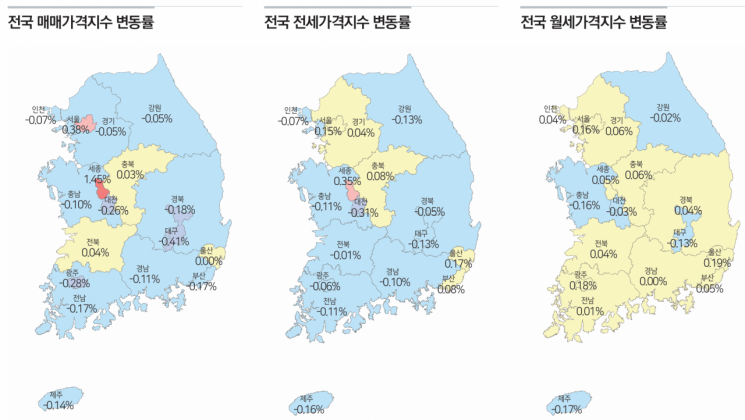 National Sales Price Index, Jeonse Price Index, Monthly Rent Price Index Change Rates. Provided by Korea Real Estate Board
In the national jeonse and monthly rent markets, demand is flowing into station-area and strong school district areas. In contrast, demand is decreasing for older complexes and outlying areas, resulting in jeonse prices remaining flat and monthly rents showing a slight upward trend.
The nationwide comprehensive housing jeonse price change rate was 0.00%, maintaining a flat trend for the second consecutive month. In Seoul, jeonse prices rose by 0.15%, with the increase widening from 0.09% in the previous month. The metropolitan area also saw a slight rise of 0.06%. In contrast, except for Sejong (0.35%), both the metropolitan cities (-0.04%) and the eight provinces (-0.07%) continued to decline.
Monthly rents continued their overall upward trend. The nationwide housing monthly rent index rose by 0.05%, the same rate as the previous month. In Seoul (0.10% to 0.16%) and the metropolitan area (0.09% to 0.10%), the rate of increase expanded compared to the previous month, while the provinces (0.01%) remained flat. The continued preference for monthly rent was attributed to economic stagnation and loan regulations.
© The Asia Business Daily(www.asiae.co.kr). All rights reserved.
![Clutching a Stolen Dior Bag, Saying "I Hate Being Poor but Real"... The Grotesque Con of a "Human Knockoff" [Slate]](https://cwcontent.asiae.co.kr/asiaresize/183/2026021902243444107_1771435474.jpg)
















