Accompanying Rainwater Drain Managers on Their Cleaning Rounds
Filter Screens Broken, Drains Filled with Cigarette Butts
"Even if we clean it up like this, when we come back next time, cigarette butts have piled up again anyway."
On the morning of June 18, around Dorimcheon in Dongjak-gu, Seoul. This area suffered severe damage from record-breaking torrential rains in August 2022. Ahead of the full rainy season, workers could be seen busily cleaning rainwater drains. Choi (52), who was wearing a fluorescent vest and lifting a metal cover, said, "This area suffers the most damage when it rains heavily," and added, "Cleaning regularly is much more helpful in preventing flooding than not cleaning at all."
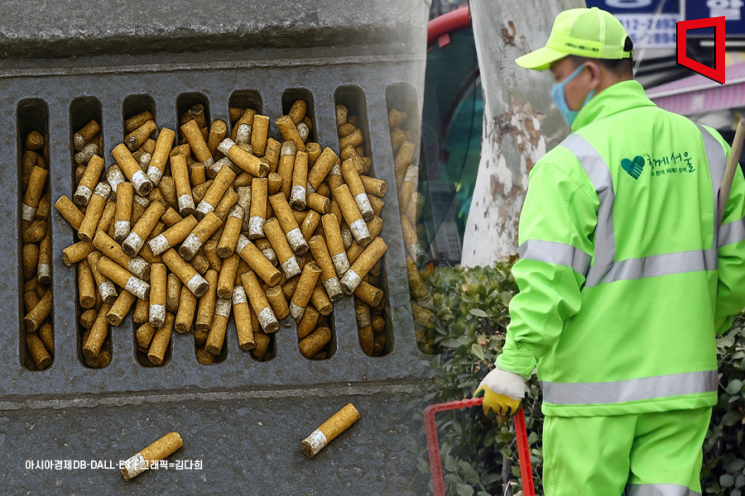
With the rainy season forecast to affect the entire country starting from the night of June 19, rainwater drains throughout the city are suffering from a buildup of trash. As Choi mentioned, the area around Dorimcheon is low-lying and adjacent to densely populated residential areas, so it experiences flooding damage every rainy season. In August 2022, Dongjak-gu saw up to 141.5mm of rain per hour. Parked cars were swept away, and water rose up to waist level in semi-basement homes, causing significant damage.
When workers removed the rainwater drain covers, cigarette butts, fallen leaves, various wrappers, and trash were tangled together. Even after shoveling, there seemed to be no end. Working in teams of three, they maintain the rainwater drains in Dongjak-gu from 9 a.m. to 3 p.m. In one day, they can clean up to about 50 drains, but if the area includes hills, the workload drops significantly.
There are about 580,000 rainwater drains installed in Seoul. The number of rainwater drain managers responsible for maintaining them is 23,000 per year. Every year before the rainy season, Seoul deploys cleaning personnel to maintain the drains, but trash keeps piling up no matter how often it is removed. One worker said, "Filter screens or plugs meant to prevent cigarette butts from being thrown in are useless," and added, "When you see people shove trash in by any means, there’s nothing we can do."
After inspecting dozens of rainwater drains around Sadang 1-dong, it was difficult to find a single drain free of trash or cigarette butts. The message next to the drains, "The cause of flooding could be you," seemed meaningless. Some drains had filter screens installed, but most were already damaged, allowing trash to be pushed in through the gaps.
Flooding damage is most likely to affect vulnerable groups living in semi-basement homes. Since 2023, Seoul has been working to reduce damage by installing flood barriers for semi-basement households, but if the rainwater drain in front of them is blocked, these efforts become useless. As the reporter observed, trash was consistently piled up near the rainwater drains close to semi-basement residences.
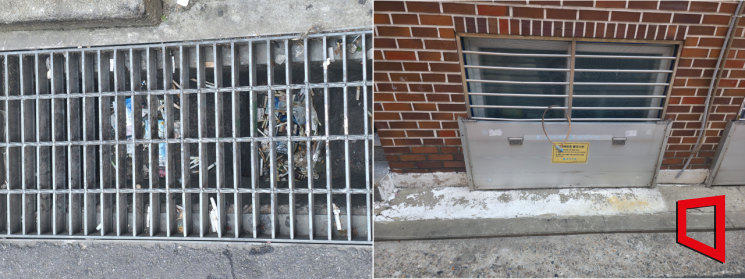 The rainwater drain near the flood barrier installed to prevent flooding damage for semi-basement residents is also filled with cigarette butts and trash. Photo by Youngchan Choi
As torrential downpours become more frequent, the role of rainwater drains has become more important than ever. In 2023, Seoul allocated a budget of 22.4 billion won solely for rainwater drain management. Some local governments have implemented "cigarette butt collection reward programs" or organized rainwater drain cleaning programs involving residents.
However, no matter how much manpower and budget are invested, it is useless if public awareness does not keep pace. The Seoul Institute stated in a report, "Education for citizens on the importance of rainwater drains and how to manage them should be strengthened," and added, "If residents voluntarily participate in cleaning, they can respond much more quickly in emergency situations."
Experts point out that the capacity of the sewer pipes themselves must be increased. Cho Woncheol, professor emeritus at Yonsei University's Department of Civil and Environmental Engineering, said, "The more 1-meter grid-type rainwater drains are installed in succession, the better the drainage." Park Changgeun, professor at Catholic Kwandong University's Department of Civil Engineering, said, "The more fundamental problem than the rainwater drains themselves is the insufficient stormwater pipelines, so it is necessary to expand their capacity."
© The Asia Business Daily(www.asiae.co.kr). All rights reserved.


















