The Lion as a Symbol of the Jewish People in Israel
Iran Also Used the Lion Before the Revolution
Analysis Suggests a Message of Resistance Against Dictatorship
After the Israel Defense Forces (IDF) carried out airstrikes on Iran's nuclear facilities, military commanders, and nuclear physicists on the 13th (local time), Prime Minister Benjamin Netanyahu announced that the operation was named "Rising Lion." The lion is an animal that both Israel and Iran have used as a national symbol for thousands of years. In particular, in Iran, the lion was also used as an emblem of the former government that collapsed 46 years ago in the revolution. Experts analyze that the Israeli operation name "Rising Lion" also contains a message urging the Iranian people to resist their government.
The "Lion of Judah" Throughout Jewish History
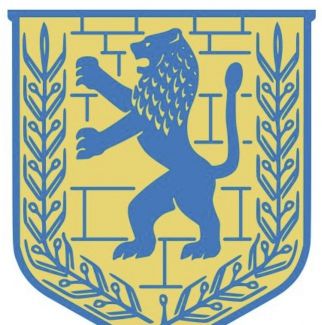 The official city seal of Jerusalem, the political capital of Israel, features the "Lion of Judah," a symbol of the Jewish people. Screenshot from the "Seal of the World" archive website
Of Israel's population of 9.7 million, 7.4 million Jews have regarded the "Lion of Judah" as their ethnic symbol since ancient times. This lion appears in Genesis of the Hebrew Bible, the national mythology of the Jewish people. Jacob, the Hebrew patriarch, blessed his son Judah (the ancestor of the Jewish people) by saying, "You are like a young lion," and since then, the Lion of Judah naturally became the symbol of the Jewish people.
The Lion of Judah is deeply embedded throughout Israeli culture. The official seal adopted by Jerusalem, Israel's administrative capital, in 1950 also features the Lion of Judah. Thus, "Rising Lion" can primarily be interpreted as a symbol of Israel itself. On the day before the airstrike, June 12, Prime Minister Netanyahu handwrote and released a phrase: "A people who rise like a lioness and lift themselves up like a lion," which is also a biblical verse describing Israel as recited by a divine messenger.
Iran Was Also a "Land of Lions" Since Ancient Times
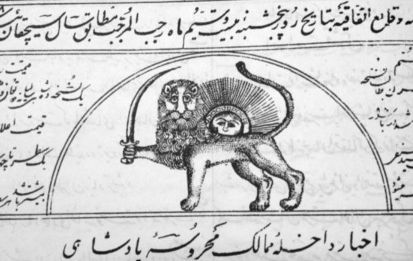 'Lion and Sun' emblem appearing in the official documents of the Iranian Empire in the 1850s. Online archive capture
The lion is not a symbol unique to Israel. Iran, too, has been known as a "land of lions" since at least the 12th century, or even earlier according to some records, using the "Lion and Sun" emblem as a national symbol. The Lion and Sun emblem, depicting a lion holding a large sword in one forepaw with the sun rising behind it, was used by the royal family of the ancient Persian Empire, the predecessor of modern Iran.
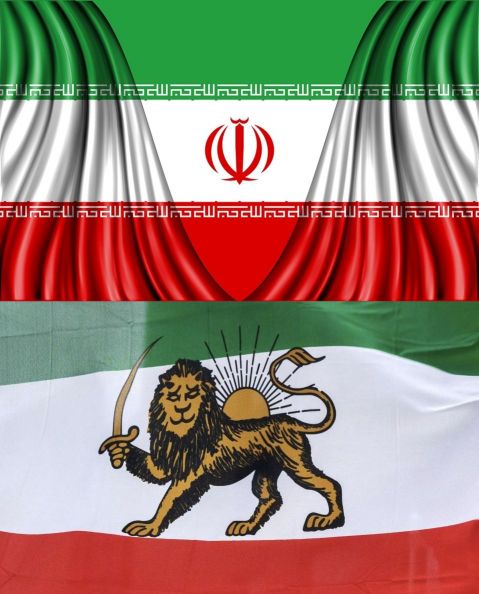 The flag of the modern Islamic Republic of Iran (above) and the flag of the Imperial State of Iran used until 1979. The Islamic Republic replaced the lion emblem of the empire with the Islamic symbol of the "crescent and sword." The old Imperial State of Iran flag is used by anti-government organizations such as the National Union for Democracy in Iran (NUFDI), which opposes the theocratic rule of the republic. Pixabay, NUFDI website
The Lion and Sun emblem survived the fall of ancient Persia and remained in use until the rise of the Iranian Empire that followed. In the 19th century, the Qajar dynasty of the Iranian Empire adopted the Lion and Sun as the official national animal, and the subsequent constitutional monarchy of the Pahlavi dynasty redesigned the Lion and Sun emblem in a modern style in 1973. The Lion and Sun appeared on government agencies, major public buildings, and the Iranian flag, but vanished after the 1979 "Iranian Revolution," which led to the collapse of the Iranian Empire and the establishment of the modern Islamic Republic of Iran.
Today, Iran is a theocracy in which the Supreme Religious Leader serves as the head of state. The Lion and Sun, as symbols of the old monarchy, became targets of government repression. Now, the Lion and Sun are used as symbols by anti-theocratic groups and Iranian democracy activists.
Does "Rising Lion" Contain a Message of Resistance Against Theocratic Dictatorship?
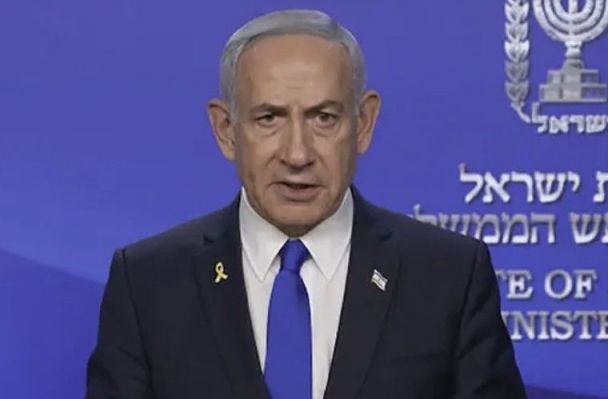 Israeli Prime Minister Benjamin Netanyahu delivering a national address on the 13th (local time). YouTube capture
For this reason, some historians speculate that Israel is sending a message to the Iranian people to resist, using the lion as a symbol. There is an interpretation that "Rising Lion" actually refers to the pre-1979 Imperial State of Iran.
Saul Sadka, an Israeli scholar of religion and history, wrote on X (formerly Twitter) on the 13th, "'Rising Lion' is a name with deep political symbolism. Iran, like Israel, was associated with the lion for 2,500 years, but that lion has been in exile for the past half-century (since the revolution). Now, thanks to Israel, the message is that the Iranian Empire has a chance for restoration after 50 years."
After the airstrikes, Prime Minister Netanyahu directly called on the Iranian people to resist in a national address. He stated, "Israel's fight is against the dictatorial regime that has oppressed the Iranian people for 46 years. Now is the time for the Iranian people to rise up against this evil regime," adding, "The day of liberation for Iran is near, and when liberation is achieved, our two ancient peoples will once again blossom into a great friendship."
Meanwhile, the confrontation between Israel and Iran has continued for several days. Ayatollah Ali Khamenei, Iran's Supreme Leader, who was in hiding during the initial airstrikes, declared on the 18th, "We will show no mercy to the Zionists," announcing a direct retaliation. The next day, Iranian forces launched dozens of ballistic missiles, striking four locations including Soroka Hospital in southern Israel, reportedly injuring at least 30 people. In response, Israel deployed about 40 fighter jets to carry out additional airstrikes on Iranian facilities, including the Arak nuclear site.
© The Asia Business Daily(www.asiae.co.kr). All rights reserved.



















