Robotics Lab's Shoulder Strength-Assist "X-ble Shoulder"
"Domestic Application First, Overseas Sales Starting in July"
Hyundai Motor Group will begin deploying wearable robots on its production sites starting this month.
On June 16, Choi Rigun, Executive Vice President of the Robotics Business Division at Hyundai Motor Robotics Lab, announced at the seminar "Convergence of Humanoid Robots and the Mobility Industry," hosted by the Korea Academy of Management in the National Assembly Members' Office Building in Yeouido, Seoul, that wearable robots to prevent industrial accidents will be introduced to production sites starting this month.
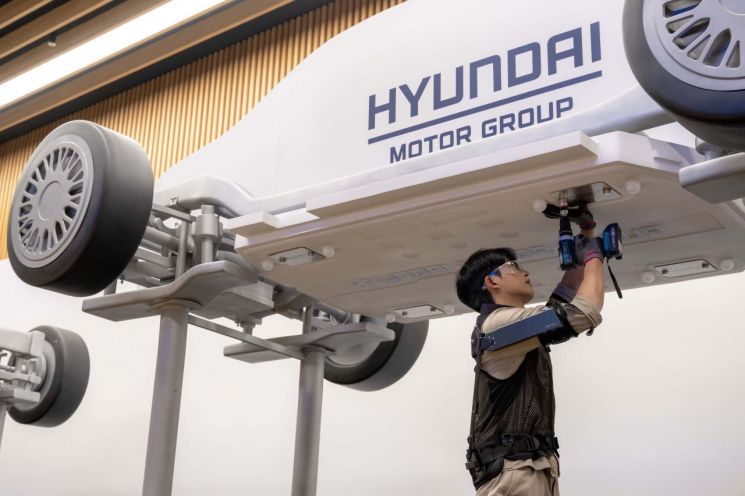
Choi explained, "We had 10,062 assembly plant workers at Hyundai Motor and Kia try on the wearable robots, and the feedback was largely positive," adding, "We will first apply them to domestic production sites and plan to begin overseas sales starting in July."
The Robotics Lab is conducting research and development on robot hardware and artificial intelligence (AI)-based software, based on a cyber-physical system (CPS). In terms of hardware, the lab is developing not only wearable robots (joint robots), but also logistics and delivery robots (mobile robots) and electric vehicle automatic charging robots (service robots).
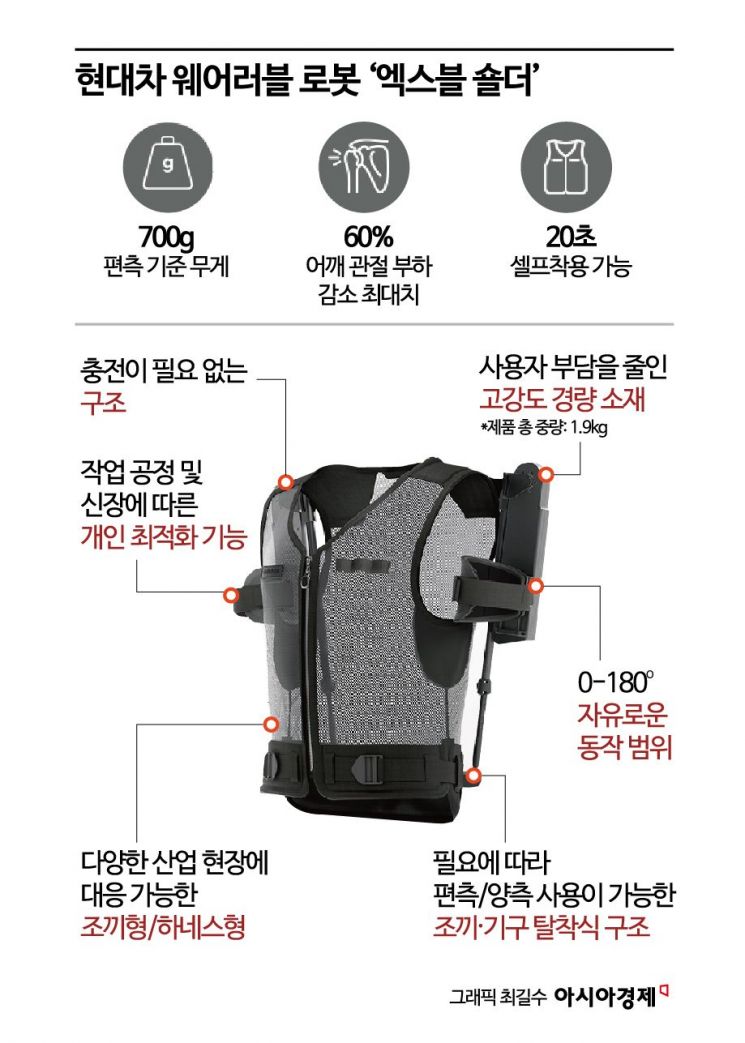
The shoulder strength-assisting wearable robot "X-ble Shoulder," which is being deployed to factories this time, is notable for not containing a motor or battery. Using a spring and link structure, it provides ultra-lightweight assistance for loads under 20kg, helping to reduce strain on the shoulder joints and muscles. The vest-type robot uses lightweight materials and weighs only 1.9kg.
Additionally, the Robotics Lab is conducting pilot tests of the "X-ble Waist," a wearable robot that assists lower back strength to reduce fatigue from repetitive bending tasks, and the "X-ble Mex," a gait rehabilitation robot for patients with spinal cord injuries.
Regarding delivery robots, the Robotics Lab is also researching a small wheel-based (Plug & Drive, PnD) indoor service platform and a large wheel-based (Drive & Lift, DnL) outdoor service platform. PnD is characterized by integrating driving, steering, braking, and sensors into a single unit, while DnL adopts a four-wheel independent steering system.
As for service robots, the lab has developed the customer service robot "DAL-e" and the automatic charging robot (ACR) for electric vehicles, and is working to implement them in actual business operations. DAL-e is currently in operation at five Hyundai Motor and Kia sales hubs, as well as at Hyundai Motor's Gangnam office building, and is scheduled to be deployed to the Yangjae headquarters as well.
Choi stated, "Until now, robots have not had many applications outside of vacuum cleaners or the medical field," adding, "Based on cyber-physical systems, we plan to become a space service provider with a robotic service business framework, offering solutions that can assist in everyday life."
© The Asia Business Daily(www.asiae.co.kr). All rights reserved.
![Clutching a Stolen Dior Bag, Saying "I Hate Being Poor but Real"... The Grotesque Con of a "Human Knockoff" [Slate]](https://cwcontent.asiae.co.kr/asiaresize/183/2026021902243444107_1771435474.jpg)
















