Spending Cutbacks Amid Economic Uncertainty
"Travel Is a Barometer of Economic Recovery"
Although the holiday season is approaching, there is analysis suggesting that American consumers are cutting back on their vacation plans and delaying travel bookings. Some warn that this decline in travel demand could be a red flag for economic growth.
On June 15 (local time), TS Lombard analyzed data from the US Transportation Security Administration (TSA) and found that the number of passengers using US airports over the past 90 days has decreased compared to the same period last year. This marks the first decline in air traffic since the peak of the COVID-19 pandemic.
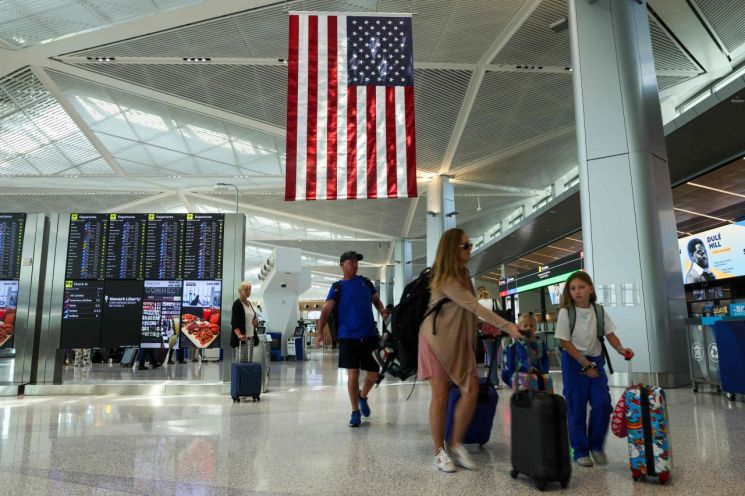 Passengers at Newark Liberty International Airport, New Jersey, USA. Photo by Getty Images Yonhap News
According to the US Bureau of Labor Statistics on June 11, both airline ticket prices and hotel accommodation rates fell on a seasonally adjusted basis in April and May. Travel agencies are expressing concern that it is becoming increasingly difficult to fill rooms, as inflation and fears of unemployment grow due to President Donald Trump’s trade war.
Joan Bottarini, Chief Financial Officer (CFO) of Hyatt Hotels Group, said at a recent investor conference, "Customers are behaving cautiously due to the uncertainty in the environment."
Bank of America (BoA) analyzed credit and debit card spending and found that American consumers across all income levels reduced their spending on lodging and airfare in the year through May, compared to the same period a year earlier. The Financial Times (FT) reported that, as the number of tourists from Canada and Europe declines and American consumers also cut back on travel, the US tourism industry is taking a significant hit.
In particular, BoA noted that travel spending among low-income households dropped sharply. Wealthier Americans only slightly reduced their travel, so luxury hotels have not been significantly affected by the economic downturn.
Ewout Steenbergen, CFO of Booking Holdings, which owns Booking.com, Kayak, and Agoda, stated, "It is definitely more difficult to sell rooms at budget accommodations." According to company data, the length of stays in the US is getting shorter, and last-minute bookings are increasing.
Adam Sacks, president of Tourism Economics, said that low- and middle-income Americans are opting for cheaper alternatives, such as road trips, instead of canceling vacations altogether, which is contributing to the slowdown in the tourism industry.
Economists have warned that the slowdown in travel demand is a sign that, after years of strong spending, American consumers’ ability to spend is starting to weaken. Stephen Blitz, chief US economist at TS Lombard, said, "Travel is one of the earliest indicators of economic recovery," adding, "Travel is the easiest expense to postpone."
© The Asia Business Daily(www.asiae.co.kr). All rights reserved.
![Clutching a Stolen Dior Bag, Saying "I Hate Being Poor but Real"... The Grotesque Con of a "Human Knockoff" [Slate]](https://cwcontent.asiae.co.kr/asiaresize/183/2026021902243444107_1771435474.jpg)















