Concerns are mounting over the shockwaves rippling through the South Korean economy as international oil prices soar due to the ongoing military conflict between Israel and Iran. With the risk of the conflict escalating from a localized clash to a broader war across the Middle East intensifying, some fear that, in the worst-case scenario, international oil prices could surge to as high as $130 per barrel. There are growing worries that the kind of multi-faceted crisis triggered by the Russia-Ukraine war in 2022-such as inflation caused by soaring global energy prices, supply chain disruptions, and trade deficits-could once again strike the Korean economy.
According to the Ministry of Economy and Finance on June 16, the government held a series of joint meetings with relevant ministries in the morning to discuss response measures to the escalating situation in the Middle East. At an emergency response team meeting chaired by the Ministry of Economy and Finance, participants stated, "Given the extremely high uncertainty regarding how the situation may unfold, we have decided to closely monitor financial and real economic trends and to respond swiftly in close cooperation with relevant agencies should any unusual developments arise." The government plans to maintain a 24-hour monitoring system centered on the joint emergency response team, and, if the market exhibits excessive volatility that is disconnected from the fundamentals of the Korean economy, it will take immediate and bold action according to scenario-based response plans.
Lee Hyungil, Acting Minister and First Vice Minister of the Ministry of Economy and Finance, convened his first expanded executive meeting since taking office on the morning of the 16th to review the situation and assess market impacts. Lee instructed thorough monitoring and management of the situation, with particular attention to trends in the real economy and financial markets, in preparation for heightened military tensions in the Middle East.
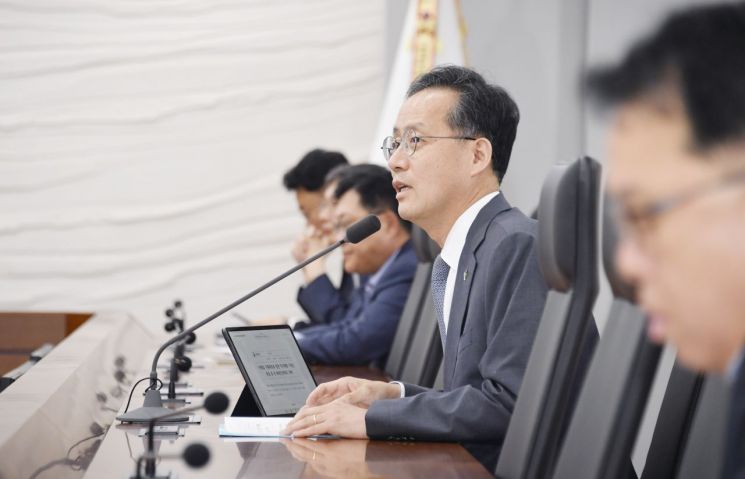 Lee Hyungil, Acting Minister and First Vice Minister of the Ministry of Economy and Finance, is delivering opening remarks at the expanded executive meeting held on the morning of the 16th at the Central Building of the Government Complex Sejong.
The government is closely watching for the possibility that the fallout from the current crisis could spill over into the real economy. Rising international oil prices lead to increased corporate costs and higher consumer prices, negatively affecting the overall economy. The key factor determining the direction of oil prices is whether the conflict escalates further. Some experts predict that if Iran retaliates by blocking the Strait of Hormuz-a key route for South Korea’s crude oil imports-or if Yemen’s Houthi rebels attack ships in the Red Sea, oil prices could exceed $130 per barrel. The Strait of Hormuz is a vital route for Middle Eastern crude oil imports to Korea, with about 20% of the world’s oil and roughly 40% of seaborne oil passing through it. The price of Brent crude futures (London ICE Exchange), which had fallen to $58 per barrel before the outbreak of war, surged to the high $70 range on June 13, when Israel launched a preemptive strike against Iran, and is now on the verge of breaking the $80 mark.
If crises simultaneously erupt at two key supply chain chokepoints for the Korean economy, the industrial sector could face significant damage. There are also concerns that, if a full-scale war breaks out in the Middle East while the aftershocks of Trump-era tariffs persist, South Korea could face catastrophic losses from being caught in two simultaneous wars. The Russia-Ukraine war, which began in February 2022, led to rising international commodity prices and increased supply chain instability, resulting in decreased exports and a widening trade deficit. If oil supply is disrupted, the government plans to release strategic oil reserves and is considering extending the fuel tax cut, which is scheduled to expire at the end of this month. The Ministry of Economy and Finance stated, "We will do our utmost to manage energy supply and demand, and to minimize the impact on exports and logistics, we will provide liquidity support to export companies affected in the Middle East and deploy temporary vessels if concerns over logistics bottlenecks intensify."
The surge in international oil prices could act as an inflationary factor. Last month, consumer prices rose by 1.9% year-on-year, dropping to the 1% range for the first time in five months. The stabilization of consumer price growth in the 1% range was largely due to the decline in international oil prices resulting from increased supply. If the sharp rise in oil prices persists for an extended period, the government’s inflation projections may also change. Earlier this month, the Bank of Korea, in its economic outlook, assumed that Brent crude prices would remain in the mid-to-high $60 range per barrel in the second half of this year.
With a major new source of uncertainty, the new administration is accelerating economic recovery by expediting the passage of a supplementary budget. Inflation is directly linked to people’s livelihoods. For the Lee Jaemyung administration, which is pushing ahead with a 20 trillion won supplementary budget to boost domestic demand and support household incomes, concerns are mounting that inflation may be further stoked. Jeong Gyucheol, Director at the Korea Development Institute (KDI), said, "Even if the variable of soaring oil prices is added to the current situation, where economic stagnation is exerting downward pressure on prices, it is unlikely that the 20 trillion won supplementary budget will significantly burden inflation."
© The Asia Business Daily(www.asiae.co.kr). All rights reserved.
![Clutching a Stolen Dior Bag, Saying "I Hate Being Poor but Real"... The Grotesque Con of a "Human Knockoff" [Slate]](https://cwcontent.asiae.co.kr/asiaresize/183/2026021902243444107_1771435474.jpg)















