Seoul City Establishes Unified Standards for 'Difficult-to-Recycle' Items
Guidelines Based on Size, Material, and Other Criteria... Disposal Instructions for About 60 Items Updated
Enhancing Public Awareness of Recyclable and Non-Recyclable Items
Seoul City has revised the guidelines for handling items classified as 'difficult-to-recycle' within its recycling sorting system. This move aims to prevent confusion among citizens regarding recycling disposal and to promote high-quality resource recycling.
On June 16, Seoul City announced that it has established a unified standard guideline for recycling disposal, which had previously varied across each of the 25 districts, and has begun informing all districts of the new standards.
Recyclables have been sorted according to the Ministry of Environment's 'Guidelines on the Separate Collection of Recyclable Resources,' but confusion has persisted because clear standards for handling certain 'non-applicable items'?which are exceptions among some specific categories?were not provided.
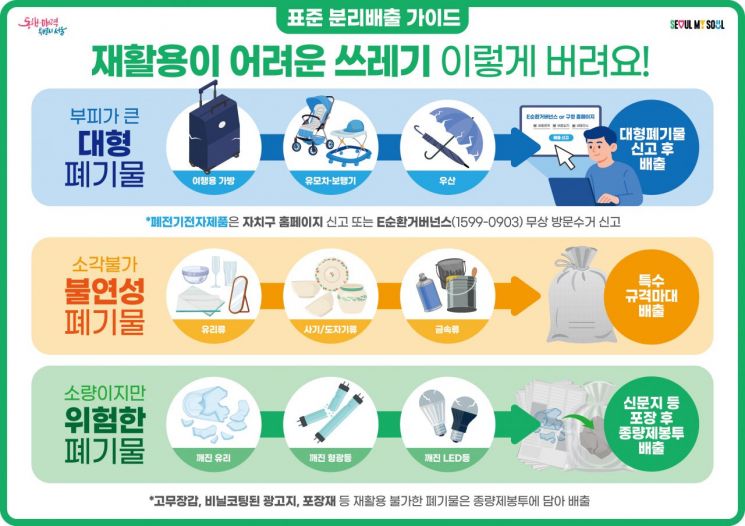
In response, Seoul City has standardized the sorting and disposal guidelines based on criteria such as combustibility, size, risk, and incineration possibility. The city also selected around 60 'confusing items' that have recently been the subject of debate in the media and on social media, and provided clear instructions for their disposal.
First, non-combustible waste that cannot be incinerated must be disposed of in special regulation bags. Items that are hazardous and in small quantities, such as broken glass or fluorescent lamps, must be wrapped in newspaper and placed in standard volume-based waste bags. Large items such as suitcases, strollers, and walkers must be reported as bulky waste. Non-recyclable waste such as rubber gloves, vinyl-coated advertisements, or packaging materials must be disposed of using standard volume-based waste bags.

Each district plans to incorporate these new guidelines into their waste management ordinances. If any ordinance currently misidentifies non-recyclable items as recyclable, the districts will revise the relevant provisions. If citizens fail to use standard volume-based waste bags for 'difficult-to-recycle' items that require them, or if they dispose of such items in a manner that does not comply with the sorting guidelines, such as mixed disposal, a fine may be imposed.
Kwon Min, Director of the Climate and Environment Headquarters of Seoul City, stated, "We will continue to provide guidance materials and pursue institutional improvements that meet the expectations of our citizens, striving to create a recycling environment that anyone can easily follow without unnecessary confusion." He added, "With these new guidelines, we hope that recycling sorting and disposal will become more accurate and convenient in the daily lives of our citizens."
© The Asia Business Daily(www.asiae.co.kr). All rights reserved.
![Clutching a Stolen Dior Bag, Saying "I Hate Being Poor but Real"... The Grotesque Con of a "Human Knockoff" [Slate]](https://cwcontent.asiae.co.kr/asiaresize/183/2026021902243444107_1771435474.jpg)
















