Analysis of Asteroid '2024 YR4' Data
Probability of Moon Collision in 2032 Rises to 4.3%
NASA: "No Impact on the Moon's Orbit Around Earth"
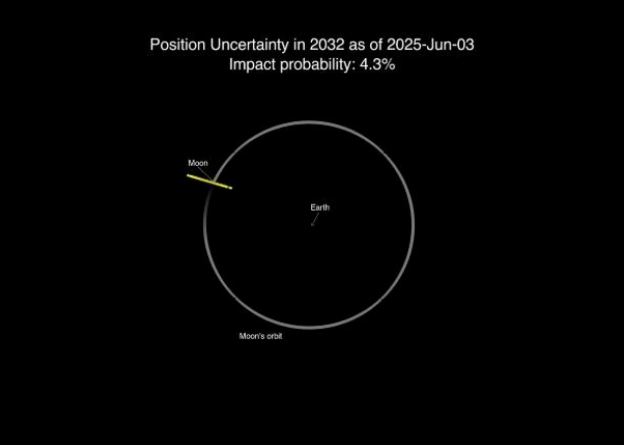
The astronomical community is paying close attention as the possibility of a large asteroid colliding with the Moon in 2032 has somewhat increased. On June 9 (local time), USA Today reported, "NASA released new data on the asteroid '2024 YR4,' captured last month by the James Webb Space Telescope (JWST), through its official blog on June 5." According to the report, the probability of this asteroid colliding with the Moon on December 22, 2032, has risen to 4.3%.
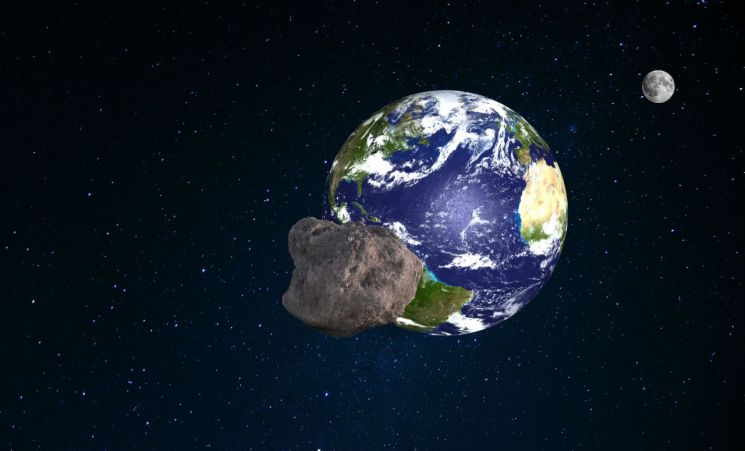
2024 YR4 was first detected in December last year by a telescope at the European Southern Observatory (ESO) in Chile. According to NASA and other international space agencies, the asteroid's diameter is estimated to be between 40 and 90 meters, roughly the size of a 10-story building. At the time of its initial discovery, the probability of this asteroid colliding with Earth was confirmed to be 1.3%. However, in February, this probability temporarily rose to 3.1%, placing it on NASA's Sentry Risk Table for collision threats. Among more than 37,000 large asteroids, it was singled out as the only object with a potential for Earth impact, earning it the label "the most dangerous asteroid in observational history."
However, subsequent detailed analysis confirmed that the possibility of 2024 YR4 colliding with Earth is virtually nonexistent. Instead, the likelihood of a collision with the Moon has somewhat increased. Due to additional data collected by the Webb Space Telescope last month, the accuracy of its predicted position in 2032 improved by 20%, resulting in a higher collision probability than before. NASA stated, "Even if the Moon is impacted, it will not affect the Moon's orbit around Earth."
Nevertheless, there is growing interest in what kind of repercussions might occur if an actual collision were to take place with the celestial body closest to humanity. Since there is no detailed information on the composition or mass of 2024 YR4, the exact magnitude of the impact cannot be determined. However, based on NASA's estimated mass and density values according to the asteroid's predicted diameter, the asteroid is expected to release energy equivalent to a 7.8-megaton (MT) TNT explosion. This is 520 times the power of the 'Little Boy' atomic bomb dropped on Hiroshima, Japan, during World War II. Currently, YR4 is orbiting the Sun and is in a position that makes it difficult to observe from Earth, so humanity will not be able to see it again until 2028. NASA is planning additional observations around that time.
According to foreign media, another asteroid called 'Apophis' has also been considered a collision risk for decades. However, the probability of this asteroid colliding with Earth has also been determined to be low. NASA continues to research related technologies to prepare for similar crisis situations in the future. In the DART experiment conducted in 2022, NASA successfully changed an asteroid's orbit by intentionally crashing a probe into it. NASA is also currently developing the NEO Surveyor (Near-Earth Object detection telescope). With a diameter of over 140 meters, this telescope aims to detect more than 90% of asteroids or comets that approach within 30 million miles of Earth. The launch is scheduled for after 2027.
© The Asia Business Daily(www.asiae.co.kr). All rights reserved.
![Clutching a Stolen Dior Bag, Saying "I Hate Being Poor but Real"... The Grotesque Con of a "Human Knockoff" [Slate]](https://cwcontent.asiae.co.kr/asiaresize/183/2026021902243444107_1771435474.jpg)
















