Interview with Fox News
Uranium Discovered for Nine Nuclear Bombs, Claims of Nuclear Weapons Development Within a Year
Refuses to Answer Questions About Eliminating Iran's Supreme Leader
Israeli Prime Minister Benjamin Netanyahu has suggested that a military attack on Iran could ultimately lead to regime change in Iran.
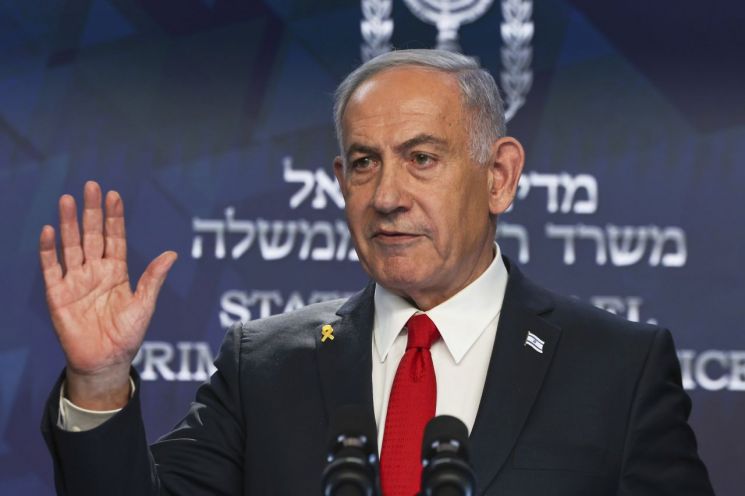
In an interview with Fox News on the 15th (local time), Prime Minister Netanyahu was asked whether regime change in Iran was part of Israel's military efforts. He responded, "The Iranian regime is so weak that it could certainly be a result."
He stated, "We have prepared everything necessary to achieve our goals," and argued that these preparations were aimed at eliminating two existential threats: the nuclear threat and the ballistic missile threat. While Israel maintains that regime change in Iran is not the objective of its attacks, Netanyahu stated immediately after the launch of the attack that "we must stand up to the oppression of this evil regime."
Prime Minister Netanyahu claimed that the attack was intended to protect the world from the Iranian regime. He said, "We acted to defend ourselves, but I believe this is not just for us, but also to protect the world from this inciteful regime," adding, "We cannot allow the most dangerous regime in the world to possess the most dangerous weapons in the world."
Netanyahu asserted that all Iran possesses are plans to acquire nuclear weapons and ballistic missiles, stating, "They clearly do not have the support of their people. Eighty percent of the Iranian people are abandoning these theological thugs," he added.
He reiterated his claim about Iran's potential to develop nuclear weapons. Netanyahu said that Israeli intelligence shared with the United States was "absolutely clear," and that "there was a possibility they could develop test and initial (nuclear) devices within a few months, and certainly achieve this within a year."
He specifically explained the reason for attacking Iran by saying, "We discovered uranium enrichment sufficient to make nine nuclear bombs. We could not allow a second Holocaust, a nuclear Holocaust."
He further claimed, "According to our intelligence, they planned to provide these nuclear weapons to the Houthis (Iran-backed rebels in Yemen) and other proxy forces," and added, "This is a global nuclear threat, and the intercontinental ballistic missiles (ICBMs) they are developing have a range of 8,000 km, which, with a slight increase, could reach the east coast of the United States." These remarks are seen as an attempt to justify Israel's preemptive strike on Iran.
When asked about a Reuters report that former U.S. President Donald Trump rejected an Israeli plan to assassinate Iran's Supreme Leader Ayatollah Ali Khamenei, Netanyahu said, "I will not address that issue," declining to answer. Previously, Reuters, citing anonymous sources, reported that Israel had informed the United States of an opportunity to eliminate Khamenei, but President Trump rejected the plan.
However, he did reveal that Israel had notified President Trump before conducting airstrikes on Iran's military and nuclear facilities. He also added that American pilots were shooting down Iranian drones flying toward Israel.
Regarding Iranian Foreign Minister Abbas Araghchi's proposal on the same day that "if Israel stops its attacks, we will also halt our retaliatory measures," Netanyahu effectively rejected the offer, saying, "Iran always lies and deceives," and, "They say they will stop, but they will continue to develop weapons of death and weapons of mass destruction."
Iran's nuclear facilities were also damaged by Israel's large-scale airstrikes. On the 15th (local time), the BBC reported, using satellite images obtained from Maxar Technologies and Umbra Space, that Iranian nuclear facilities and other sites were damaged by Israeli airstrikes on the 13th. Rafael Grossi, Director General of the International Atomic Energy Agency (IAEA), stated at the United Nations Security Council on the 13th that "the above-ground section of the Pilot Fuel Enrichment Plant (PFEP), where Iran was enriching uranium-235 up to 60%, was destroyed."
© The Asia Business Daily(www.asiae.co.kr). All rights reserved.
![Clutching a Stolen Dior Bag, Saying "I Hate Being Poor but Real"... The Grotesque Con of a "Human Knockoff" [Slate]](https://cwcontent.asiae.co.kr/asiaresize/183/2026021902243444107_1771435474.jpg)















