Development of High-Efficiency Semi-Transparent Organic Solar Cells by Professor Changdeok Yang's Team
Molecular Structure Design Extends Lifespan by 17 Times, Published in Angew. Chem. Int.
A semi-transparent organic solar cell with an efficiency exceeding 10% has been developed.
The day is approaching when windows or mobile device screens can be used as "transparent power plants."
The research team led by Professor Changdeok Yang from the Department of Energy and Chemical Engineering at UNIST announced on June 15 that they have developed a semi-transparent organic solar cell with a power conversion efficiency of 10.81% and a visible light transmittance of 45.43%.
 (Research Team) Professor Changdeok Yang, Researcher Sangjin Yang, Dr. Yongjun Cho, Dr. Xuexiang Huang, Researcher Wonjun Kim. Provided by UNIST
The reason solar cells on rooftops or roads appear black is because the cells absorb sunlight to generate electricity. The more effectively a solar cell absorbs sunlight, the higher its efficiency. In contrast, for an object to appear transparent, sunlight must pass through without being absorbed. This is why developing high-efficiency transparent solar cells is challenging.
The key to the newly developed semi-transparent solar cell lies in its high-performance photoactive layer, which selectively absorbs only infrared light. This photoactive layer allows nearly half of the visible spectrum?which is detectable by the human eye?to pass through, while absorbing the invisible infrared spectrum to generate electricity.
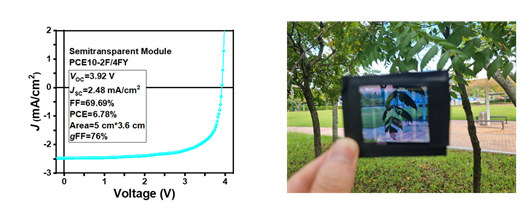 Efficiency of 18㎠ Large-Area Module Based on 4FY Receptor Molecules and the Corresponding Semi-Transparent Module.
When generating electricity by absorbing infrared light, the power conversion efficiency is typically lower than when absorbing high-energy visible light. The research team overcame this issue by newly designing the molecular structure of the acceptor in the photoactive layer. The photoactive layer of an organic solar cell consists of donor molecules, which provide electrons, and acceptor molecules, which receive electrons.
The "4FY" acceptor molecule synthesized by the research team has an overall symmetric A-D-A structure, but was designed to induce local asymmetric interactions between fluorine and hydrogen, and between fluorine and sulfur. This molecular structure improves the degree of molecular alignment and secures charge transport pathways, thereby increasing cell efficiency.
First author Sangjin Yang explained, "Asymmetry can increase cell efficiency, but it usually results in shorter lifespans and more difficult synthesis. By inducing local asymmetry within the molecular structure, we were able to combine the advantages of both symmetry and asymmetry."
The cell demonstrated high durability by maintaining most of its initial performance after undergoing a total of 134 hours of "diurnal cycle (circadian) stability testing" under simulated outdoor conditions that alternated between day and night. This represents an approximately 17-fold improvement in lifespan compared to previous semi-transparent solar cells based on Y6 acceptor molecules.
Professor Changdeok Yang stated, "We have presented a new type of solar cell that generates electricity from invisible light," adding, "This will help develop 'invisible power plants' in various environments, such as smartphone screen protectors, building windows, and transparent displays."
The results of this research were published on June 10 in the international journal Angewandte Chemie International Edition.
This research was supported by the National Research Foundation of Korea under the Ministry of Science and ICT, and by the Korea Institute of Energy Technology Evaluation and Planning under the Ministry of Trade, Industry and Energy.
© The Asia Business Daily(www.asiae.co.kr). All rights reserved.
![Clutching a Stolen Dior Bag, Saying "I Hate Being Poor but Real"... The Grotesque Con of a "Human Knockoff" [Slate]](https://cwcontent.asiae.co.kr/asiaresize/183/2026021902243444107_1771435474.jpg)
















