Special Inspection Completed for 350 km
Emergency Repairs Finished for Detected Cavities
District-Level Survey Results Also Made Public
The Seoul Metropolitan Government has released the survey sections and action results of its GPR (Ground Penetrating Radar) inspections in an effort to alleviate public anxiety over ground subsidence. Emergency repairs have been completed for all underground cavities discovered during the inspection process.
On June 15, the city announced the results of its special GPR inspections conducted over a 350-kilometer section from January to May, now available to the public as a 'GPR Survey Map.' Previously, following the ground subsidence incident in Myeongil-dong in March, GPR results were posted in the form of articles in the 'Safety Data Room' on the Seoul Safety Nuri platform. However, to make it easier for residents to check local information, the city has newly added the 'GPR Survey Map.' The main purpose is to allow anyone to easily check whether GPR surveys have been conducted in areas of interest and whether any underground cavities have been detected.
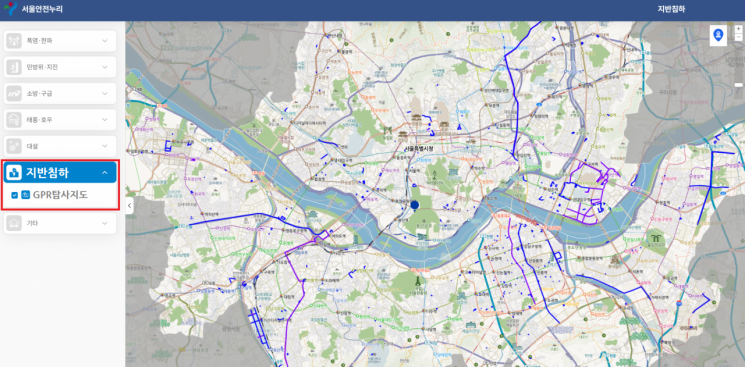 Seoul Safety Nuri usage screen showing the GPR (Ground Penetrating Radar) survey section and action results. Seoul City
The GPR survey sections are displayed as lines on the map, and by selecting a line, users can view detailed information such as the survey period and length. Survey results are color-coded: blue indicates sections where no cavities were found, while purple marks sections where cavities were detected. For detected cavities, users can also check details such as the exact location, size, and actions taken.
The initial release covers the results of the special GPR inspections conducted over the 350-kilometer section. The inspections prioritized areas needing urgent assessment to prevent ground subsidence accidents, including: five railway construction sites (Phase 4 of Line 9, Dongbuk Line, Yeongdong-daero, Shinansan Line, and GTX-A), 50 locations requested by district offices, and 309 excavation sites. Through these special inspections, a total of 63 underground cavities were discovered and emergency repairs were completed. Specifically, 33 cavities were addressed at railway construction sites (32 in the Shinansan Line section and one in the Dongbuk Line section), 12 at excavation sites, and 18 at locations requested by district offices.
To enhance public awareness of safety and trust in underground safety management, starting at the end of June, the map will also provide detailed information?including occurrence date, location, size, and on-site photos?when users select a ground subsidence point. In addition, a new feature will be added to allow users to check whether GPR surveys have been conducted at specific addresses via an 'address search' function on the map.
Going forward, the city plans to strengthen GPR surveys conducted at the district level, in addition to those led by the city, and will display the results on the 'GPR Survey Map.' For sites independently identified by district offices, the city and districts will share inspection costs on a one-to-one matching basis, with the city providing a total of 1.5 billion KRW in funding. Han Byungyong, Director of Disaster and Safety at the Seoul Metropolitan Government, stated, "We have decided to provide a GPR survey information service that anyone can easily access, reflecting our commitment to guaranteeing the public's right to know and managing underground safety more responsibly." He added, "Through thorough GPR inspections, we will not only prevent ground subsidence but also ensure the highest standards of safety management at underground excavation sites."
© The Asia Business Daily(www.asiae.co.kr). All rights reserved.
![Clutching a Stolen Dior Bag, Saying "I Hate Being Poor but Real"... The Grotesque Con of a "Human Knockoff" [Slate]](https://cwcontent.asiae.co.kr/asiaresize/183/2026021902243444107_1771435474.jpg)















