Impact of Rising Food Ingredient Prices Including Rice
Japanese School Lunch Cost Per Student at Around 2,700 Won
30% of Japanese Local Governments Have Introduced Free School Meals
Recently, as the prices of food ingredients in Japan, including rice, have risen sharply, this impact has reached elementary school lunches. Schools are finding it difficult to maintain the previous quality of meals within their existing budgets, leading to growing controversy over 'poor-quality school meals' as both the variety and quantity of side dishes decrease. On June 12, the Yomiuri Shimbun reported that, following controversy over the quality of meals at an elementary school in Fukuoka City, the Fukuoka City Board of Education announced plans to improve the situation.
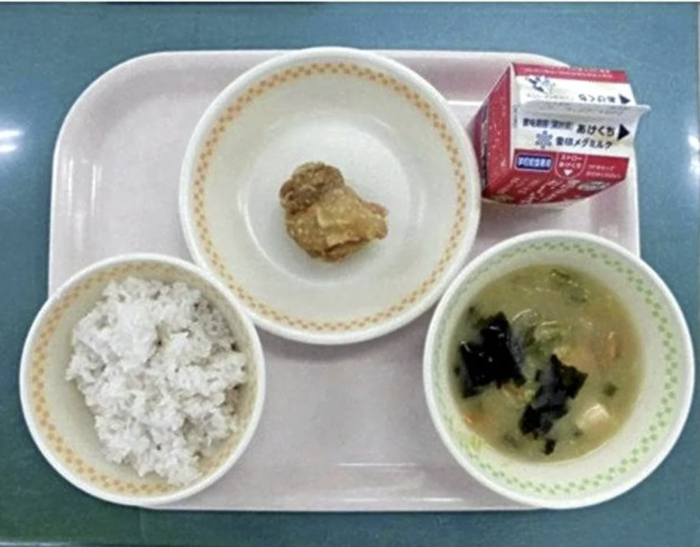
The problematic meal consisted of rice, miso soup, a single piece of fried chicken as a side dish, and a pack of milk for dessert. As photos of this meal spread on social media, criticism poured in, with comments such as "This is not just poor, it's extremely poor" and "This is insufficient for children who are still growing." In response, the education authorities took action. Fukuoka City, which is at the center of the controversy, is also moving to make school lunches completely free of charge for all municipal elementary and middle schools starting from the second semester. On June 11, Fukuoka Mayor Soichiro Takashima stated, "We want to turn this crisis into an opportunity and change school lunches into something children can look forward to and enjoy." He added that the city is considering increasing the school lunch budget, saying, "We will move away from the existing concept of school meals as merely efficient nutrition supply and instead provide food that children actually want to eat."
However, the controversy has not subsided, as photos of school lunches from other regions in Japan are also spreading on social media, sparking debate among parents and citizens. According to the Yomiuri Shimbun, the Fukuoka City Board of Education stated that "the necessary nutrition has been secured" regarding the controversial meal. They also explained, "The bowl was large, so the fried chicken appeared relatively small. We should have considered the appearance as well," further fueling the controversy. The fried chicken at the center of the debate was about 60 grams and 155 kilocalories per piece, which the Fukuoka City Board of Education says is equivalent to two typical pieces.
30% of Japanese Local Governments Provide Free School Meals... Some Cite Financial and Supply Limitations
Currently, unlike in South Korea, Japanese parents are responsible for a significant portion of school lunch costs at elementary, middle, and high schools, excluding facility, equipment, and labor costs. For students from low-income families, such as those receiving welfare, local governments or the central government provide full support. However, in recent years, some local governments have begun offering free school meals using their own budgets. As of 2024, about 30% of local governments across Japan provide free school meals at the primary and secondary school level, but in most regions, parents are still required to pay.
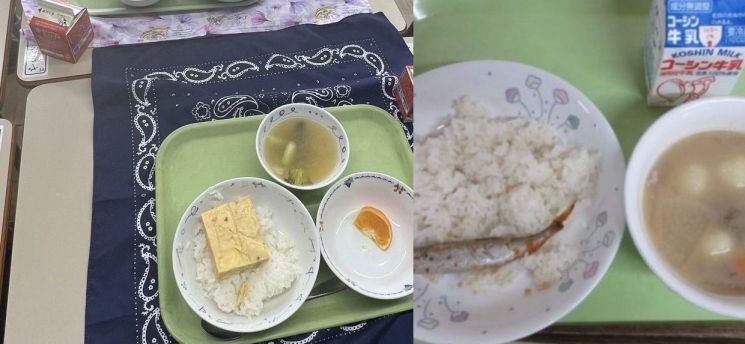 A photo of school lunch provided at a Japanese elementary school has spread on social media, sparking controversy. X (X)
In this context, the recent issues with school meals in Japan are largely due to the sharp rise in ingredient costs caused by inflation. According to the Fukuoka City Board of Education, the per capita school lunch cost this year is 289.47 yen (about 2,700 won), which is approximately 20% higher than the 243.15 yen (about 2,300 won) in 2015, ten years ago. However, the monthly lunch fees collected from parents have remained unchanged for ten years at 4,200 yen (about 40,000 won) for elementary schools and 5,000 yen (about 47,000 won) for middle schools. The city is covering the shortfall with public funds, and this year's subsidy amounts to about 1.2 billion yen (about 11.3 billion won), which is roughly three times higher than three years ago. The main reasons why the per capita cost of school lunches in Japan cannot be sufficiently increased include the limits on what parents can afford and budget constraints faced by local and central governments.
Meanwhile, regarding these issues, the Japanese government announced in February that the ruling Liberal Democratic Party, Komeito, and Japan Innovation Party had agreed to implement free school lunches at elementary schools starting in 2026 and to expand this to middle schools as soon as possible. As a result, the push for free school meals is gaining momentum. However, some local governments are reluctant due to financial conditions and supply capacity limitations. The Asahi Shimbun reported, "Local governments are struggling to balance maintaining the quality of school lunches with reducing the financial burden on parents, and there is an urgent need for the central government to establish a nationwide free meal system."
© The Asia Business Daily(www.asiae.co.kr). All rights reserved.
![Clutching a Stolen Dior Bag, Saying "I Hate Being Poor but Real"... The Grotesque Con of a "Human Knockoff" [Slate]](https://cwcontent.asiae.co.kr/asiaresize/183/2026021902243444107_1771435474.jpg)
















