The Path to a Just Transition
I. The Conflicts Brought by Energy Transition
Offshore Wind Farm Project in Tongyeong, Gyeongnam
Fishers Oppose Wind Turbine Installation in "Golden Fishing Grounds"
There are lives that have never left the sea. Lee Hyungmae (56, female) grew up near Saryangdo, Tongyeong City, Gyeongnam Province, with a father who was a fisherman. She later married a man who catches octopus near Yokjido, Tongyeong. Her husband has been fishing for octopus for 30 years. For over 10 years, Lee has joined her husband in octopus fishing. Unless there is a storm, she goes out to sea every day to catch octopus. It is impossible to describe Lee's life without the sea of Tongyeong.
Recently, Lee has become increasingly worried that her home might disappear every time she looks at the sea. This is due to the offshore wind turbines planned for the lower left coast of Yokjido, Tongyeong. Unfortunately, this is exactly where she mainly fishes for octopus. According to Lee, octopus are extremely sensitive creatures, so not only will their habitat disappear, but it will also be difficult to find alternative fishing grounds. Lee said, "As a fisher, there is no room for compromise regarding the installation of offshore wind turbines," adding, "because our livelihood is at stake."
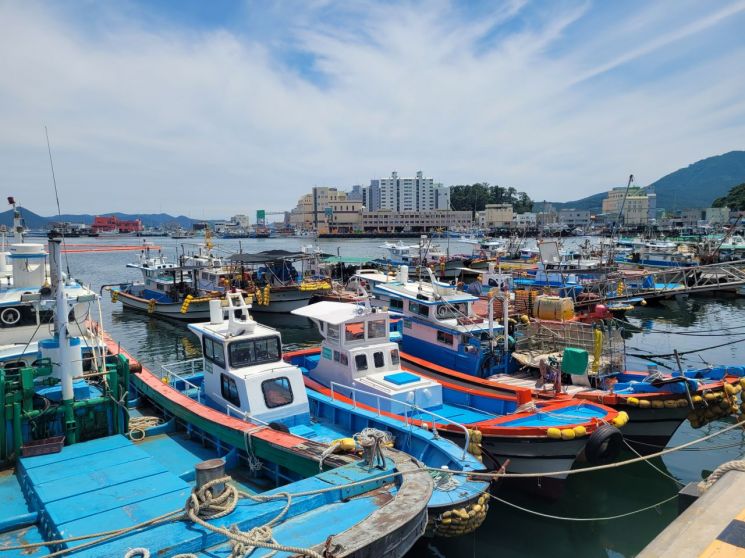 On the 11th of last month, anchovy fishing boats gathered off the coast of Jeongryangdong, Tongyeong City. Every year, from April to June is the closed season for anchovy fishing. Photo by Gong Byungseon
Conflicts are intensifying between fishers, local governments, and companies over the Yokjido offshore wind power project in Tongyeong, which is being promoted in the name of combating climate change and developing renewable energy. Fishers oppose the installation of offshore wind turbines along the Yokjido coast, arguing that it could destroy their livelihoods. However, local governments and companies claim that the wind turbines will not significantly affect the fishers' livelihoods, and they warn that any delay in the transition to renewable energy could result in substantial national losses.
The Yokjido offshore wind power project involves five companies?Hyundai Engineering & Construction, Korea South-East Power, IS Dongseo, Yeongdong Power, and Yokji Wind Power?with the goal of installing offshore wind turbines by 2032. The location spans from the lower left coast of Yokjido to Jwasarido. This area is known for its strong winds and gently sloping seabed, which allows for high energy output at a relatively low installation cost.
However, fishers are demanding that the offshore wind turbines be relocated. They do not oppose the introduction of wind energy facilities themselves, but their concerns about losing their livelihoods have not been addressed. The area targeted by the Yokjido offshore wind power project is known among local fishers as a "golden fishing ground." Not only small fish like anchovies but also mackerel, butterfish, octopus, and Nakji are caught here. Fishers explain that the gently sloping seabed supports abundant marine life, and the plentiful food ensures a balanced food chain.
Choi Piljong, head of the Anchovy Purse Seine Cooperative, said, "If offshore wind turbines are installed, ocean currents could change, and anchovies, which are pelagic fish, might no longer pass through here. If anchovies are not caught here, it could become difficult to see anchovies on the dining table." As of 2023, Tongyeong accounted for 55,162 tons of anchovy catch, about 42% of the national total of 132,000 tons.
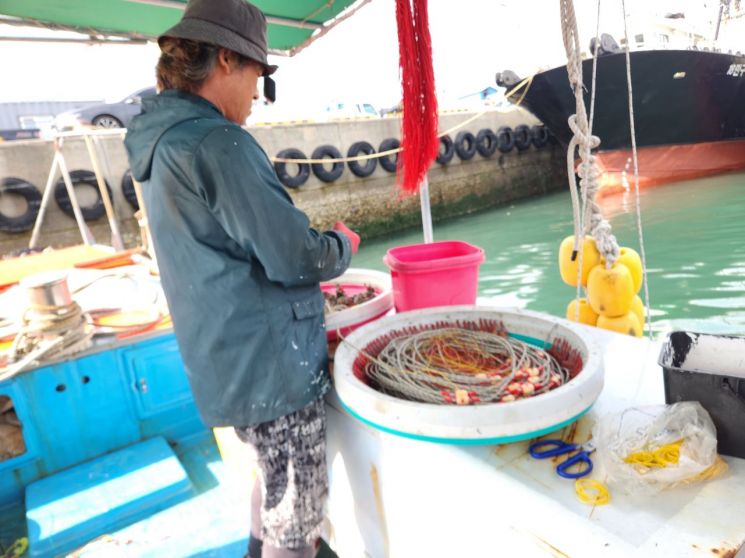 Lee Hyungmae (56, female) is preparing the jig for catching octopus. She has been fishing for octopus with her husband for over 10 years in the waters near Yokjido, Tongyeong City, Gyeongnam Province. She expressed concern that if offshore wind turbines are installed in the Yokjido sea, their livelihood could be disrupted. Photo by Lee Hyungmae
The local government maintains that it is difficult to find a more suitable location than this one, given the site conditions. Offshore wind turbines must be installed in waters no deeper than 50 meters, and the average wind speed must be at least 6 meters per second. The left coast of Yokjido is the only area that meets all these requirements. An official from Gyeongnam Province acknowledged the fishers' opposition but said, "We considered other areas, but there is not enough wind behind Yokjido or near the Samcheonpo Thermal Power Plant in Goseong County, Gyeongnam. Excluding marine national parks and military training zones, the only remaining area is the lower left coast of Yokjido." The official added that this decision also considered regional development. "Companies such as Doosan Enerbility, which manufacture wind turbine turbines, are based in Gyeongnam. We intend to carry out the offshore wind turbine project in connection with local industries," the official said.
Companies are frustrated and anxious that opposition from fishers could cause repeated delays to the offshore wind turbine project. Hyundai Engineering & Construction, which is leading the Yokji Jwasarido Coastal Wind Power Project, stated that the project is urgent in terms of responding to carbon neutrality and creating new business opportunities. A Hyundai E&C representative said, "The Yokji Jwasarido coast has consistently strong sea winds averaging over 7.5 meters per second, and unlike other seas, it is less affected by military operations. South Korea has a low proportion of renewable energy and a high dependence on energy imports, so expanding offshore wind power is essential."
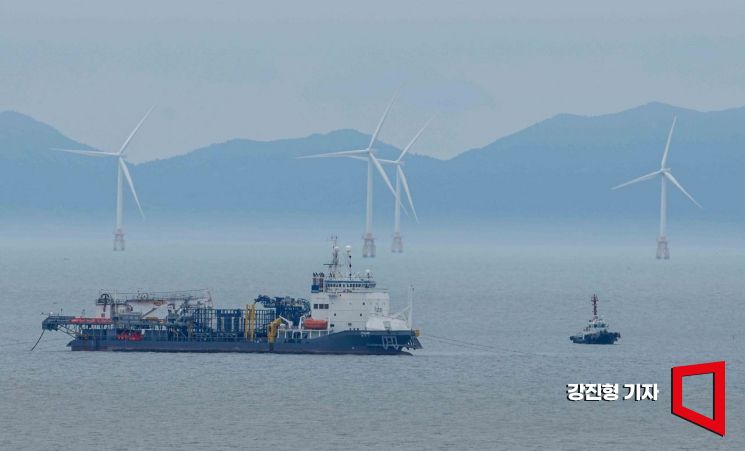 Windsong Wind Power Complex as seen from Baeksu Coastal Road, Yeonggwang County, Jeollanam-do. Photo by Hyung Kangjin
Yeonggwang fishing villages face similar conflicts as Tongyeong...Hopeful examples of successful resolution
The Yokjido offshore wind power project, which is losing momentum due to conflict, has much in common with the past of Yeonggwang, Jeonnam, which has emerged as a hub for renewable energy. During the process of attracting new wind power complexes such as Hanbit and Nakwol, following the currently operating Yaksu Offshore Wind Power Complex, Yeonggwang County experienced similar issues to those of Tongyeong City.
Last year, the Yeonggwang County Fishers' Association held a rally demanding the cancellation of the Nakwol Offshore Wind Power Complex, scheduled for completion next year. Their concern was that the construction of the offshore wind power complex would reduce their fishing grounds and threaten their livelihoods. In January last year, the Fishers' Association blocked the car of former Yeonggwang County Governor Kang Jongman, who was on his way to an outside event, and occupied the county office in protest.
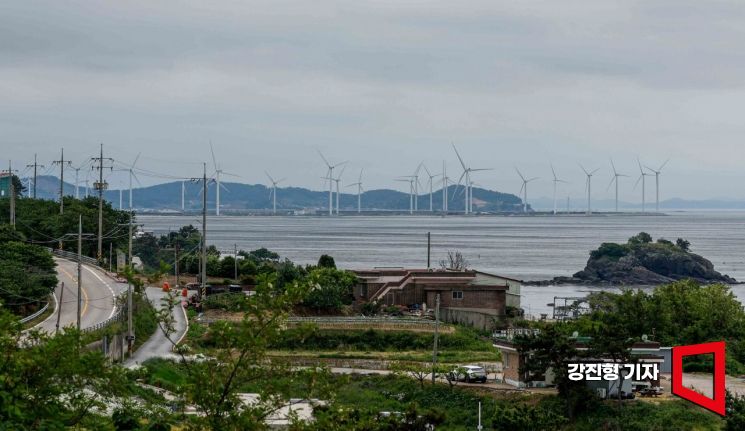 Windsong Wind Power Complex as seen from Baeksu Coastal Road, Yeonggwang County, Jeollanam-do. Photo by Jin Hyung Kang
However, Yeonggwang County and the Fishers' Association were able to reach an agreement through open dialogue at the negotiating table. Yeonggwang County lowered the barriers so that representatives from the power generation company, fishers, and local government (administration) could all participate in negotiations. Compensation ranges are being determined based on assessment surveys that all parties can agree upon. On July 3, Yeonggwang County held a meeting with the Integrated Committee of Fishers, and plans to hold official discussions with stakeholders such as power generation companies, representatives of fishers, and the fishing vessel coalition.
Jang Seil, the newly appointed governor of Yeonggwang County, proposed a plan to ensure that the benefits of offshore wind power are shared by all county residents. The renewable energy profit-sharing system promoted by Yeonggwang County is a basic income model in which residents share profits generated from renewable energy, including offshore wind power. If residents feel that renewable energy contributes to their daily lives, public opinion on energy transition policies will also become more positive.
Yeonggwang County is at the forefront of a successful transition to renewable energy, expanding offshore wind power complexes while also pursuing solar power projects. From the outset, the projects have been resident-participatory, eliminating sources of conflict with local residents. Recently, a cooperative was established, and residents of Wolpyeong Village, Yeomsan-myeon, won a public bid for an "agrivoltaic" project. Solar panels were installed on 3,000 pyeong (approximately 9,900 square meters) of rice paddies, enabling residents to earn profits from both rice cultivation and solar energy. Once the project is fully operational, 28 households will be able to earn a steady monthly profit of 100,000 to 150,000 won. Kang Jongoh, director of the Wolpyeong Solar Power Cooperative, said, "Most of the village residents are in their 70s or 80s. It is becoming increasingly difficult for them to focus solely on farming," adding, "We realized that renewable energy could be a new opportunity."
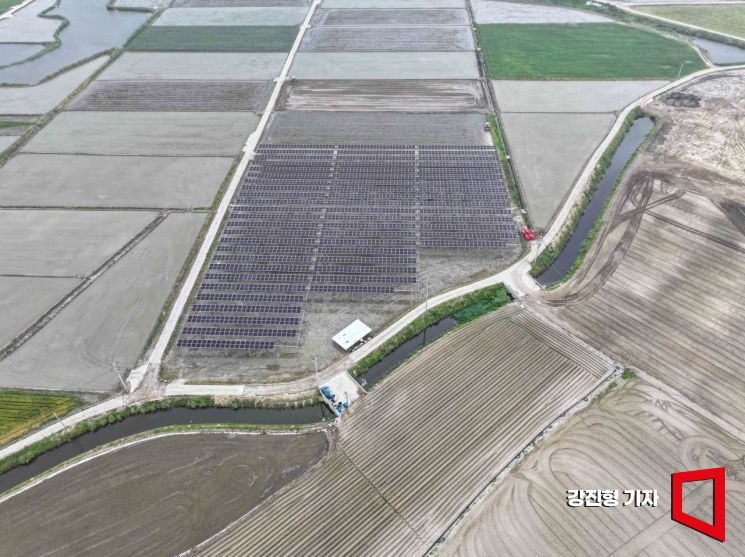 Agrivoltaic power plant installed on farmland in Wolpyeong-eup, Yeomsan-myeon, Yeonggwang-gun, Jeollanam-do. Photo by Kang Jinhyung
This feature was supported by the Press Promotion Fund, created with government advertising fees.
© The Asia Business Daily(www.asiae.co.kr). All rights reserved.
![Clutching a Stolen Dior Bag, Saying "I Hate Being Poor but Real"... The Grotesque Con of a "Human Knockoff" [Slate]](https://cwcontent.asiae.co.kr/asiaresize/183/2026021902243444107_1771435474.jpg)


















