Blocking Secondary Wildfire Damage at the Source
Preemptive Response Including Emergency Restoration
Yeongdeok County in North Gyeongsang Province has established a comprehensive safety plan to prepare for summer weather anomalies such as heavy rain, typhoons, and heat waves, and will operate a full-scale response system through October.
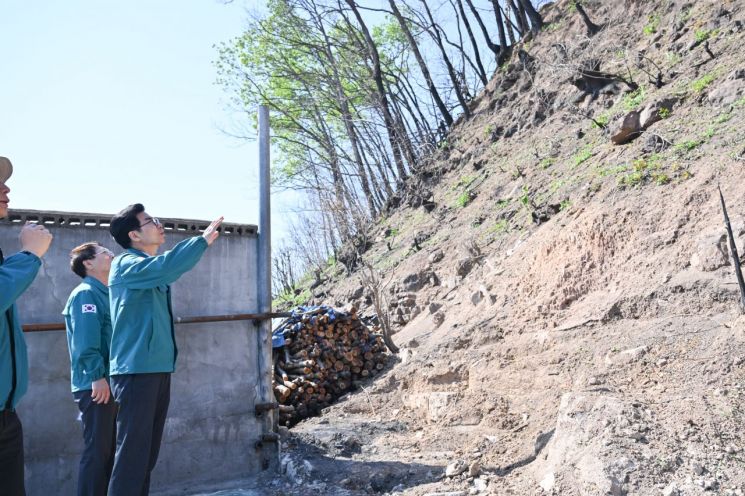 Kim Kwangyeol, the governor of Yeongdeok County, is inspecting a landslide risk area at the end of April. Photo by Yeongdeok County
According to the Korea Meteorological Administration, this summer is expected to see intensified abnormal weather conditions, with nationwide precipitation levels exceeding the annual average due to atmospheric instability and low pressure systems, and an increased frequency of "extreme heavy rain" events with more than 100 mm of rainfall per hour.
In response, Kim Kwangyeol, the governor of Yeongdeok County, will hold a comprehensive safety plan meeting in each of the county's nine towns and townships from June 16 to June 20. These meetings will include the heads of each town and township, relevant department heads, and the village heads' council to establish area-specific natural disaster response plans and set up clear role assignments and collaboration systems for effective implementation.
Previously, Yeongdeok County designated the period from May 15 to October 15 as the "summer disaster response period," during which it conducted monitoring and inspections of 18 locations at risk of casualties and 18 areas designated as extreme wildfire danger zones. In addition, a comprehensive inspection was carried out in low-lying areas that have repeatedly suffered from flooding.
In particular, to prevent secondary damage from the large wildfire that occurred at the end of March, a detailed full-scale survey was conducted from April 23 to April 25 in the main wildfire-affected areas of Yeongdeok-eup, Chuksan-myeon, and Jipum-myeon. As a result, 1,860 burned trees posing an accident risk were removed, and emergency restoration was completed in eight landslide-prone areas near residential neighborhoods.
The detailed measures in Yeongdeok County's summer disaster response plan this year include: pre-inspection and assignment of professional personnel for four stormwater retention facilities, ten drainage pump stations, and 99 steep slope sites; safety inspections of 99 steep slopes during the rainy season; installation and operation of large water pumps in flood-prone low-lying areas; preparation of sandbags to prevent river flooding and overflow; installation of flood barriers in homes to prevent residential flooding; promotion and encouragement of storm and flood insurance enrollment; development of customized heatwave countermeasures by target group and sector; and establishment of a resident-participatory evacuation system.
Yeongdeok County maintains a real-time joint management system involving the governor, deputy governor, and department heads to ensure effective disaster response and minimize damage in the event of a disaster. The county also plans to expand rapid information delivery through emergency disaster text alerts and village broadcasting systems.
Additionally, through the resident-participatory evacuation system, a "village patrol team" has been organized in 204 villages, comprising a total of 827 members including village heads, the autonomous disaster prevention team, volunteer fire brigades, and women's associations. These teams will guide evacuation routes, monitor hazards, and assist residents in evacuating during emergencies.
Furthermore, considering the increasingly severe heatwaves and the high proportion of elderly residents, a heatwave response task force team will operate from May to September. The county will inspect and operate 36 fixed shade canopies, install 15 additional smart shade canopies, keep 28 cooling centers open 24 hours, and immediately deploy water-spraying vehicles to main roads when heatwave advisories are issued.
In addition, from June to September, Yeongdeok County has designated a water safety management period, during which safety personnel will be stationed at 11 rivers and beaches to prevent water-related accidents. Special measures will also be implemented, such as operating a situation management team during the summer vacation and peak holiday season to further prevent water safety accidents.
Governor Kim Kwangyeol stated, "Due to recent climate change, abnormal weather is becoming more frequent, so we are building a more thorough and effective response system to prepare for any eventuality. We will remain vigilant and respond thoroughly to ensure that the safety and property of county residents are not threatened by unexpected disasters and accidents."
© The Asia Business Daily(www.asiae.co.kr). All rights reserved.
![Clutching a Stolen Dior Bag, Saying "I Hate Being Poor but Real"... The Grotesque Con of a "Human Knockoff" [Slate]](https://cwcontent.asiae.co.kr/asiaresize/183/2026021902243444107_1771435474.jpg)















