Hundreds of Ceramic Jars, Pots, and Iron Bars Detected
Advancements in Exploration Technology Lead to Surge in Shipwreck Discoveries Worldwide
The remains of a 16th-century Italian merchant ship were discovered beneath the French sea at a depth of 2,500 meters. On June 12 (local time), Yonhap News, citing the French daily Le Monde, reported that the French Navy discovered the wreckage of the sunken ship during an underwater exploration training exercise near the Gulf of Saint-Tropez in southern France on March 4.
The French Navy detected an abnormal signal at a depth of 2,500 meters using an underwater sonar device and subsequently deployed an underwater camera, which confirmed the silhouette of a wreck measuring 30 meters in length and 7 meters in width. The Navy then deployed a remotely operated robot, and ultra-high-resolution footage captured the ship’s anchors and cannons, hundreds of ceramic jars, iron bars, and more.
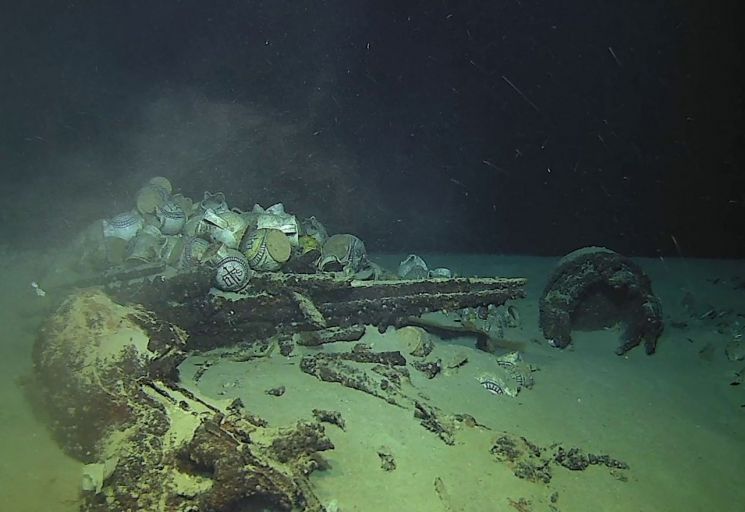 The remains of a 16th-century Italian merchant ship were discovered under the French sea at a depth of 2500 meters. Photo by AFP and Yonhap News
The Navy immediately notified the Department of Underwater Archaeological Research under the French Ministry of Culture. According to the department’s investigation, the ship was identified as a 16th-century merchant vessel that likely departed from a port in northern Italy and sank off the coast of France. This is the deepest shipwreck ever discovered in waters under French jurisdiction. However, authorities decided not to carry out excavation work due to concerns about damaging the hull. Arnaud Chomas, head of the department, said, "We believe that the next generation will be able to conduct better work with less energy and cost, while minimizing damage to the site." The current goal of the authorities is to create a 3D digital replica of the wreck with technical support from the Navy. Afterwards, a team of experts from various fields?including historians, geologists, archaeologists, and ceramics specialists?will be formed to reconstruct the ship’s history.
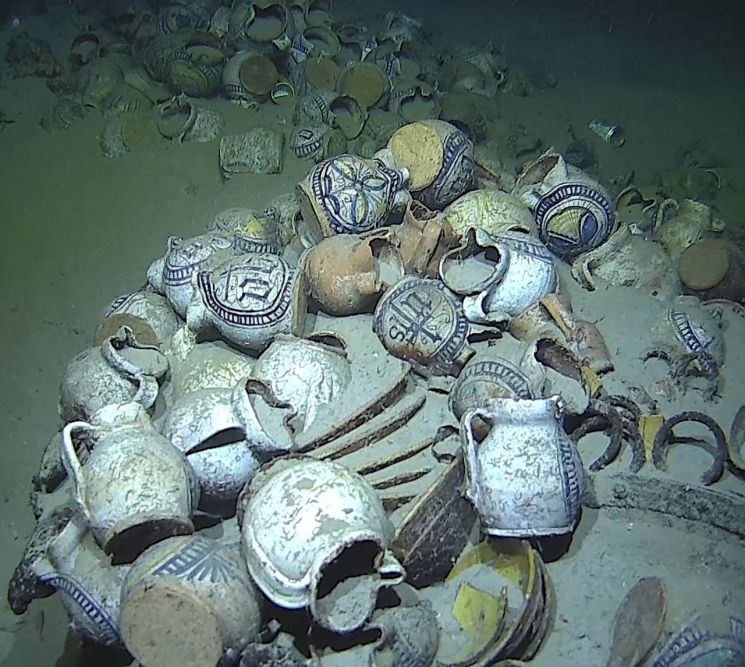 Anchors and cannons of the ship, hundreds of ceramic jars, iron bars, and more were captured on screen. Photo by AFP and Yonhap News
Meanwhile, advances in underwater exploration technology are leading to the discovery of shipwrecks around the world. The private organization 'World Ocean Shipwreck Database' estimates that approximately 250,000 ships have sunk in the world’s seas and lakes. Of these, about one quarter are classified as "missing ships" with unknown sinking locations. As technologies related to underwater exploration?such as underwater cameras and sonar detectors?continue to advance, legendary shipwrecks like the San Jose are also expected to be uncovered.
Furthermore, as private companies join in underwater exploration, the long-held scientific dream of creating a "complete map of the Earth’s seafloor" is said to be within reach. The US National Oceanic and Atmospheric Administration (NOAA) is strengthening cooperation with related organizations for seafloor mapping, underwater exploration, and research. Nonprofit research organizations such as the Schmidt Ocean Institute, founded by former Google CEO Eric Schmidt and his wife, and the Ocean Exploration Trust, established by Robert Ballard, who led the 1985 expedition that discovered the Titanic, have partnered with NOAA.
© The Asia Business Daily(www.asiae.co.kr). All rights reserved.
![Clutching a Stolen Dior Bag, Saying "I Hate Being Poor but Real"... The Grotesque Con of a "Human Knockoff" [Slate]](https://cwcontent.asiae.co.kr/asiaresize/183/2026021902243444107_1771435474.jpg)
















