As the passage of the Commercial Act amendment bill, a topic of intense market interest, has been postponed in the National Assembly’s plenary session, some experts point out that attention should focus more on the specific provisions to be included in the amendment rather than the timing of its passage. There is analysis suggesting that provisions under consideration, such as the mandatory cumulative voting system and the "3% rule," could increase the influence of foreign institutional investors on domestic companies.
Kim Jongyoung, a researcher at NH Investment & Securities, stated on the 13th, "Since the Commercial Act amendment is a core government initiative, it is highly likely to pass the plenary session in the near future," adding, "The specific provisions included in the amendment will likely have a greater impact on the market than the timing of its passage." Previously, the Democratic Party of Korea postponed the plenary session originally scheduled for the 12th until after the election of new floor leadership.
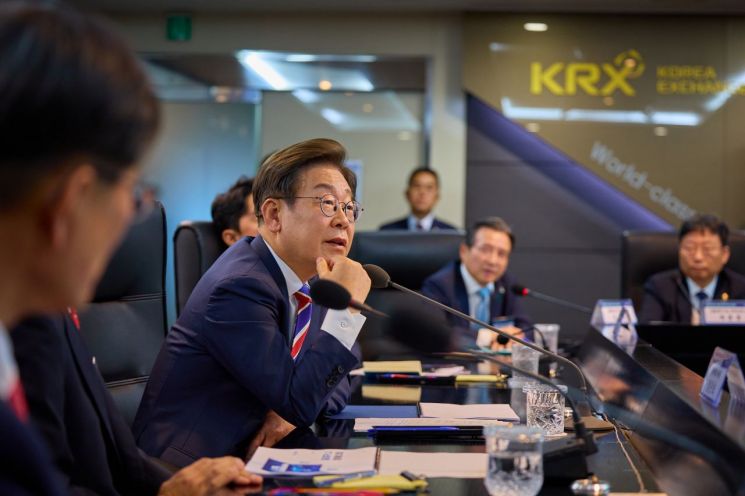 President Lee Jae Myung visited the Korea Exchange Integrated Control Center in Yeongdeungpo-gu, Seoul, on the 11th to receive a briefing on the stock market conditions and market surveillance system. Photo by Yonhap News
The main framework of the Commercial Act amendment is to expand the fiduciary duty of directors from the current "company" to "company and shareholders." However, Kim paid particular attention to the potential inclusion of mandatory cumulative voting and the expansion of the number of audit committee members subject to the "3% rule." This is because both systems have their own advantages and disadvantages.
First, the cumulative voting system allows shareholders to allocate all their voting rights for the number of directors to be elected to specific candidates. For example, a shareholder with one share who is electing three directors would have three votes. These three votes can be concentrated on a single candidate or distributed among several candidates, enabling minority shareholders to counterbalance a board dominated by major shareholders.
Kim explained, "If this system is introduced, it could help enhance corporate value by strengthening the rights of minority shareholders and invigorating activist funds." However, he also noted, "As a side effect, companies may have to spend more to defend management rights, which could weaken their long-term growth drivers."
The "3% rule" limits the combined voting rights that the largest shareholder and related parties can exercise in electing audit committee members to 3%. Under the current system, only one separately elected audit committee member is required, allowing the largest shareholder to bypass the rule through equity splitting. The new amendment proposes to increase the number of separately elected audit committee members from one to two or more, and to apply the "3% rule" to all of them.
Kim stated, "According to a November 2024 announcement by the Korea Chamber of Commerce and Industry, if the 3% rule is applied to companies belonging to holding company groups among listed firms with assets exceeding 2 trillion won, the internal shareholding ratio (holding company + related parties + affiliates) would plummet from an average of 48.7% to 5.1%, while the external shareholding ratio would only slightly decrease from 49.7% to 45.4%." He added, "The influence of external shareholders is therefore expected to increase significantly."
If these two provisions are included in the final amendment, they could serve as upward momentum for the market in the short term. However, in the medium to long term, both positive effects, such as the expansion of minority shareholder rights, and negative effects, such as increased costs for defending management rights and more conservative decision-making by management, are expected to appear simultaneously.
© The Asia Business Daily(www.asiae.co.kr). All rights reserved.
![Clutching a Stolen Dior Bag, Saying "I Hate Being Poor but Real"... The Grotesque Con of a "Human Knockoff" [Slate]](https://cwcontent.asiae.co.kr/asiaresize/183/2026021902243444107_1771435474.jpg)















