Police: "Meticulously Planned the Crime After Failing Military Enlistment"
Quick Response by Police and School Minimizes Casualties
The suspect in the mass shooting at an Austrian high school was found to have been deeply immersed in first-person shooter (FPS) games, while being isolated from the outside world. On June 12 (local time), Yonhap News, citing foreign media outlets such as the Associated Press, reported that Michael Loneger, head of the Criminal Investigation Department of Styria, said at a press conference that day, "The suspect led an extremely reclusive life and did not attempt to participate in the everyday activities of the real world." He added, "He preferred spending time in virtual spaces over the real world and was absorbed in first-person shooter games."
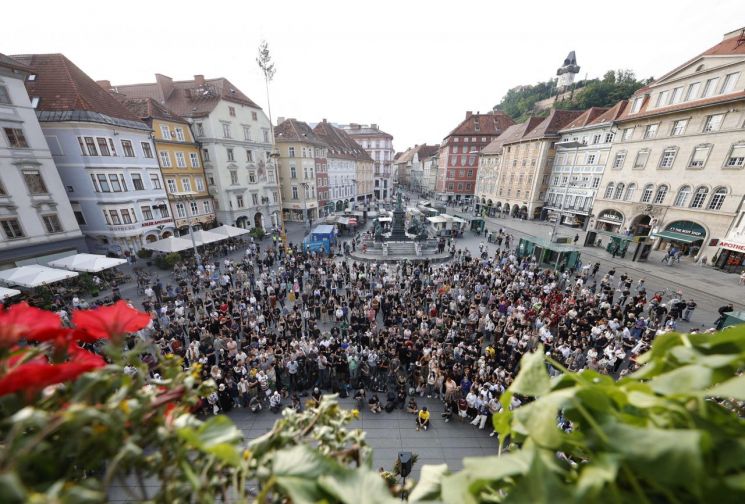 On the 11th, a memorial event for the victims of the school shooting was held at a central square in Graz, southeastern Austria. Photo by AFP and Yonhap News
Previously, on June 10, the 21-year-old suspect broke into a high school in Graz, southeastern Austria, where he had formerly been a student, and carried out an indiscriminate shooting, killing 10 people, including students and staff, before taking his own life. This incident resulted in the highest number of casualties in a school shooting in Austria's history. According to the police, he had failed the 10th grade twice at this school before dropping out, and later attempted to enlist in the military but was rejected during the psychological evaluation. However, he subsequently passed the psychological assessment required for a civilian firearms license and legally purchased a handgun and a shotgun between April and May.
As a result, the Ministry of the Interior has launched an investigation to determine whether there were any issues in the psychological evaluation process. Loneger stated, "Most of the victims had no personal connection to the suspect. Only one deceased teacher knew him, but no direct link to the motive has been established." Some local media outlets have raised the possibility that the suspect committed the crime out of resentment over being bullied at school. However, Loneger maintained a cautious stance, saying, "There is no evidence that he expressed anger or dissatisfaction toward the school, students, or staff."
The police believe that this incident was meticulously planned in advance. The suspect had been training at a shooting range since March, and a bomb plot plan and pipe bombs were found at his home. Furthermore, police reported that a note discovered at his residence contained an apology to his mother, but did not provide any direct clues regarding his motive.
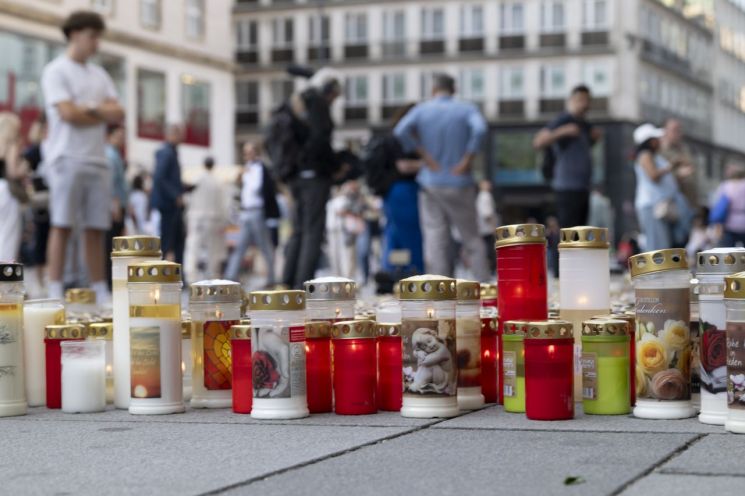 Memorials for the victims are taking place throughout the streets of Austria. Photo by EPA Yonhap News
The New York Times reported that the swift response by Austrian police and the school has been praised by the public. The first patrol car arrived at the scene just six minutes after the initial report from a resident, and two minutes later, about 50 members of the special unit COBRA entered the school immediately. Austrian police adopted a tactic of entering the scene upon arrival, based on analysis of cases in the United States and other countries. This approach was implemented in response to criticism after the 2018 shooting at Marjory Stoneman Douglas High School in Parkland, Florida, where police hesitated outside the school for some time instead of entering immediately, resulting in the deaths of 17 people. In addition, the school's emergency response training proved effective. Norbert Urabl, the vice principal of the high school where the incident occurred, explained, "Many teachers and students responded calmly. They locked the doors, and for doors that could not be locked, they built barricades with desks and other objects."
© The Asia Business Daily(www.asiae.co.kr). All rights reserved.
![Clutching a Stolen Dior Bag, Saying "I Hate Being Poor but Real"... The Grotesque Con of a "Human Knockoff" [Slate]](https://cwcontent.asiae.co.kr/asiaresize/183/2026021902243444107_1771435474.jpg)
















