Producer Price Index Rises Only 0.1% in May
Oracle Surges 13.3% on Strong Earnings, Boeing Drops 4.8%
Trade Uncertainty Limits Market Gains
Trump: "Letters to Be Sent to Trading Partners Within Two Weeks"
Continuing Jobless Claims Hit Highest Level in Three and a Half Years
All three major indexes on the New York Stock Exchange closed higher on June 12 (local time). The market was buoyed by a decline in wholesale prices, which eased concerns over inflation, while large-cap tech stocks, led by Oracle, drove the market's gains.
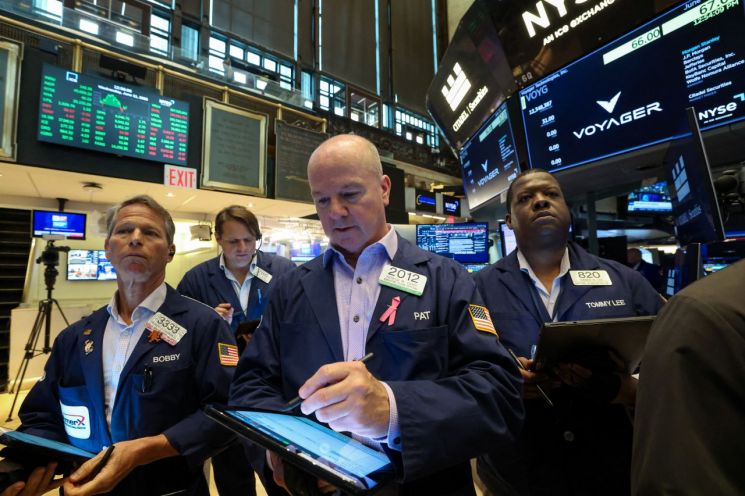
On this day, the Dow Jones Industrial Average, which is focused on blue-chip stocks, rose 101.85 points (0.24%) to close at 42,967.62. The S&P 500, which tracks large-cap stocks, gained 23.02 points (0.38%) to end at 6,045.26, while the tech-heavy Nasdaq climbed 46.61 points (0.24%) to finish at 19,662.49.
By stock, Oracle, which reported a surprise earnings result the previous day, soared 13.31%. The company announced better-than-expected results for the fourth quarter of its fiscal year 2025 (March 2025 to May 2025) and projected further expansion in cloud growth. Oracle CEO Safra Catz said during a conference call that, due to increasing demand for artificial intelligence (AI), cloud infrastructure revenue in fiscal year 2026 is expected to grow by more than 70%. This far exceeds the previous quarter's growth rate of 52%. Nvidia and Microsoft rose 1.52% and 1.32%, respectively. Meanwhile, Boeing shares plunged 4.81% following news of an Air India passenger plane crash en route from India to London. The aircraft involved was a Boeing 787 Dreamliner.
Favorable inflation data also supported investor sentiment. According to the U.S. Department of Labor, the Producer Price Index (PPI) rose by just 0.1% in May compared to the previous month. While this marked a turnaround from April's 0.2% decline, it still fell short of market expectations of a 0.2% increase. As a result, the PPI, often referred to as wholesale inflation, continued its trend of slowing for the fourth consecutive month. Both goods and services prices saw only slight increases, indicating that the impact of President Donald Trump's tariffs was limited. The Consumer Price Index (CPI) for May, released the previous day, also rose 2.4% year-on-year, below expectations of 2.5%.
Chris Zaccarelli, Chief Investment Officer (CIO) at Northlight Asset Management, said, "With inflation indicators coming in below expectations for two consecutive days, the Federal Reserve now has room to take a wait-and-see approach. As long as inflation does not rise, or preferably declines, the Fed can patiently observe and wait for additional information to see how new tariffs and trade negotiations will affect price stability."
With inflationary pressures easing, expectations for rate hikes have increased, leading to a decline in Treasury yields. The yield on the U.S. 10-year Treasury note, the global benchmark for bond yields, fell by 5 basis points (1bp=0.01 percentage point) from the previous day to 4.35%. The yield on the 2-year Treasury note, which is sensitive to monetary policy, dropped by 3 basis points to 3.9%.
The labor market showed signs of cooling. According to the U.S. Department of Labor, the number of continuing jobless claims?those claiming unemployment benefits for at least two consecutive weeks?stood at 1,956,000 for the week of May 25-31. This is the highest level in three and a half years, since November 2021. The figure exceeded both the previous week's revised number (1,902,000) and market expectations (1,910,000). This suggests that it is taking longer for the unemployed to find new jobs. Initial jobless claims for the week of June 1-7 totaled 248,000, matching the previous week's figure and surpassing the forecast of 242,000.
Trade uncertainty also limited the market's gains. The previous day, President Trump said that it was "probably unnecessary" to extend the mutual tariff suspension set to expire on July 8, adding, "At a certain point, we will send letters to our trading partners." He continued, "We are negotiating with Japan, South Korea, and several other countries. Within a week and a half or two weeks, I will send letters to each country explaining the terms of the agreement, just as I did with the European Union (EU)."
The market is also awaiting the official results of the U.S.-China trade talks held in London, UK, on June 9-10. President Trump stated the previous day that the trade negotiations between the two countries had been completed. China agreed to resume rare earth supplies to the U.S., while the U.S. agreed to ease restrictions on Chinese students entering American universities. However, the leaders of both countries have yet to give final approval to these agreements.
Tom Hainlin, senior investment strategist at US Bank Asset Management Group, said, "We remain in a baseline scenario of uncertainty regarding the progress of trade negotiations. While the market is showing volatility across a wide range, it will be difficult to find a sustained breakthrough until a conclusion is reached."
© The Asia Business Daily(www.asiae.co.kr). All rights reserved.

















