Estimated Usage of Illegal Drugs Continues to Decline, According to Ministry of Food and Drug Safety
Higher Levels Found in Foreign Resident Concentrated Areas Such as Incheon and Siwha, Gyeonggi Province
Scope of Analysis to Expand from 15 to About 200 Substances This Year
Analysis of residual drugs from samples collected at sewage treatment plants nationwide has shown that the estimated usage of illegal drugs such as methamphetamine (Philopon), amphetamine, MDMA (Ecstasy), and cocaine has continued to decline. Starting this year, the scope of the analysis will be significantly expanded to include about 200 substances, covering both medical narcotics and new types of drugs, thereby strengthening the investigation.
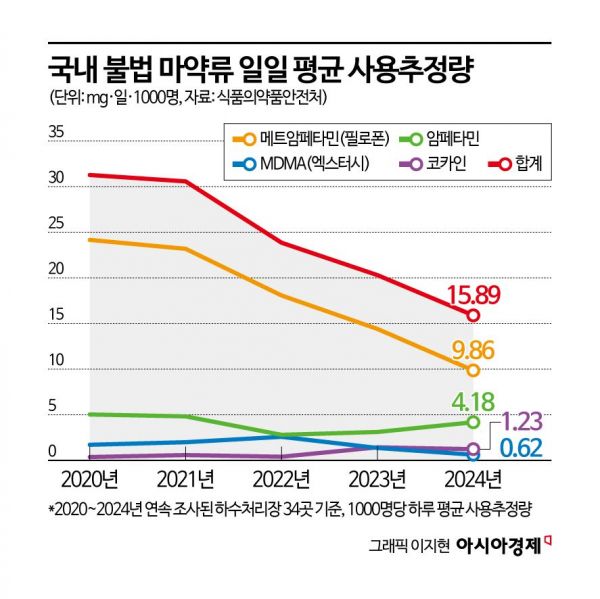
The Ministry of Food and Drug Safety announced on June 12 the results of a wastewater-based epidemiological survey on illegal drug usage, conducted over the past five years by collecting and analyzing samples from 34 sewage treatment plants nationwide.
Wastewater-based epidemiology involves collecting samples from sewage treatment plants to analyze the types and quantities of residual drugs, and estimating per capita drug usage by considering sewage flow and the population of the catchment area. This method allows authorities to assess the actual use of drugs beyond what is detected by law enforcement agencies, and similar approaches are used in Europe and Australia. This study was conducted over five years by a research team from the Department of Environmental Engineering at Pusan National University.
As a result, the combined estimated usage of the five major illegal drugs decreased for four consecutive years, from a daily average of 31.27 mg per 1,000 people in 2020 to 30.57 mg in 2021, 23.85 mg in 2022, 20.30 mg in 2023, and 15.89 mg last year. In particular, although Philopon was detected in all sewage treatment plants every year, its estimated usage last year was 9.86 mg, a 59% decrease compared to 24.16 mg in 2020. According to the Ministry of Food and Drug Safety, this is a significantly lower level compared to countries such as the United States. The estimated usage of Ecstasy began to decline in 2022, and the estimated usage of cocaine started to decrease last year.
In particular, analysis of estimated usage by region showed that Philopon was used relatively more in Incheon and Siwha in Gyeonggi Province. In 12 sewage treatment plants located in areas with a high concentration of foreigners, which were additionally surveyed last year, the estimated usage of Philopon was about 41% higher than the national average. This trend was consistent with the increase in drug-related crimes among foreigners.
In response, the government plans to operate a joint interagency task force this year, composed of the National Police Agency and the Supreme Prosecutors' Office, to carry out intensive crackdowns on facilities with a high concentration of foreigners and prevent the spread of illegal drug use through foreigners.
Oh Yu-kyoung, Commissioner of the Ministry of Food and Drug Safety, stated, "The fact that illegal drugs have been detected for five consecutive years in all 34 sewage treatment plants nationwide is a serious issue that cannot be ignored," and added, "The entire nation must unite to eradicate illegal drug use, and the government will continue to seek effective measures and respond firmly and with vigilance."
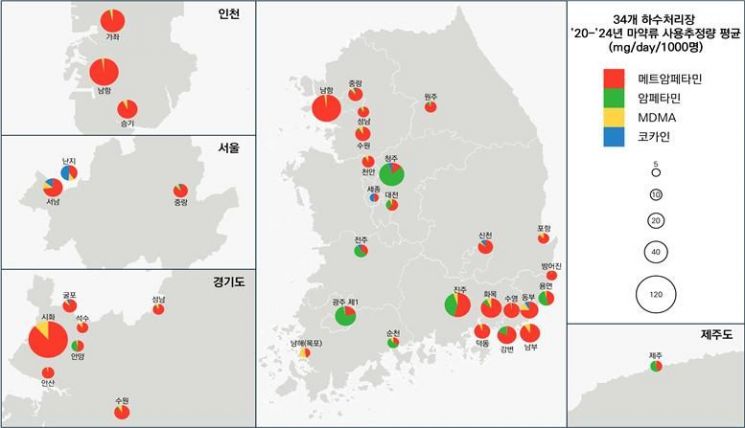 Estimated Daily Average Consumption of Illegal Drugs by Region (2020-2024). Ministry of Food and Drug Safety
Based on the results of the past five years, the Ministry of Food and Drug Safety plans to further develop this year's wastewater-based epidemiological survey into the 'Neighborhood Sewage Monitoring Network' project, aiming for broader and more precise tracking. The number of substances analyzed will be greatly expanded from 15 types of illegal drugs to about 200 substances, including medical and new types of drugs. Based on the analysis results, the ministry will actively respond by assessing whether drugs are entering the country, analyzing changes in usage trends, and taking swift action regarding substances not yet designated as temporary narcotics.
In addition, in cities with a large floating population, samples will be collected from more than 10 locations within each drainage district. If drug substances are detected, additional samples will be collected from related building septic tanks to enhance traceability.
An official from the Ministry of Food and Drug Safety emphasized, "Wastewater-based epidemiological surveys are an important scientific basis for objectively understanding the actual status of drug use and taking proactive measures. We will do our utmost to track illegal drug use and protect public safety by strengthening this year's survey and cooperating with related agencies based on last year's results."
© The Asia Business Daily(www.asiae.co.kr). All rights reserved.











![The Special Connection Between the Statue of Martyr Lee Jun in Jangchungdan Park and Mayor Oh Sehoon ③ [Current Affairs Show]](https://cwcontent.asiae.co.kr/asiaresize/319/2026012110001599450_1768957215.jpg)

