Core CPI up 2.8% year-on-year, below expectations
New and used car prices fall despite higher auto tariffs
Companies hold off on price hikes amid weak consumer sentiment
The U.S. Consumer Price Index (CPI) for last month rose less than market expectations. Despite increased tariff burdens, companies are reportedly holding off on raising consumer prices amid weakened consumer sentiment.
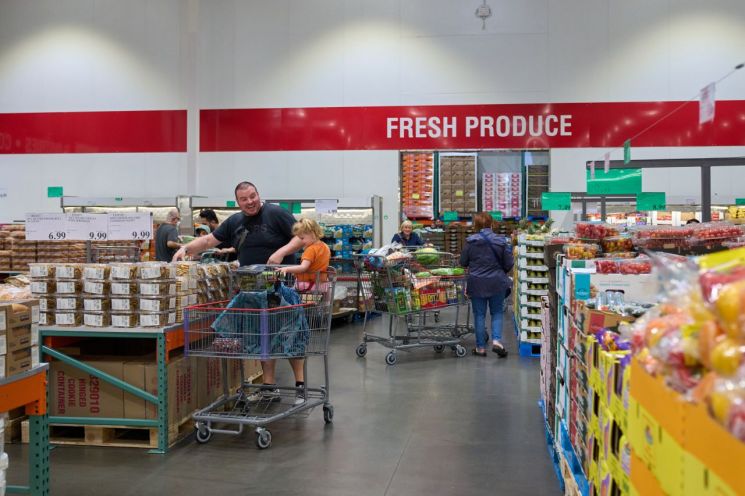
According to the U.S. Department of Labor on June 11 (local time), the CPI for May 2025 rose 2.4% year-on-year. This figure is slightly higher than April's 2.3%, but falls short of the market expectation of 2.5%. On a month-on-month basis, the CPI increased by only 0.1%, which is lower than both the forecast of 0.2% and April's increase of 0.2%.
Excluding volatile energy and food prices, the core CPI rose 2.8% year-on-year. This is the same as April's 2.8% but below the market expectation of 2.9%. Month-on-month, the core CPI rose 0.1%, which is lower than both April's 0.2% and the forecast of 0.3%. The core CPI is used to gauge the underlying trend of inflation.
By category, declines in energy and service prices were notable. Energy prices fell 1% from the previous month, with gasoline prices dropping 2.6%, marking a sharp 12% decline year-on-year. Food prices rose 0.3%, but within this category, egg prices fell 2.7%.
Despite expectations of price increases due to higher tariffs, prices for new and used cars fell by 0.3% and 0.5%, respectively. Clothing prices also declined by 0.4%, defying expectations of an increase. Housing costs, which were a major contributor to last month's CPI rise, increased by 0.3% month-on-month. On an annual basis, housing costs rose 3.9%, marking the lowest level since the end of 2021.
This CPI data was released amid ongoing concerns about tariff-driven inflation. President Donald Trump has imposed a universal 10% tariff on goods from around the world since April, and additional tariffs on specific items such as steel and automobiles have also taken effect. However, due to various grace periods and trade negotiations, companies have been cautious about raising prices, leading analysts to conclude that inflationary pressures remain limited for now.
Alexandra Wilson-Elizondo, Global Co-Chief Investment Officer (CIO) of Multi-Asset Solutions at Goldman Sachs Asset Management, analyzed, "Companies are utilizing existing inventories or adjusting prices slowly due to demand uncertainty, so tariffs are not having an immediate major impact. While goods prices may rise somewhat, service prices are expected to remain stable, making it likely that the increase in inflation will be temporary."
However, there is uncertainty as mutual tariff suspension measures between countries may expire in the future, and tariff burdens could increase depending on the outcome of trade negotiations. There is also a possibility that companies will pass these costs on to consumer prices, which could lead to a rebound in inflation.
With inflation figures coming in lower than expected, market expectations are rising that the U.S. Federal Reserve (Fed) will cut its benchmark interest rate twice within the year. According to CME FedWatch, the federal funds futures market is now pricing in more than a 69% probability that the Fed will cut rates twice by 0.25 percentage points each this year, up from 61% the previous day.
Yields on U.S. Treasury bonds are also declining. The yield on the 2-year Treasury note, which is sensitive to monetary policy, fell by 6 basis points (1bp=0.01 percentage point) from the previous day to 3.94%. The yield on the 10-year Treasury note, the global benchmark for bond yields, is trading at 4.43%, down 3 basis points from the previous day.
© The Asia Business Daily(www.asiae.co.kr). All rights reserved.
![Clutching a Stolen Dior Bag, Saying "I Hate Being Poor but Real"... The Grotesque Con of a "Human Knockoff" [Slate]](https://cwcontent.asiae.co.kr/asiaresize/183/2026021902243444107_1771435474.jpg)















