The first 'oxygen-deficient water mass' (hypoxic water mass) of the year has been observed in the western waters of Jinhae Bay, Changwon, Gyeongnam.
The National Institute of Fisheries Science under the Ministry of Oceans and Fisheries announced on June 11 that, through on-site investigations conducted over the past two days, they confirmed the presence of an oxygen-deficient water mass with dissolved oxygen concentrations ranging from 0.29 to 2.33 mg/L in the bottom layer of the western waters of Jinhae Bay.
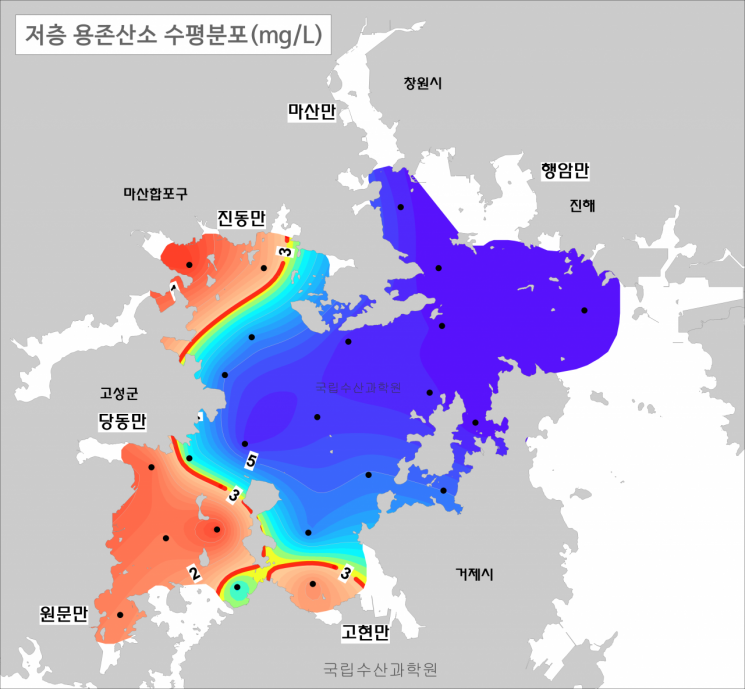 Horizontal distribution map of low-level dissolved oxygen near Jinhae Bay, Changwon, Gyeongnam. Provided by National Institute of Fisheries Science
This oxygen-deficient water mass refers to water with a dissolved oxygen concentration of 3 mg/L or less, which hinders the respiratory activity of fish and shellfish, causing damage to aquaculture organisms.
Such water masses mainly occur in semi-enclosed inner bays where seawater circulation is poor, especially during the summer when there is a significant temperature difference between the surface and bottom layers. When water temperatures rise in the summer, it becomes difficult for the surface and bottom seawater to mix, making it harder for oxygen to move to the bottom layer.
In Changwon, these phenomena typically appear every year during the summer and autumn, particularly in Jinhae Bay, Jindong Bay, and Masan Bay. Depending on the timing and severity of the occurrence, mass mortality events of aquaculture organisms such as oysters, mussels, and sea squirts, as well as sardines, have been reported.

According to the National Institute of Fisheries Science, oxygen-deficient water masses form annually along the southern coast from mid-May to early June and dissipate from late September to early November. However, compared to May 23 last year, this year's occurrence was delayed by more than 18 days.
The institute predicts that although the oxygen-deficient water mass is currently distributed only in certain areas, it will thicken and expand closer to the surface as water temperatures continue to rise. Its range is also expected to widen, affecting not only the surrounding waters but also the entire southern coast.
In response, aquaculture farms in the affected areas have been advised to shorten the length of 'suhayeon'?the hanging lines used to suspend shellfish?so that the organisms remain in water layers with relatively higher oxygen concentrations.
An official from Changwon City stated, "We will strengthen on-site monitoring and provide guidance on adjusting the length of hanging lines, thoroughly monitoring and preparing for changes in sea conditions," adding, "We will do our best to minimize damage to fish and shellfish and to ensure that fishermen do not face difficulties."
© The Asia Business Daily(www.asiae.co.kr). All rights reserved.


















