Financial Support Reaches 140.2 Billion Won, Seven Times Higher Than the First Year
Operating Costs Double While Fare Revenue Decreases
City Says "Fare Adjustments and Pre-determined Settlement System Under Review"
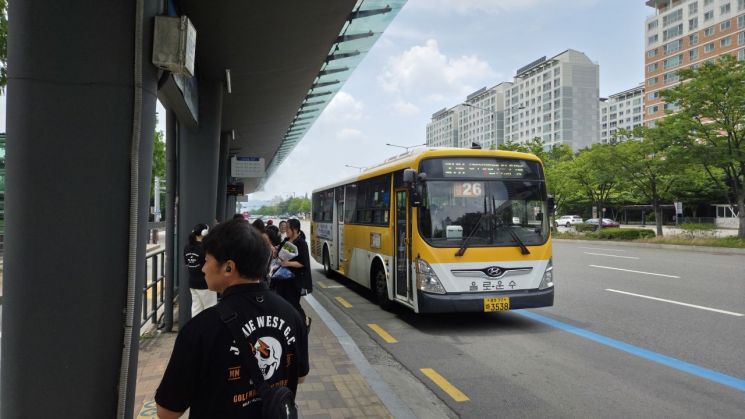 On the morning of the 9th, when the Gwangju city bus union resumed a full strike, a bus stop in Seo-gu, Gwangju, was crowded with citizens heading to work. Photo by Min Chanki
As the Gwangju city bus union has gone on strike demanding wage increases and an extension of the retirement age, there is growing criticism that the semi-public bus system needs a comprehensive overhaul, since billions of won in taxpayer money are spent every year to cover the massive deficits of city bus companies.
With the financial burden increasing to the point where even local government bonds are being issued to support city bus operations, there is an urgent call for a major restructuring of the operating revenue model for each city bus company to reduce their deficits.
According to Gwangju City on June 11, the estimated operating cost for city buses last year was 246.7 billion won. Of this, labor costs accounted for 175.6 billion won (71.2%), fuel costs were 36 billion won (14.6%), and depreciation expenses were 11.7 billion won (4.7%), bringing the total for fixed expenses to 90.5%. Non-fixed expenses, including maintenance, insurance, other costs, and performance profits, amounted to 23.4 billion won (9.5%).
Last year, fare revenue for city bus companies was about 106.5 billion won, and Gwangju City provided 140.2 billion won to cover the shortfall. This is seven times higher than the amount provided in 2007, the first year the city introduced the semi-public bus system, when the subsidy was 19.6 billion won. The city bus union is currently demanding an 8.2% wage increase, which would raise the city's annual financial support by more than 9 billion won each year.
In 2007, the operating cost for Gwangju city buses was 136.2 billion won, with 82.8 billion won (60.8%) allocated for labor costs, and fare revenue at 116.6 billion won. Over the past 18 years, operating costs have doubled, but fare revenue has actually decreased, leading to a several-fold increase in financial subsidies.
With financial support continuing to rise, the city issued 70 billion won in local government bonds last year. As a result, it now pays 1.5 billion won in annual interest. The city’s total local government bonds exceeded 1 trillion won in 2020 and surpassed 2 trillion won this year, just five years later. Based on the city’s registered population of 1,400,827, this means each citizen effectively carries 1.477 million won in debt. As of last year’s settlement, the city’s debt ratio was 23.1%, the highest among all metropolitan and special cities nationwide.
As a result, there are increasing calls for an overall improvement in the financial support and operation of Gwangju city buses. The city is reportedly considering route restructuring, fare adjustments, and a pre-settlement system for city bus companies.
Previously, Seoul City decided to switch from a "post-settlement" system, in which all deficits were reimbursed after the fact, to a "pre-determined" system, in which the total revenue and costs for the following year are set in advance and only the difference is subsidized. Among local governments operating semi-public city bus systems nationwide, Seoul is the only one to adopt the pre-determined system.
Under the previous post-settlement system, city bus companies had little incentive to reduce costs. However, with the switch to the pre-determined system, transportation companies are expected to voluntarily cut costs, including restructuring of drivers, executives, maintenance staff, and administrative personnel.
A city official said, "It is true that as it becomes harder to improve revenue, the deficits of city bus companies receiving financial support are increasing, and the burden of financial support is growing. While switching from a post-settlement to a pre-determined system could improve some aspects of the financial situation, side effects are also expected, so we will review other cases such as Seoul before making a decision."
© The Asia Business Daily(www.asiae.co.kr). All rights reserved.

















