Strengthening Eco-Friendly Quarantine and Public Awareness Campaigns
Yangcheon District in Seoul has launched eco-friendly quarantine measures and is promoting public awareness on how residents can respond to the summer nuisance known as the Lovebug (Plecia nearctica).
The Lovebug travels in male-female pairs and is classified as a beneficial insect because it feeds on decaying weeds and helps pollinate plants. While it does not bite humans or transmit diseases, its cockroach-like appearance and tendency to fly toward people can cause psychological discomfort. Additionally, Lovebugs can stick to vehicles and obstruct drivers' vision, and their dead bodies can contribute to building corrosion, leading to safety concerns.
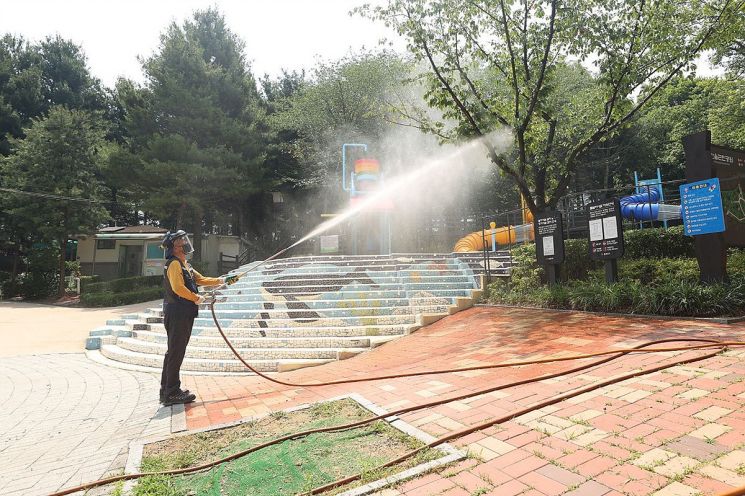 Last summer's public-private emergency quarantine activity site in preparation for Lovebug outbreak. Provided by Yangcheon District.
In fact, civil complaints related to Lovebugs have surged over the past three years. There were only 12 complaints in 2022, but this number jumped to 240 in 2023 and reached 1,321 in 2024. According to a survey by the Seoul Metropolitan Government, 86% of citizens perceive Lovebugs as pests, and nearly half reported feeling discomfort simply by seeing them.
In response, Yangcheon District has activated a "Public-Private Emergency Quarantine Task Force" consisting of four teams?General Situation Team, Mobile Quarantine Team, Park Quarantine Team, and Neighborhood Quarantine Support Team?with a total of about 400 personnel. The Public Health Center's Infectious Disease Management Team oversees complaint intake and overall situation management. The Mobile Quarantine Team and Park Quarantine Team conduct eco-friendly spraying (using water) in major outbreak areas and at the boundaries between mountains and residential zones. Private quarantine specialists are also participating to focus disinfection efforts on vulnerable areas.
Additionally, Yangcheon District is continuing its "Community Gap Quarantine" initiative, which involves officials from 18 neighborhood community centers, the Volunteer Disaster Prevention Corps, and the Village Love Quarantine Volunteer Group. Patrols have been intensified in areas that saw mass outbreaks last year, and daily quarantine activities are being carried out in residential neighborhoods, alleyways, and commercial districts.
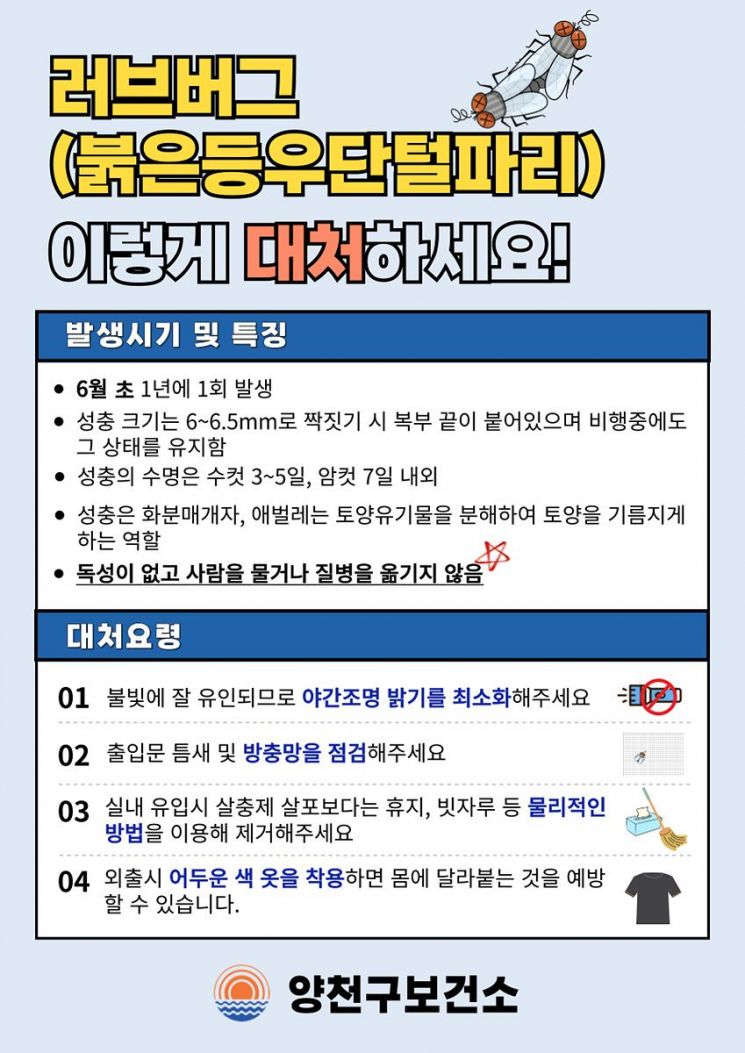
The district is actively promoting public education so that residents can understand the ecological role of Lovebugs and practice appropriate response measures. Key recommendations include "reducing nighttime lighting," "checking for gaps around doors and inspecting window screens," and "wearing dark-colored clothing when going outside."
Lee Gijae, Chief of Yangcheon District, stated, "Although Lovebugs do not transmit diseases, they cause significant inconvenience and stress in daily life. We will minimize residents' discomfort through systematic quarantine measures."
© The Asia Business Daily(www.asiae.co.kr). All rights reserved.
![Clutching a Stolen Dior Bag, Saying "I Hate Being Poor but Real"... The Grotesque Con of a "Human Knockoff" [Slate]](https://cwcontent.asiae.co.kr/asiaresize/183/2026021902243444107_1771435474.jpg)
















