Proposal to Introduce a National New Drug Dividend Policy
There has been a call to introduce a policy that would support the use of citizens' biometric information (bio data) in the development of blockbuster new drugs and return a portion of the resulting profits back to the public.
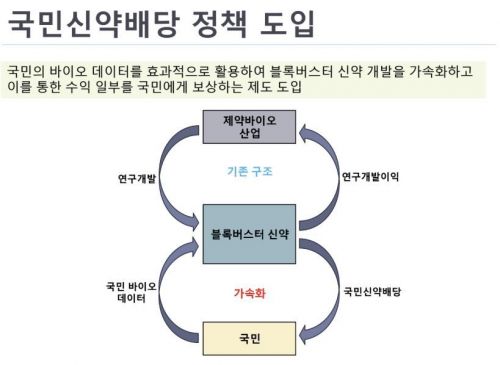 The policy structure of the 'National New Drug Dividend' proposed by the Korea Pharmaceutical and Bio-Pharma Manufacturers Association. Korea Pharmaceutical and Bio-Pharma Manufacturers Association
On June 11, Kim Hwajong, head of the K-MELLODDY (Federated Learning-Based New Drug Development Acceleration Project) group at the Korea Pharmaceutical and Bio-Pharma Manufacturers Association, held an online briefing session titled "Policy Proposal for National New Drug Dividend through the Establishment of the Bio Data Alliance (BDA)." Kim stated, "For Korea, a latecomer, to leap forward as a leading bio nation, an innovative strategy is necessary," expressing this view.
Kim emphasized, "The most important factor in the artificial intelligence (AI) bio industry is bio data, and Korea possesses the world's best bio data." He added, "We need to accelerate the development of blockbuster new drugs by utilizing this data and introduce a system that rewards a portion of the profits to the public."
According to the Korea Pharmaceutical and Bio-Pharma Manufacturers Association, Korea's pharmaceutical industry accounts for only 1.8% of the global market. In particular, the field of new drug development is monopolized by advanced countries such as the United States, Switzerland, Japan, Germany, France, and the United Kingdom, highlighting the need for innovation.
Kim asserted that personal bio data is a core resource of the bio industry and argued for maximizing the use of public resources. As a successful example of utilizing public resources, he introduced the "Rail plus Property" business model of MTR Corporation in Hong Kong. In this model, the Hong Kong government, as the major shareholder of MTR, transfers the rights for complex development of station areas and public land surrounding stations to MTR. MTR then develops housing or commercial facilities through private competitive bidding and recoups development profits through sales or rental income. As a result, Hong Kong's subway system is operated at affordable fares without direct taxpayer subsidies.
 Kim Hwajong, head of the K-MELLODDY project group at the Korea Pharmaceutical and Bio-Pharma Manufacturers Association, is speaking at the briefing session titled "Policy Proposal for National New Drug Dividend through the Establishment of the Bio Data Alliance (BDA)" held online on the 11th. Screenshot of the briefing video
Kim suggested that one concrete way to realize such a policy is to introduce "federated learning" technology, which can improve the weak security of existing personal information sharing formats. This is because collecting sensitive personal bio data on a central server can pose a serious risk of privacy violations.
Federated learning is a technology that trains data on local devices (such as individual computers and research servers) instead of sending it to a central server. After training, only the resulting AI model parameters (weights) are sent to the central server. This approach allows for the use of bio data while ensuring that the original data never leaves the local device, thus simultaneously protecting and utilizing sensitive information.
Kim also emphasized that the National New Drug Dividend policy could become the "moonshot project" of Korea's pharmaceutical and bio industry?a bold and innovative initiative that aims to achieve seemingly impossible goals, akin to launching a rocket to the moon. Kim stated, "It is a strategy to gain infinite value without opening Pandora's box (personal bio data)," and added, "If we become the first in the world to utilize citizens' real-world bio data (RWD) in AI model development, Korea could emerge as a leader in new drug development and precision medicine."
© The Asia Business Daily(www.asiae.co.kr). All rights reserved.


















