Panel Discussion Held at Cemtech Asia 2025
Urgent Need to Recycle Secondary Resources to Reduce Greenhouse Gas Emissions
Restrictions Remain in Korea Due to Hazard Concerns
Financial Support Needed, Including Climate Response Funds
There have been calls for the domestic cement industry to expand the production of low-carbon limestone cement and to recycle secondary resources in order to reduce greenhouse gas emissions.
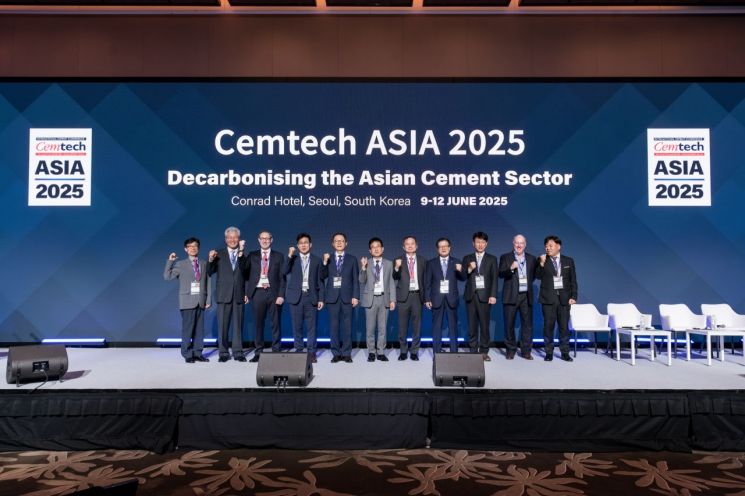 (From left) Jongseok Yoon, President of Korea Ceramic Technology Institute; Changgi Lee, Vice Chairman of Korea Cement Association; Thomas Armstrong, Editor-in-Chief (Chairman) of International Cement Review and Head of Semtech Asia; Wonjin Lee, CEO of Sampyo Cement; Seungryeol Lee, Director of Industrial Policy at Ministry of Trade, Industry and Energy; Geunsik Jeon, Chairman of Korea Cement Association; Inho Han, CEO of Sungshin Cement; Hyunjun Lee, CEO of Ssangyong C&E; Donghwan Bae, CEO of Sampyo Cement; Tony Hadley, CEO of THAA Ltd; Euichul Kim, Director of Technology Development at Korea Cement Association. Provided by Korea Cement Association
On June 10, the Korea Cement Association announced that it had hosted "Cemtech Asia 2025," organized by Cemnet, a UK-based global cement industry institution, and sponsored by the Korea Cement Association. On the first day of the event, a special session was held featuring a panel discussion with domestic and international cement industry experts, where in-depth discussions took place on reducing greenhouse gas emissions in the Korean cement industry.
Thomas Armstrong, Chairman of Cemnet, who attended the panel discussion, said, "I am very pleased that Cemtech is being held in Korea, a country that demonstrates excellent manufacturing technology, quality, and environmental facilities, and is committed to ESG management in the global cement industry."
Of the 25 research presentations at this Cemtech Asia, 15 focused on reducing greenhouse gas emissions through the recycling of secondary resources. Nevertheless, in Korea, the recycling of secondary resources is still subject to many restrictions due to ongoing concerns about potential hazards.
Jean Michel, Executive Director at Sampyo Industry, explained why the cement industry in Europe plays a key role in waste management. He stated, "First, the extremely high temperatures of cement kilns almost perfectly thermally decompose hazardous substances. Second, there is no need to landfill potentially hazardous fly ash. These are the core factors in recycling secondary resources."
Jinhyo Kim, attorney at Bae, Kim & Lee LLC, said, "Just like in Europe, the domestic cement industry is actively pursuing reduction activities in response to the Emissions Trading Scheme." He added, "Considering that carbon capture and utilization/storage (CCU/CCS) of CO2 generated in the cement process is still at a pre-commercial stage, utilizing combustible waste (secondary resources) and recycling various industrial by-products as non-carbonate raw materials are representative reduction measures for the cement industry."
However, he argued, "Within systems such as the Emissions Trading Scheme, it is necessary to continuously provide reasonable incentives so that the domestic cement industry can more actively adopt these reduction measures." He also stated, "Financial support, such as carbon contracts for difference through climate response funds, is essential to enable the cement industry to develop and commercialize carbon-neutral technologies."
Jinman Kim, a professor at Kongju National University, also presented areas where the Korean cement industry needs urgent improvement compared to Europe. Professor Kim explained, "Limestone, which is used as a raw material for clinker in the cement process, emits CO2 during calcination, and this accounts for more than 60% of the total carbon emissions from cement." He analyzed, "If about 15% of the total cement volume is made by using limestone powder as a raw material for cement instead of clinker, it can serve as a very easy means of achieving carbon neutrality without compromising cement quality."
Changgi Lee, Chairman of the Korea Cement New Materials Research Association, emphasized the need to ease the calorific value standard for alternative fuels in cement production. Chairman Lee pointed out, "According to the domestic Waste Management Act, only waste that meets the calorific value standard can be recycled as alternative fuel." He added, "Currently, the calorific value standard for alternative fuels in cement under the Waste Management Act is 4,500 kcal/kg, which is 1,000 kcal/kg higher than the 3,500 kcal/kg standard for solid recovered fuel (SRF), and this serves as a barrier to expanding the use of alternative fuels."
Finally, Chairman Armstrong asserted, "Using non-hazardous waste or pre-treating waste to render it non-hazardous, as well as recycling and utilizing waste resources, is only natural and has long been pursued by almost all industries, including steel, paper, concrete, and wood. Opposing the recycling of such secondary resources essentially means advocating for not utilizing resources at all." He added, "Unlike Korea, Europe recognizes waste as a 'resource' and maximizes social benefits by utilizing it, so in order to resolve conflicts among social stakeholders, public interest considerations must be taken into account."
© The Asia Business Daily(www.asiae.co.kr). All rights reserved.

















