Prime Minister Nominee Kim Emphasizes
Personal Ties with Trump Administration Figures
and Vision for Advancing Korea-U.S. Relations
Addresses 1985 U.S. Cultural Center Incident,
Clarifies Stance on Korea-U.S. Alliance
Highlights Economic Challenges,
Stresses Need for Policy Debate on Solutions
Calls for Price Stabilization Measures,
Expresses Frustration with Slow Government Response
Supports Public Recommendations for High-Ranking Officials,
Advocates Diverse and Competent Cabinet
Prioritizes Economic Recovery Over Prosecutorial Reform,
Vows Full Transparency at National Assembly Hearing
Prime Minister nominee Minseok Kim (61) stated on June 10, "I have maintained fairly long-standing personal exchanges with key figures from the Trump administration in the United States," adding, "If I am to serve as Prime Minister of the Korean government, I believe I can play a certain role in advancing Korea-U.S. relations."
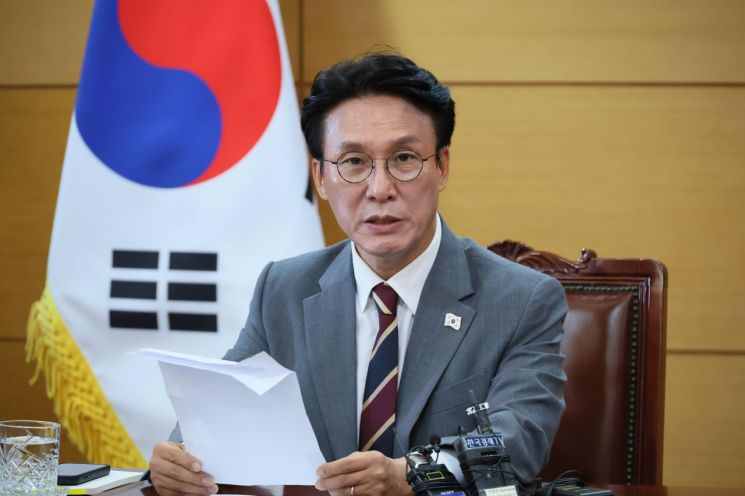 Prime Minister nominee Minseok Kim is holding a press conference at the hearing preparation office in Tonguidong, Jongno-gu, Seoul on the 10th. 2025.6.10 Yonhap News Agency
 Photo by Yonhap News Agency
At his first press conference with the media since his nomination, held at the Financial Supervisory Service Training Center in Jongno-gu, Seoul, Kim was asked about the so-called "1985 U.S. Cultural Center occupation incident" and his views on Korea-U.S. relations. He responded, "I have studied various subjects in the United States and have a deep understanding of the country."
The U.S. Cultural Center occupation incident refers to an event in June 1985, when 73 students from five universities in Seoul occupied the U.S. Cultural Center, demanding that the U.S. administration take responsibility for supporting the Gwangju Massacre and issue a public apology. At the time, Kim, who was chairman of the National Student Union (Jeonhakryeon), was arrested for allegedly orchestrating the incident and served two years and eight months in prison. This has led some to raise suspicions that he is "anti-American."
Regarding the incident, Kim said, "Regardless of whether one supports or opposes the United States, the point was to observe what kind of democratic attitude the U.S., as our ally and a democracy, would demonstrate." He added, "Fundamentally, I believe it was significant in bringing the Gwangju Democratization Movement to the attention of the world." He continued, "Through that event, both Korea and the United States became more aware, and this accumulation of historical experience led the U.S. government to consistently support Korea's democracy and not side with the forces behind the military coup during the recent 'Revolution of Light.'"
Kim, who holds a Master of Public Administration from Harvard Kennedy School, a Doctor of Law from Rutgers Law School, and is licensed to practice law in New Jersey, stated, "The greatest export of the United States is its Constitution," and added, "I believe there is much to learn from the criminal procedure system embedded in the U.S. Constitution."
Regarding the direction the new administration should take in establishing Korea-Japan relations, he said, "Korea-Japan relations are extremely important, even in the process of finding a breakthrough in tariff negotiations." Notably, Kim revealed that on June 4, the day he was nominated as Prime Minister, he received a congratulatory phone call from Taro Kono, a member of the Japanese House of Representatives and former Foreign Minister. Kim described Kono as "a friend of 30 years with whom I have long shared the view that Korea and Japan should openly discuss their future-oriented positions," and said, "He emphasized the importance of the diplomatic consistency accumulated between Korea and Japan and suggested that we engage in many discussions going forward." Taro Kono is the son of Yohei Kono, former Speaker of the Japanese House of Representatives and the official behind the "Kono Statement," which was the first acknowledgment by a senior Japanese official of the issue of comfort women.
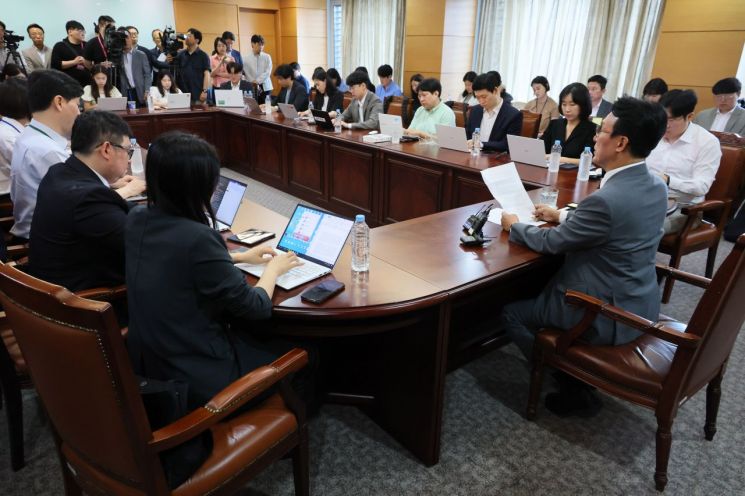 Prime Minister nominee Minseok Kim is holding a press conference on the 10th at the hearing preparation office in Tonguidong, Jongno-gu, Seoul. 2025.6.10 Yonhap News Photo by Yonhap
When asked to assess the current economic situation, Kim said, "It is more difficult than during the IMF (1997 foreign exchange crisis)." He has repeatedly emphasized this point since his nomination. He noted, "The potential growth rate is low, and the trend of growth is either declining or stagnant." He also expressed concern that "relations with major countries such as the United States, China, Japan, Russia, and North Korea are much more complicated." He continued, "With the tariff negotiations initiated by President Donald Trump, the entire global economic landscape is changing, and the previous administration left behind an extreme amount of debt." However, he added, "I have personally thought about solutions to overcome the crisis for a long time, and I have also discussed them with President Lee Jaemyung, so I am considering the issue from multiple angles." He suggested that "it would be appropriate to address these matters through policy debate during the National Assembly's confirmation process," without providing further specifics.
Nevertheless, Kim showed strong determination regarding measures to stabilize prices. He stated, "Managing overall structural prices is not easy, but the issue of lunch costs, which young salaried workers face daily, is particularly important." He added, "I have requested that the Prime Minister's Office hold a meeting to discuss price stabilization measures." Kim expressed frustration, saying, "In a normal government, when the President raises the issue of prices, all ministries should come together to discuss follow-up measures, but currently, things are not moving quickly." He continued, "Although the government has not yet fully settled in, I cannot tell the public that the 'system is not yet set up,' so I will do my utmost as a nominee."
Regarding President Lee Jaemyung's announcement that he would accept recommendations from the public for high-ranking officials such as ministers and vice ministers, Kim said, "From the perspective of the Lee Jaemyung administration, which is founded on the philosophy of popular sovereignty, this is only natural." He added, "In this era of collective intelligence, it is meaningful for the government to receive recommendations for talented individuals it may have overlooked, based on the judgment of the majority of the people."
On the possibility of achieving integration in personnel appointments, such as selecting opposition figures during the formation of the new cabinet, Kim stated, "If loyalty and competence are prerequisites, it is desirable to assemble a diverse puzzle, taking into account gender, age, region, and political orientation."
Regarding the direction of prosecutorial reform, Kim said, "The broad direction, which the public already agrees with, has been established," but added, "The specific timing and methods should be decided calmly in accordance with the will of the people, after the government is fully established." He repeatedly emphasized, "The most important thing, first, second, and third, is economic and livelihood recovery."
The National Assembly's confirmation hearing for Kim is expected to be held no later than June 25. Kim said, "I will do my utmost to willingly undergo thorough and free scrutiny by the public and the media to ensure that there is not a single suspicion," adding, "I hope that this National Assembly hearing will serve as a serious policy review for discussing the nation's future."
According to the Personnel Hearing Act, the National Assembly must hold a confirmation hearing within 15 days of the submission of the appointment proposal, and submit a report on the hearing within 3 days after its conclusion. If the National Assembly passes the Prime Minister's appointment proposal in a plenary session, the appointment is finalized. Given that the ruling Democratic Party holds a majority of seats, making it a "ruling party majority, opposition minority" situation, it is expected that Kim's confirmation process will proceed smoothly. The ruling and opposition parties are expected to soon form a special committee for the confirmation hearing and coordinate the schedule.
© The Asia Business Daily(www.asiae.co.kr). All rights reserved.
![Clutching a Stolen Dior Bag, Saying "I Hate Being Poor but Real"... The Grotesque Con of a "Human Knockoff" [Slate]](https://cwcontent.asiae.co.kr/asiaresize/183/2026021902243444107_1771435474.jpg)

















