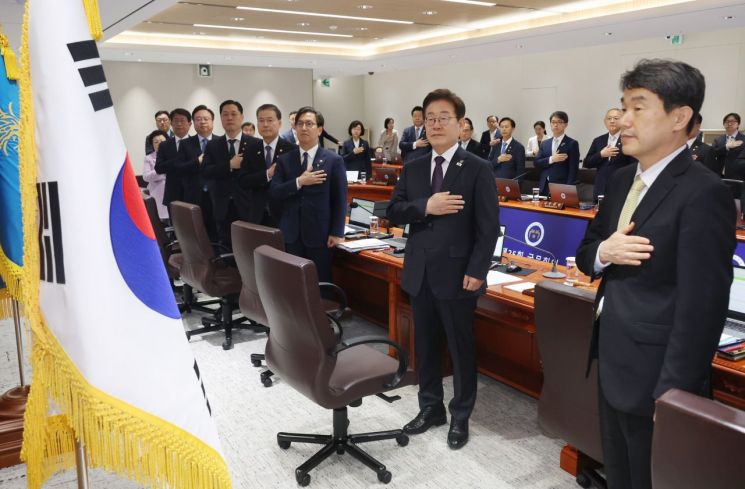
 President Lee Jae Myung is saluting the national flag at the Cabinet meeting held at the Presidential Office in Yongsan, Seoul, on the 10th. Photo by Yonhap News
President Lee Jae Myung spent his first week in office focusing on addressing key economic and diplomatic issues. It appears that his second week will also be centered on diplomatic affairs, including attending the Group of Seven (G7) summit, as well as economic matters.
The Lee administration, which began without a presidential transition committee, launched an Emergency Economic Task Force (TF) on its first day, June 4, to address public livelihood issues. The TF is currently discussing the formation of a supplementary budget (extra budget) exceeding 20 trillion won, with a primary focus on restoring the economy for ordinary citizens.
On the international front, President Lee has stepped onto the diplomatic stage in earnest. He has held phone calls with leaders of major countries, starting with U.S. President Donald Trump, and has begun preparations for the G7 summit.
Through the Emergency Economic Task Force, President Lee is responding to urgent domestic economic issues and directing the implementation of necessary policies. The TF was established by President Lee’s first executive order on his inauguration day. Because appointing new ministers and vice ministers for the economic ministries is expected to take time, President Lee’s intention to work with members of the previous administration’s cabinet in a TF format has been reflected in this arrangement.
The TF has convened twice, on June 4 and June 9, focusing on the prompt execution of the supplementary budget. In the TF meeting, President Lee instructed, “Formulate the extra budget swiftly to promote economic recovery and stimulate consumption.” The scale of the supplementary budget is likely to increase from the baseline of 20 trillion won. Given the large size of the budget, key campaign pledges such as local currency programs and livelihood recovery support payments are expected to be included. Budget allocations for universal support payments are also being discussed.
According to the business community, a meeting between the Presidential Office, leaders of major conglomerates, and heads of economic organizations is being considered for June 12?13. This meeting appears to be aimed at hearing directly from business leaders about the current economic situation. While the detailed schedule and participant list have not been finalized, it is known that the Korea Chamber of Commerce and Industry is coordinating the schedule on behalf of the business sector.
Attendance is likely to include the heads of the five major conglomerates: Lee Jae Yong, Chairman of Samsung Electronics; Chey Tae Won, Chairman of SK Group and President of the Korea Chamber of Commerce and Industry; Chung Eui Sun, Chairman of Hyundai Motor Group; Koo Kwang Mo, Chairman of LG Group; and Shin Dong Bin, Chairman of Lotte Group.

While the administration has focused on economic issues domestically, preparations for major international diplomatic engagements are also underway. The Presidential Office is currently making full preparations for the G7 summit, which will be held in Canada for three days starting June 15. Although Korea is not a G7 member, President Lee has been invited to attend by Canada, the host nation. As a meeting with President Trump may also take place during this period, strategies to address issues such as tariffs, U.S. Forces Korea, and defense cost-sharing will need to be developed.
President Lee has already begun communicating with leaders of major countries by phone. He held a phone call with President Trump on June 6, just three days after his inauguration. During the call, President Trump invited President Lee to visit the United States, and President Lee responded that he hoped to meet frequently and consult as special allies. Notably, the two presidents reportedly discussed their experiences of facing assassination threats during their election campaigns, as well as their shared interest in golf. The Presidential Office stated, “The two leaders highly valued each other’s leadership and agreed to work closely together for the advancement of the Korea-U.S. alliance.”
On June 9, President Lee spoke by phone with Japanese Prime Minister Shigeru Ishiba. The Presidential Office reported, “The two leaders agreed to build a stronger and more mature Korea-Japan relationship based on mutual respect, trust, and a responsible attitude.” The call with Prime Minister Ishiba took place five days after President Lee’s inauguration, ahead of his planned call with Chinese President Xi Jinping, which is also being arranged.
© The Asia Business Daily(www.asiae.co.kr). All rights reserved.


















