Second Round of U.S.-China Trade Talks Underway in London
Kavit Hassett, Senior White House Official, Interview with CNBC
"Nvidia's Advanced Semiconductor Chips Like H20 Are Excluded"
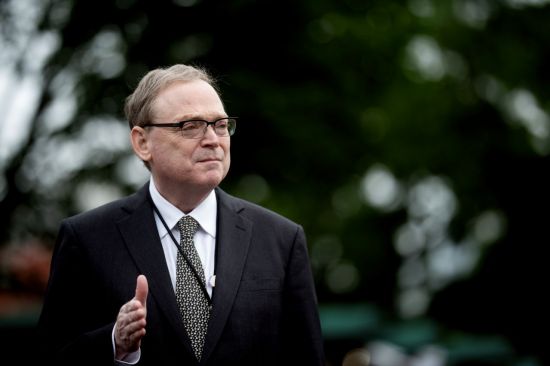 Kavit Hassett, Chairman of the White House National Economic Council (NEC). Photo by EPA Yonhap News
The Trump administration, under pressure from China's rare earth export restrictions, has announced that it is considering easing semiconductor export controls to China as a potential card for the second round of U.S.-China trade negotiations. For the first time, the U.S. has stated during ongoing bilateral talks in London that if China agrees to resume exports, the U.S. will also reverse its export control policy toward China.
Kavit Hassett, Chairman of the White House National Economic Council (NEC), said in an interview with U.S. business channel CNBC on the 9th (local time), "We expect the U.S. and Chinese negotiating teams to reach an agreement that will enable the swift resumption of China's exports of rare earths and rare earth magnets."
When asked whether the concession to lift China's rare earth export restrictions would involve easing U.S. semiconductor export controls?an issue of great importance to China?Hassett replied, "Yes," adding, "Once the two sides shake hands, we expect U.S. export controls to be relaxed immediately and large quantities of rare earths to be released."
Industries worldwide, including those in the United States, have faced emergencies due to the rare earth export restrictions. In particular, industries that require motors and mechanical parts dependent on rare earths, such as the automotive and aviation sectors, have experienced factory shutdowns.
Hassett stated, "President Trump is taking this very seriously and has even called President Xi Jinping of China." In fact, the Financial Times (FT) reported that China's rare earth export restrictions were one of the key topics during a one-hour phone call between President Trump and President Xi on June 6.
However, Hassett clarified, "We are not talking about high-end products like Nvidia's H20," and added, "We are referring to export controls on other types of semiconductors, which are also extremely important to them."
The H20 is a semiconductor chip from U.S. company Nvidia that the Trump administration has banned from being exported to China. During its first-quarter earnings announcement, Nvidia strongly criticized the measure, stating that its revenue would have been $8 billion higher without the restriction. In an effort to circumvent U.S. export controls, Nvidia had been selling the lower-performing H20 model to China instead of the H100, but even this avenue was blocked by the U.S. government, disrupting Nvidia's business in China.
Meanwhile, the U.S. and Chinese delegations, who met for the first time on the 9th, plan to meet again in London on the 10th to continue trade negotiations. The U.S. delegation is led by Treasury Secretary Scott Besant, Commerce Secretary Howard Lutnick, and U.S. Trade Representative (USTR) Jamison Greer. The Chinese delegation is led by Vice Premier He Lifeng, regarded as China's "economic czar."
© The Asia Business Daily(www.asiae.co.kr). All rights reserved.
![Clutching a Stolen Dior Bag, Saying "I Hate Being Poor but Real"... The Grotesque Con of a "Human Knockoff" [Slate]](https://cwcontent.asiae.co.kr/asiaresize/183/2026021902243444107_1771435474.jpg)















