Replacement of Train Interior Materials with Non-Combustible Materials...
Expansion of Real-Time CCTV Monitoring for Line 3
Joint Drills with Fire Stations and External Safety Inspections to Enhance On-Site Response...
Minimizing Casualties
Amid growing concerns over fire accidents in urban railways, Busan Transportation Corporation is implementing measures to strengthen its initial response capabilities in the event of a fire on trains.
Busan Transportation Corporation (President Lee Byungjin) replaced the interior materials of electric trains with flame-retardant and non-combustible materials after the 2003 Daegu subway fire disaster, completing the process in 2006. The corporation is also upgrading and installing key fire safety equipment in stations and conducting regular inspections.
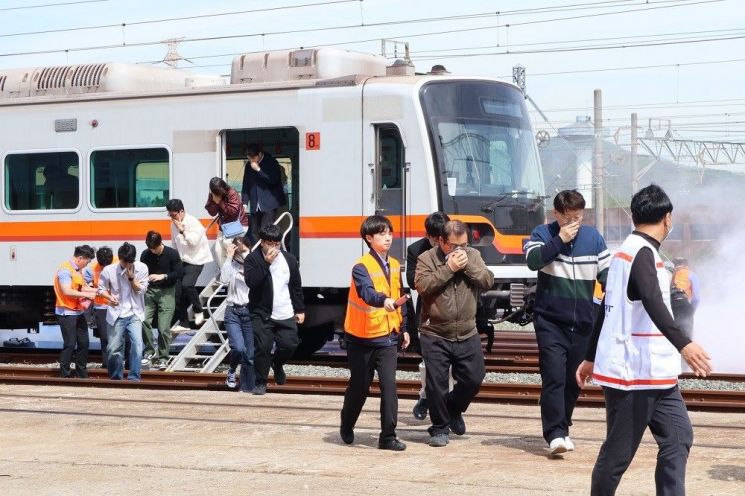 Busan Transportation Corporation is conducting an electric train fire response drill. Photo by Busan Transportation Corporation
CCTV cameras are installed across all urban railway lines (Lines 1 to 4), and real-time video monitoring is available at the integrated control center for Lines 1 and 4. The corporation plans to implement a real-time video linkage system for Lines 2 and 3 by April 2026, aiming to enhance emergency response capabilities across all lines.
At deep underground stations where evacuation is difficult during a fire (such as Mandeok Station and Mulmangol Station), rescue handkerchiefs are placed near evacuation routes. In cooperation with the Busan Fire and Disaster Headquarters, joint evacuation drills with 12 local fire stations will also be conducted in June.
The corporation is also strengthening real-time information sharing and establishing an organic response system among train operators, controllers, and station staff. In particular, joint practical drills will be conducted in the Millak-Centum City section of Line 2 (Suyoung River underwater tunnel) and the Mandeok-Minam section of Line 3 (deep underground) to assess on-site response capabilities.
In addition, the corporation will intensify safety behavior guideline campaigns for passengers and conduct fire safety inspections by external professional organizations (such as the Korea Fire Safety Institute) at all 99 stations on Lines 1 to 4, sequentially implementing recommended improvements.
Lee Byungjin, President of Busan Transportation Corporation, stated, "Fire response is as much about action as it is about equipment," and added, "We will do our utmost to strengthen our practical response capabilities to ensure that not a single casualty occurs."
© The Asia Business Daily(www.asiae.co.kr). All rights reserved.

















